
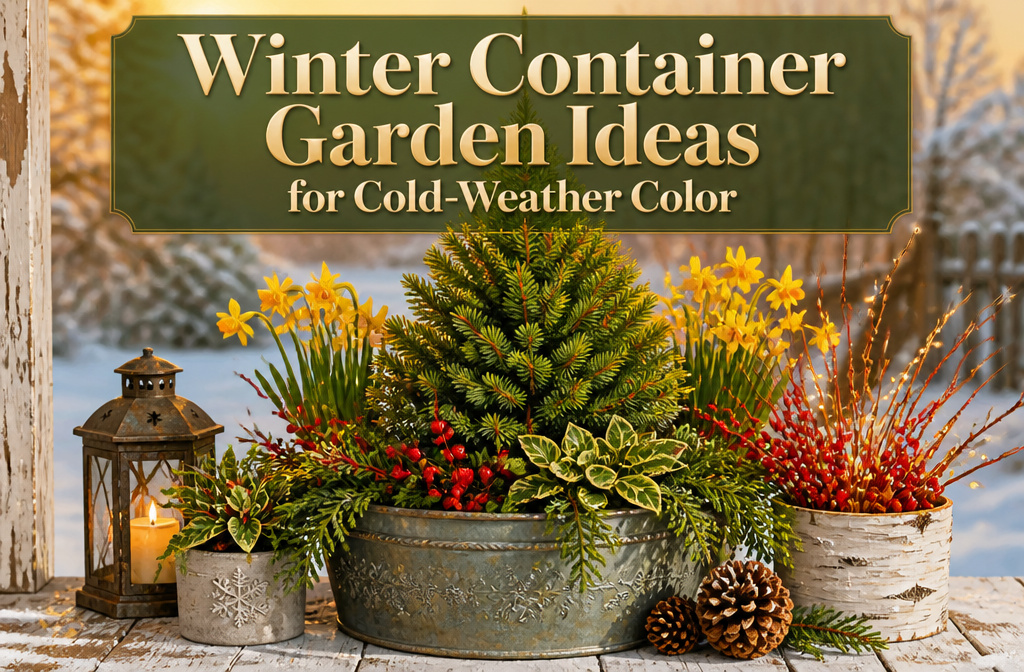
Winter container gardens run from a single pot of cut birch branches to layered arrangements with living evergreens, forced bulbs, and wired lights.
The difference is not budget or skill but whether you are willing to check soil moisture through freeze-thaw cycles or would rather build the whole display from cut material and call it finished.
A dwarf Alberta spruce rated to zone 3 will still die in a zone 6 pot if the roots freeze without the ground’s insulation, which is why the hardiest choices in this list are not always the ones with the lowest zone number.
1. Evergreen Arrangements
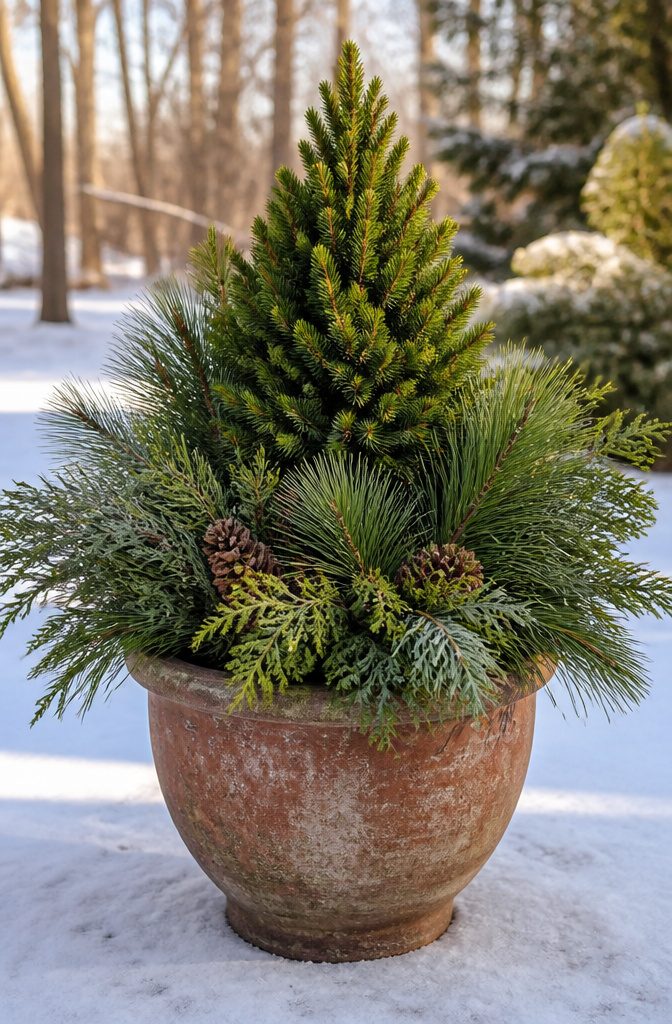
Pine, cedar, and spruce mix together into the classic winter container look most people picture first. These evergreens give the backbone structure that holds a pot together through months of cold when everything else has faded.
For a living center piece, Dwarf Alberta spruce (Picea glauca ‘Conica’) works especially well.
It stays small for years, maturing slowly in a neat pyramid of upturned needles, and it survives in zones 3 through 6. In a container, though, roots have less protection than they would in the ground.
A plant rated hardy to your zone may still struggle. The safer move is choosing evergreens rated one to two zones colder than yours, so a zone 6 gardener should look for material hardy to zone 4 or 5.
Living plants or cut boughs both work. Cut cedar branches can fill gaps and hide insulation like fall leaves packed around an inner pot.
Either way, the evergreens do the heavy lifting: they give height, hold color, and let you add lights or later holiday pieces without starting from zero.
2. Winterberry Holly
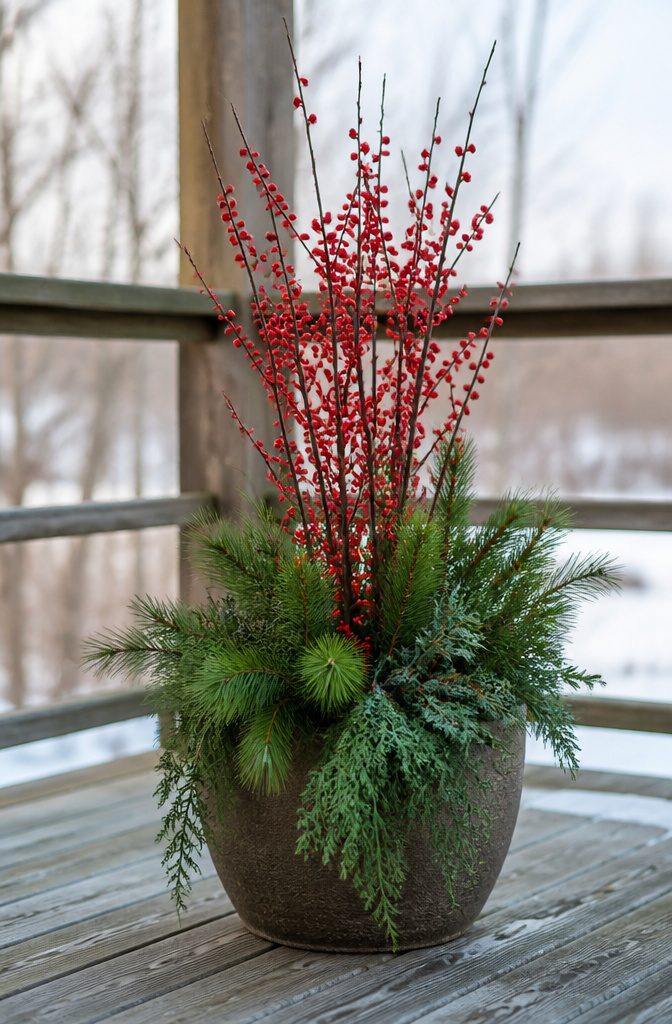
Ilex verticillata, the winterberry holly, carries its fruit long after the leaves have fallen, turning bare stems into vertical wands of red.
The cultivar ‘Winter Red’ holds plump, shiny berries, while ‘Maryland Beauty’ does much the same; ‘Winter Gold’ branches lean salmon-orange if you want something softer against evergreen backdrops.
You need a male pollinizer planted nearby or the show never starts, a detail I nearly missed my first year and would have cost me the whole point of growing it.
American robins, mockingbirds, and gray catbirds feed on the fruit in some winters, though not reliably every season.
That unpredictability is part of working with living material. The stems themselves carry the arrangement once the foliage drops, giving height without bulk, and they read as architecture against the low mounded forms that usually fill container edges.
I pair mine with cut white pine or juniper bases rather than fighting to keep broadleaf evergreens alive in the same pot through freeze-thaw cycles.
3. Cyclamen
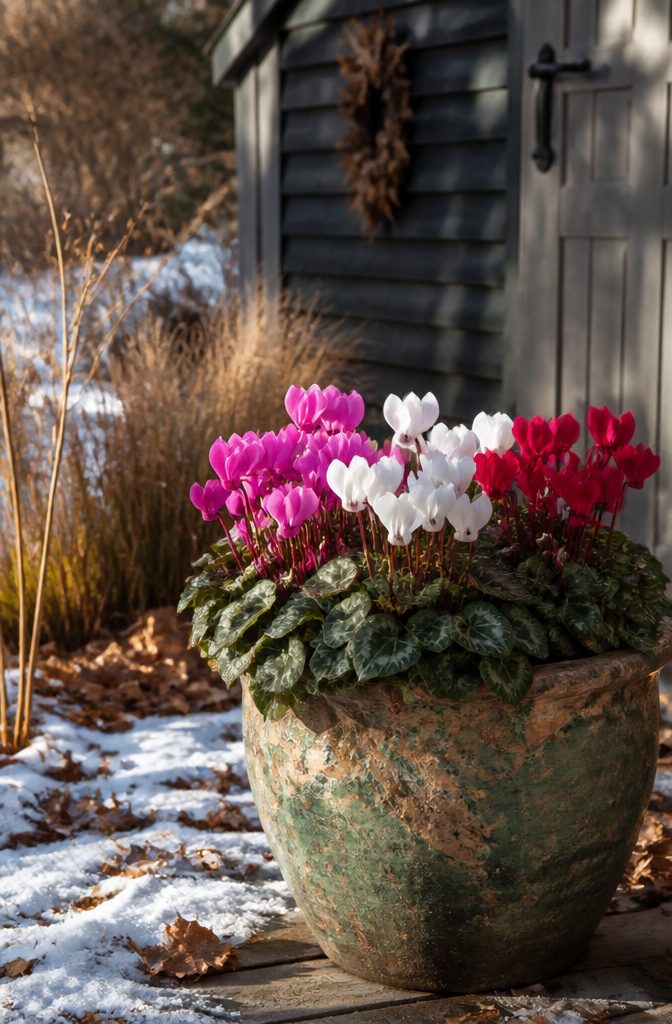
Cyclamen persicum carries winter containers with blooms in pink, white, and red, each flower nodding on a stem tall enough to read as a centerpiece even in a small pot.
The silver-patterned leaves stay handsome after the flowers finish, so the plant earns its place for months rather than weeks.
What convinced me, reading through the guides, is the temperature ceiling: nights above 60°F will stress it, and in a mild winter the plant sputters rather than thrives.
That makes cyclamen a poor fit for a covered porch in a warm zone, and a strong one for an exposed spot where cool air settles.
If a hard freeze threatens, the plastic-pot trick works well; leave it potted, drop it into the display container, and lift the whole thing indoors for the night rather than digging around in frozen soil.
4. Hellebores
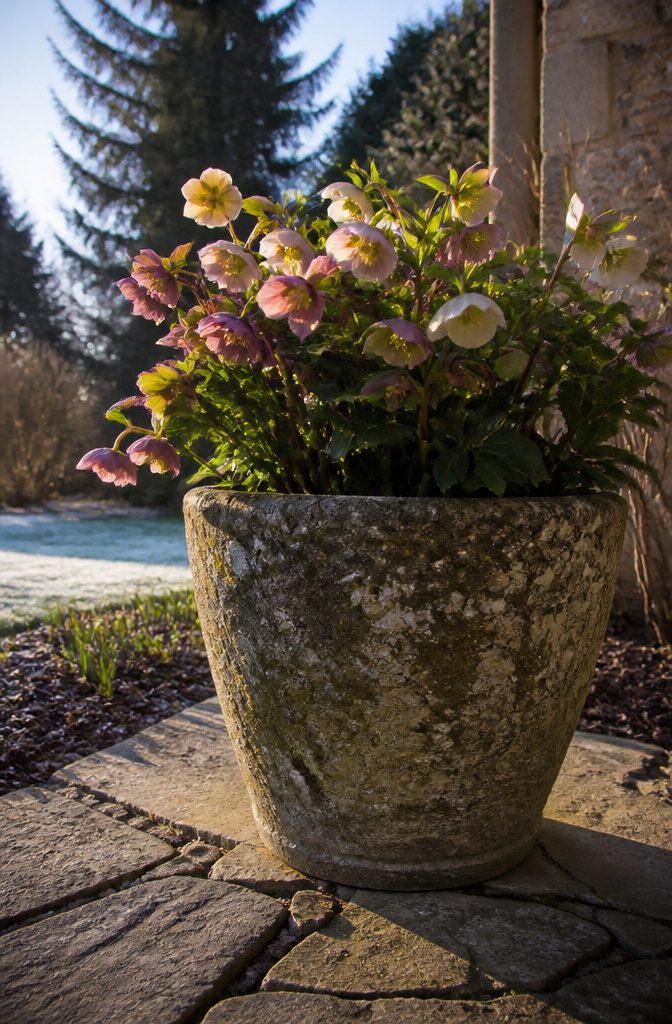
Hellebores carry winter containers through the months when most plants have given up.
The nodding flowers come in dusky purples, soft greens, and clean whites, each one hanging like a small lantern above the leathery evergreen foliage that clumps at the base.
In milder zones, blooms can open as early as January, well before the spring rush begins.
The clumping habit matters for pots. A single hellebore fills enough space to anchor a container without crowding neighbors, and the leaves stay presentable all year so the pot never looks bare.
I have leaned toward cultivars like ‘Frosted Rose’ or ‘Pink Frost’ for the edge of a large planter, where their downward-facing flowers sit at a height you actually notice from above.
Hardiness spans zones 3 to 9, and a mature plant runs about 1 to 2 feet in both directions. Full sun to partial shade works, though the soil must drain; soggy cold roots kill where dry cold ones survive.
Place them where you will brush past on winter walks, since half the point is seeing those blooms from close up.
5. Ornamental Kale
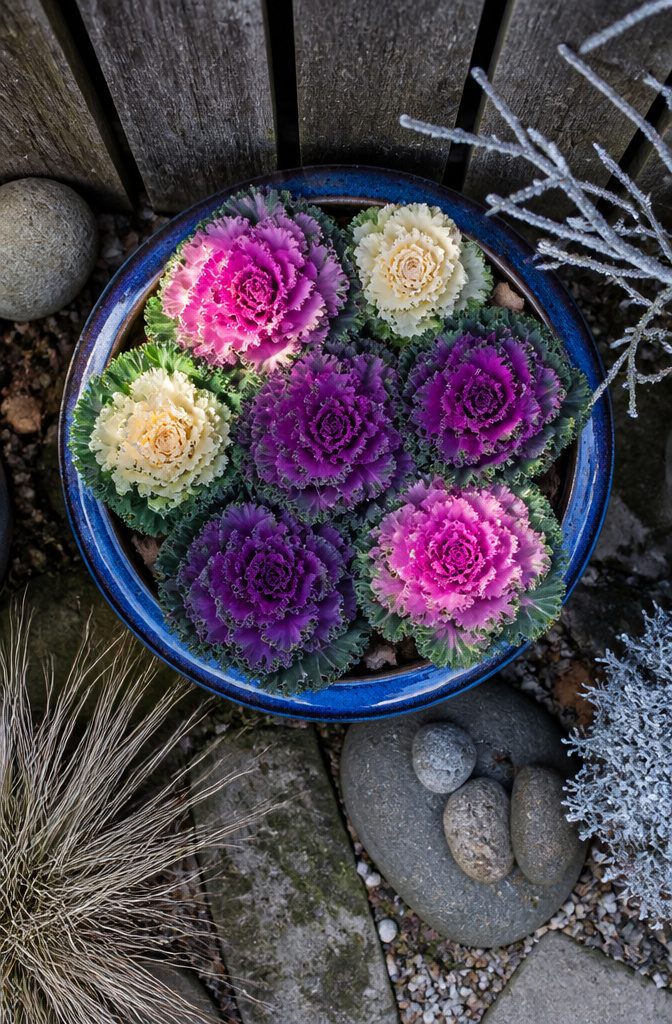
Brassica oleracea, the same species that gives us broccoli and cabbage, produces ornamental kale with ruffled leaves that open into domed rosettes in white, pink, and purple centers.
The color looks almost painted on, and a hard frost actually sets it tighter instead of killing it.
I have planted these in spring, let them bulk up through summer, then lifted them into fall containers where they carry the display straight into winter.
The plants run 12 to 18 inches tall and wide, so one fills a pot nicely or tucks under a taller thriller without getting lost.
They prefer full sun and rich, well-draining soil, and they ask for little beyond water when rain or snow skips a week. No pruning, no deadheading.
Yes, you can eat ornamental kale.
The leaves are technically edible, but the breeding chased color and form, not flavor, so the texture runs tough and the taste is flat. I leave it in the pot and buy lacinato for the kitchen.
6. Pansies and Violas
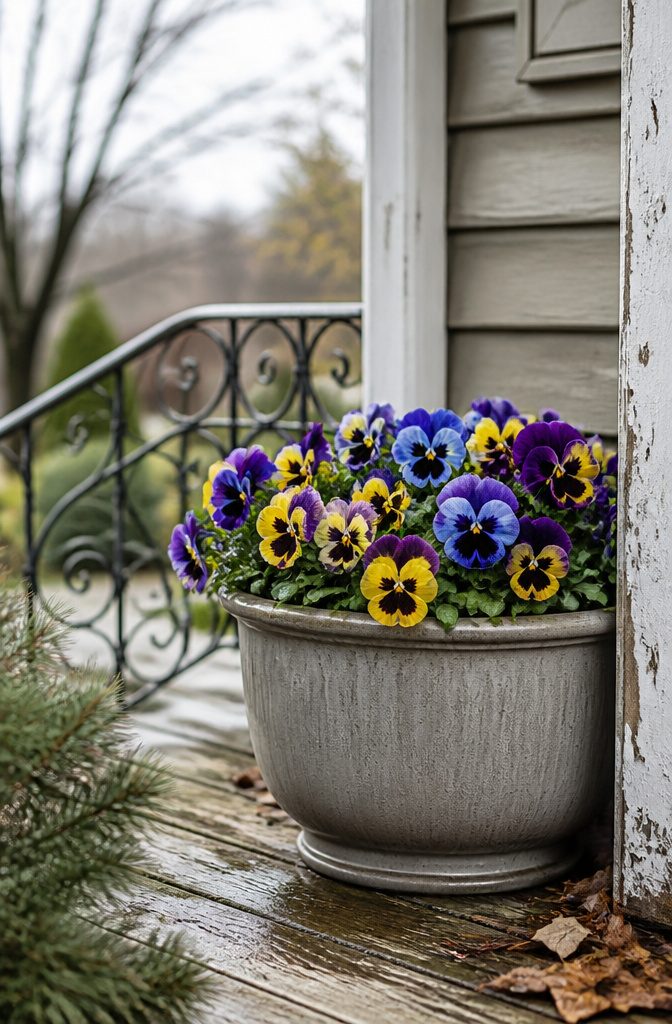
Viola tricolor var. hortensis drops its blooms at 23°F, which is colder than most of us want to be outside anyway.
I plant these in October and let them settle before real cold arrives. The botanical name covers both pansies and violas, though garden centers usually sort them into separate benches.
Pansies carry the larger, rounder faces; violas pack more blooms on a smaller plant, each face thumbnail-sized but massed so thick the foliage barely shows.
In the coldest weeks of January, mine sometimes stall completely.
The leaves stay green and the roots keep working, but no new flowers open. A thaw in the 40s or 50s wakes them again, and the color resumes as if nothing happened.
I have had violas in a glazed pot on my north-facing step survive an entire winter this way, blooming in every mild spell, while a plastic pot of the same variety on the railing fried in a February freeze-thaw cycle when I forgot to check the soil moisture.
The difference was drainage, not the plant.
7. Red Twig Dogwood
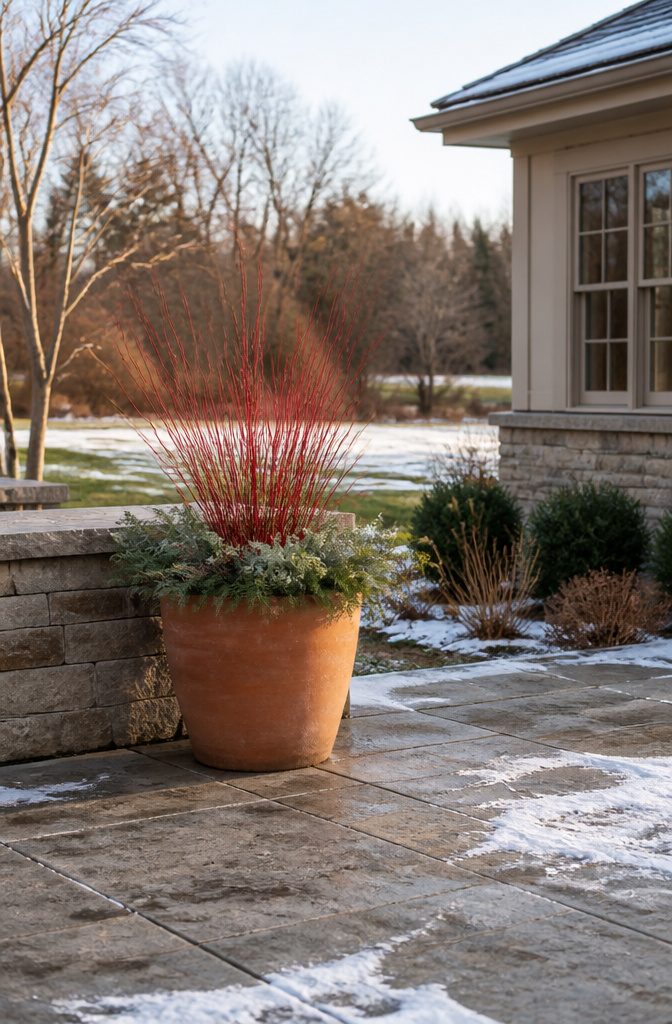
Cornus sericea carries its color on the young wood, which means the coral-red stems you bought the plant for will dull to brownish-gray after a few seasons unless you cut them back hard.
I learned this the winter my own red twig went muddy on me; the flush of new growth the following spring came back almost neon against the snow.
Hard prune every two to three years, taking the oldest stems to the ground in late winter while the plant is still dormant.
The variety ‘Cardinal’ runs more salmon-orange, and ‘Flamiramea’ goes yellow if you want a different note, but the pruning rule stays the same.
In a large container the multiple upright stems work as a thriller, tall enough to hold the eye without evergreen foliage.
Zones 3 to 8, full sun, acidic well-draining soil, and it will want water if the pot dries out even in cold weather.
8. Birch Branches
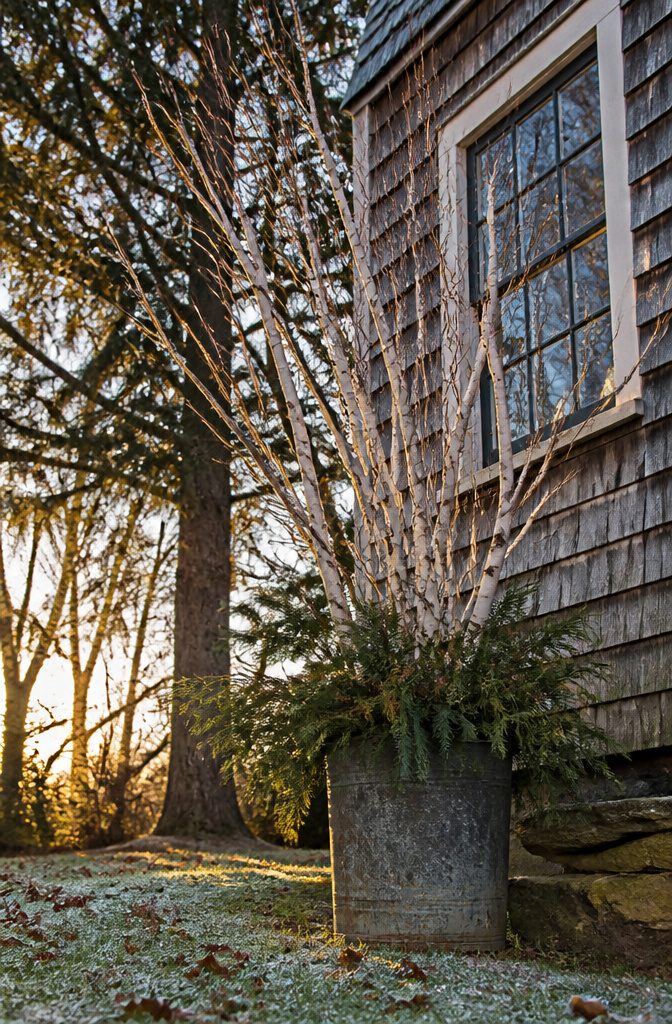
White birch branches bring height and a papery, peeling texture that reads as winter even from the street. I usually find mine after a neighbor prunes a clump, though dried bundles sell at most craft stores through January.
The pale bark catches low afternoon light and reflects it back into the arrangement, which matters when everything else has gone gray.
Cluster three to five stems off-center, not dead middle. Asymmetrical balance keeps the eye moving and stops the pot from looking like a floral-shop display.
Angle two stems slightly backward, one forward, let the others split the difference. The gaps between them are as important as the branches themselves; that negative space is what makes the grouping feel found rather than forced.
Pair birch with cedar or Southern magnolia for contrast, or keep the palette quiet with dried hydrangea and lichen-covered bark.
Red winterberry works too, though the holiday association can read as December-specific if you are aiming for a planter that carries to March.
9. Curly Willow
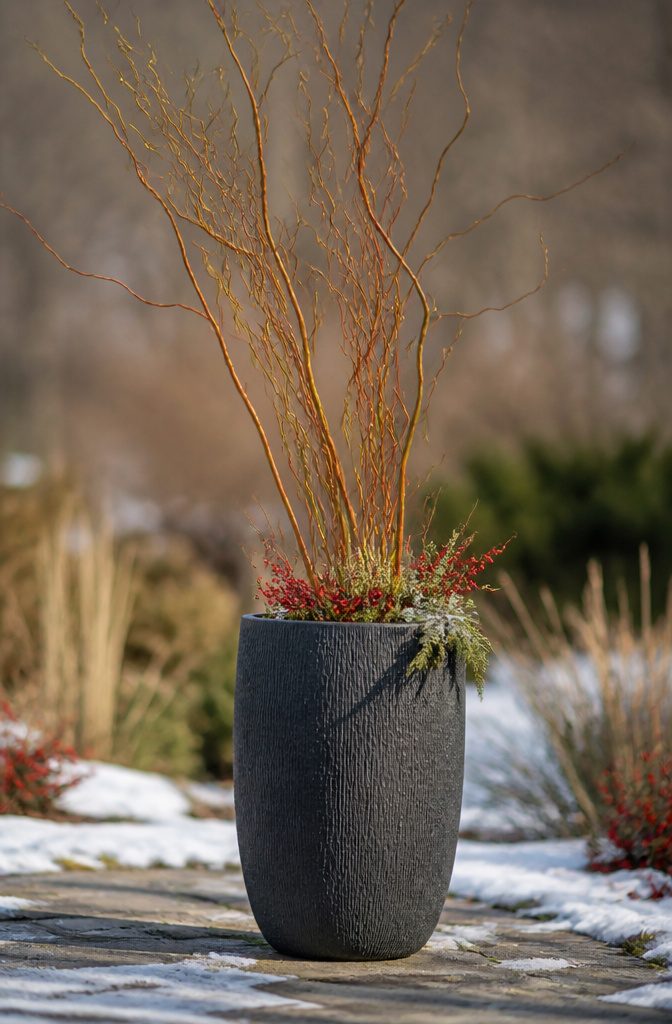
Salix matsudana ‘Tortuosa’ carries itself differently from straight twigs in a winter container. The branches corkscrew in unpredictable directions, catching low afternoon light and throwing shadows against the wall behind them.
I have seen these used as the vertical anchor in tall pots where nothing else would read at a distance, and the curves do the work that color usually handles.
The cut branches root easily if the soil stays moist, turning a temporary arrangement into a living sculpture by spring.
This is not guaranteed, but it happens often enough that I now choose containers deep enough to hold the stems at least six inches in the mix, just in case. A shallow cachepot wastes the chance.
Tall cylinders or urns suit curly willow best. The height gives the branches room to spiral without tangling, and the narrow silhouette keeps the container from dominating a small patio.
Pair it with nothing more than a dark evergreen at the base; the willow is the whole point, and competing textures only soften its impact.
10. Dried Flowers and Pods
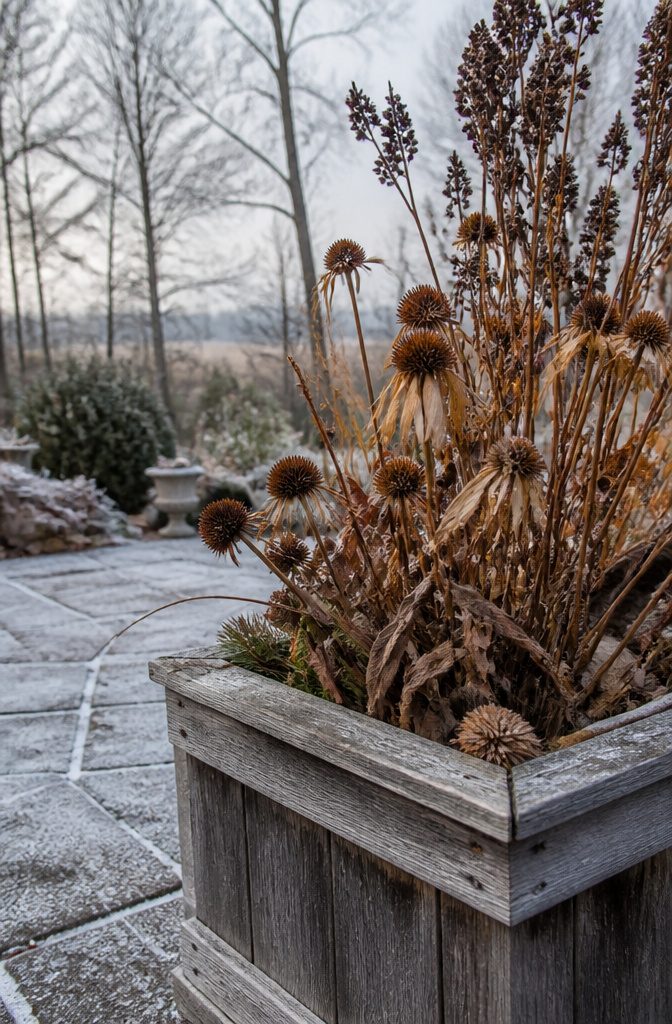
Seed heads left standing in fall carry straight through to spring without any care.
Rudbeckia cones darken to chocolate brown and hold their shape, echinacea centers stay rigid and bristly, and allium spheres shrink to papery globes that rattle in the wind.
These are the bones of a winter container garden, giving structure when color has drained out of everything else.
The only catch is the shedding. A hard gust sends chaff and seeds flying across the patio, which neighbors rarely appreciate.
A light coat of clear lacquer fixes this. Spray the heads after they have dried fully in place, let them cure for a day, and they become stiff enough to survive storms without dropping debris.
I have used the cheap hardware-store aerosol version with no trouble; one can covers a dozen large alliums with room to spare.
Place these toward the back or center of a pot, since their real strength is silhouette rather than close detail. They read as sculpture from the kitchen window, and they cost nothing if you grew them yourself the summer before.
11. Decorative Twigs
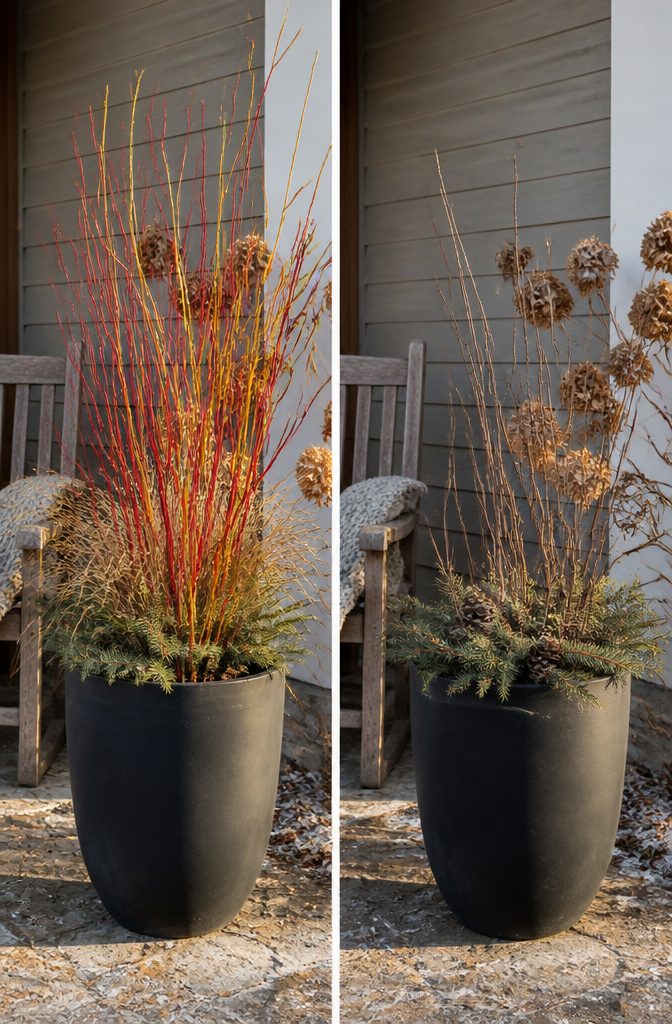
Dogwood and willow twigs in yellow, orange, and red give winter containers the vertical lift that flat arrangements miss.
I coppice my own red twig dogwood, Cornus sericea, cutting the oldest stems to the base in late winter so the new growth comes back brighter.
The yellow-stemmed cultivar ‘Flamiramea’ does the same trick in a different register. Corkscrew willow branches twist upward with the same low effort.
These are gathered from winter pruning or cut from shrubs you already own, not bought as a special product. Once cut, the stems last the full season without water.
No vase, no rooting hormone, no attention. I stuck last year’s dogwood into a pot of damp soil the week before Thanksgiving and pulled them out in March still holding their color.
The height draws the eye up past the rim of the container, which matters more than you’d think when most winter interest sits low and flat.
12. Hardy Succulents
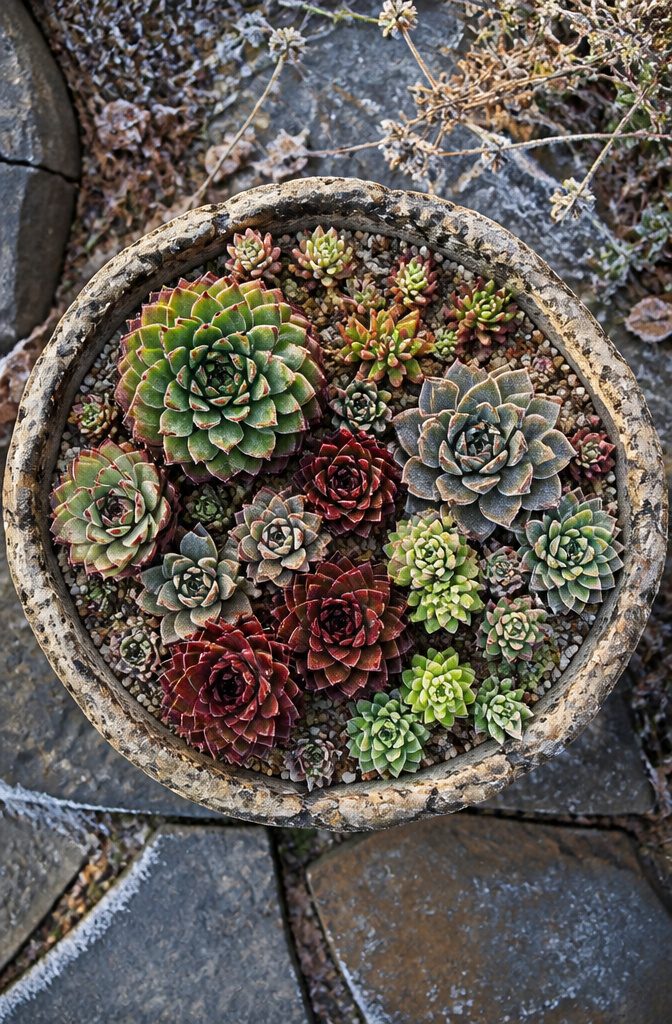
Hens-and-chicks and stonecrop survive frozen pots by drawing their own moisture down into the roots, letting the top growth go almost paper-dry while the plant waits out the cold.
That dehydration trick means shallow containers with fast drainage matter more than pot size here; a saucer left underneath in winter will pool, freeze, and split even a well-fired pot.
Sempervivum varieties run from lime to near-black, and I keep coming back to ‘Red Lion’ for the blood-colored rosettes it pushes up against gray stone.
The shallow root system makes them easy to shift from garden bed to container and back as seasons change, which suits gardeners who rearrange pots often.
Stonecrop sedums work the same way, though their looser mats of foliage need a grittier mix to keep from rotting where water lingers.
Both want full sun to part shade through winter and only the lightest feeding; heavy nitrogen late in the year forces soft growth that does not harden off.
In my experience, the hardiness range of zones 3 to 8 covers most of the country, but the pot itself still needs protection from standing water more than the plant needs protection from cold.
13. Faux Elements
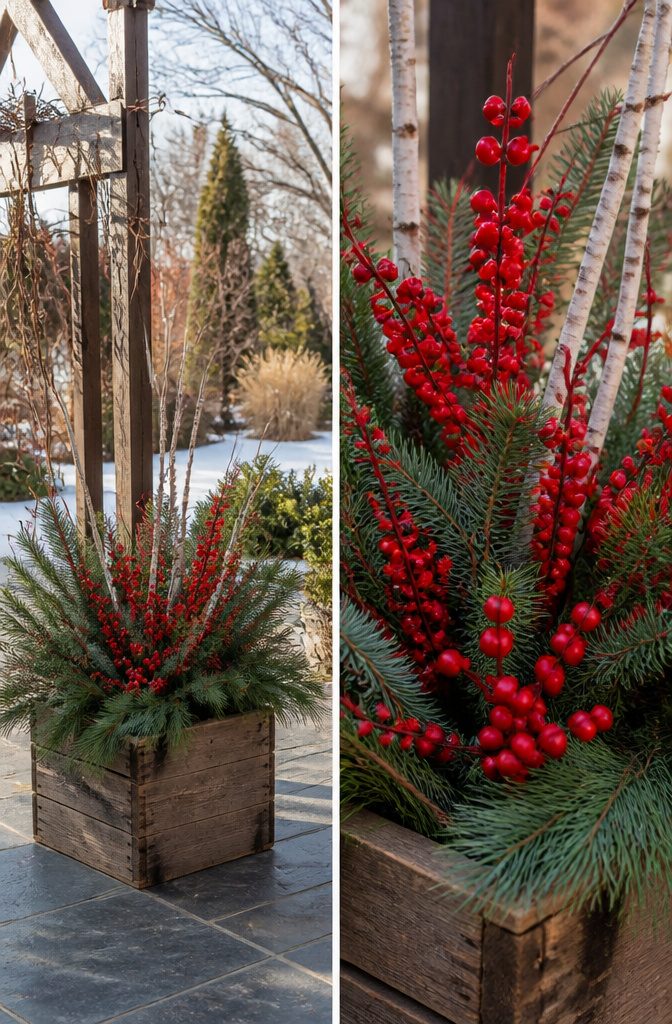
Realistic faux berries, pinecones, and small ornaments give color that does not quit when the light drops below what living plants need.
I learned this the hard way on a north-facing balcony where even pansies went leggy and gray by January.
The fake red berries wired into a spruce tip arrangement looked the same in March as they did in October, and cost maybe six dollars for a bunch.
The trick is mixing them with enough real material that the eye does not catch the plastic. A few faux crabapples tucked among fresh evergreen branches, or painted pinecones glued onto grapevine, reads as decoration rather than admission of defeat.
Low corners of a porch, the space under an overhang, anywhere that gets maybe two hours of weak winter sun, these are where the artificial pieces earn their place.
Securing them matters more than you’d think. Floral wire blends into stems and lets you anchor berries exactly where the wind won’t knock them onto your neighbor’s steps.
A small dab of hot glue on the back of a pinecone, pressed against a twig frame, holds through freeze and thaw.
Wire anything over an inch across in two places, not one, or you’ll be picking it off the ground after the first storm.
14. Natural Materials
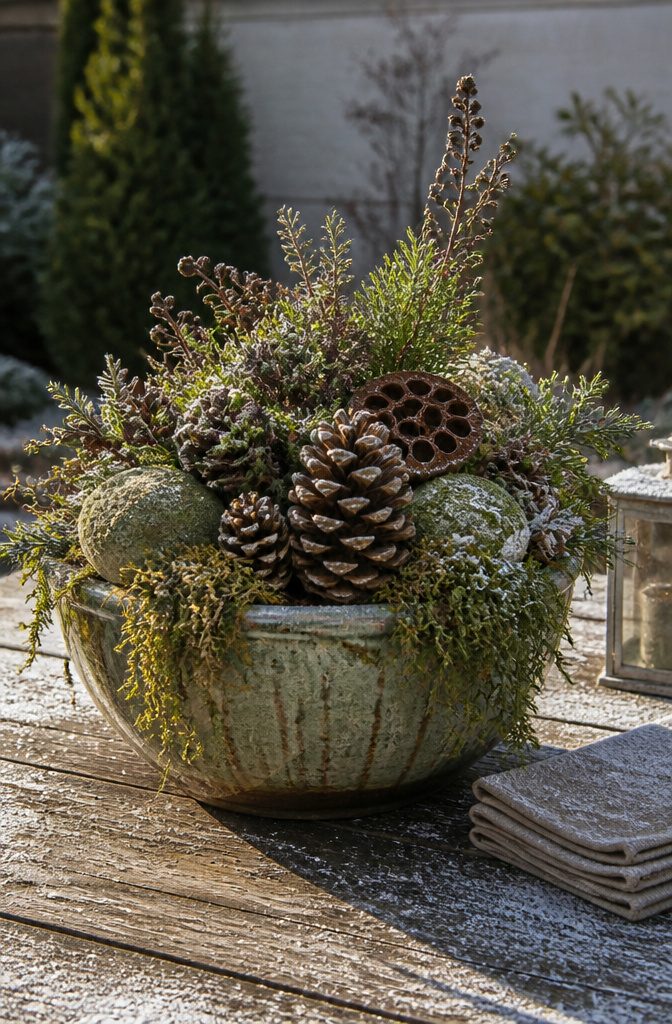
Pinecones, stones, bark, and moss do more than fill space in a winter container.
They add weight that keeps lightweight arrangements from tipping in wind or under snow, and the rough textures read as organic contrast against smooth ceramic or metal pots.
I gather mine from the yard or nearby woods, which brings the cost to zero.
Last season I tucked a few flat field stones at the base of a galvanized bucket arrangement; the pot stopped sliding across the patio every gust.
Bark pieces wedged between stems hide the edge of the soil and give the eye something irregular to rest on. Moss works the same way, and it stays green through most of the cold months here in zone 6.
The thriller-filler-spiller rule still applies, but these materials let you stretch what you have.
A pinecone cluster reads as filler density without a live plant behind it. A stout branch of paper birch bark becomes the focal point where a cut evergreen would go.
15. Ribbons and Lights
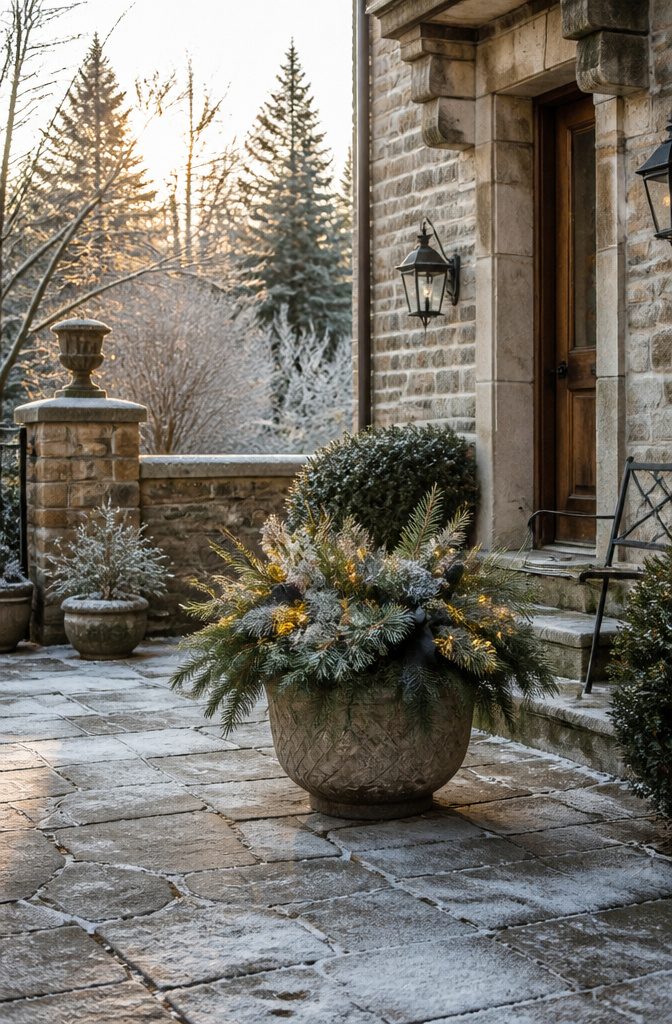
Weatherproof ribbon holds up through rain and snow cover without turning soggy or faded.
I look for the kind with wire running through it, since that stiffness makes a bow that keeps its shape instead of drooping after the first wet week.
Black ribbon reads as surprisingly festive against evergreen branches, and it works past New Year’s without looking leftover from a holiday that ended.
Battery-operated fairy lights warm up a container after dark.
Warm white LEDs on timer functions are the ones worth buying; they switch themselves on and off so you are not trudging out in freezing weather to plug anything in or remember where you left the remote.
Keep the battery pack tucked inside a plastic bag or removed entirely when heavy rain or snowmelt is coming. Saturation kills these units faster than cold does, and a soaked battery pack usually means replacing the whole string.
16. Layering Techniques
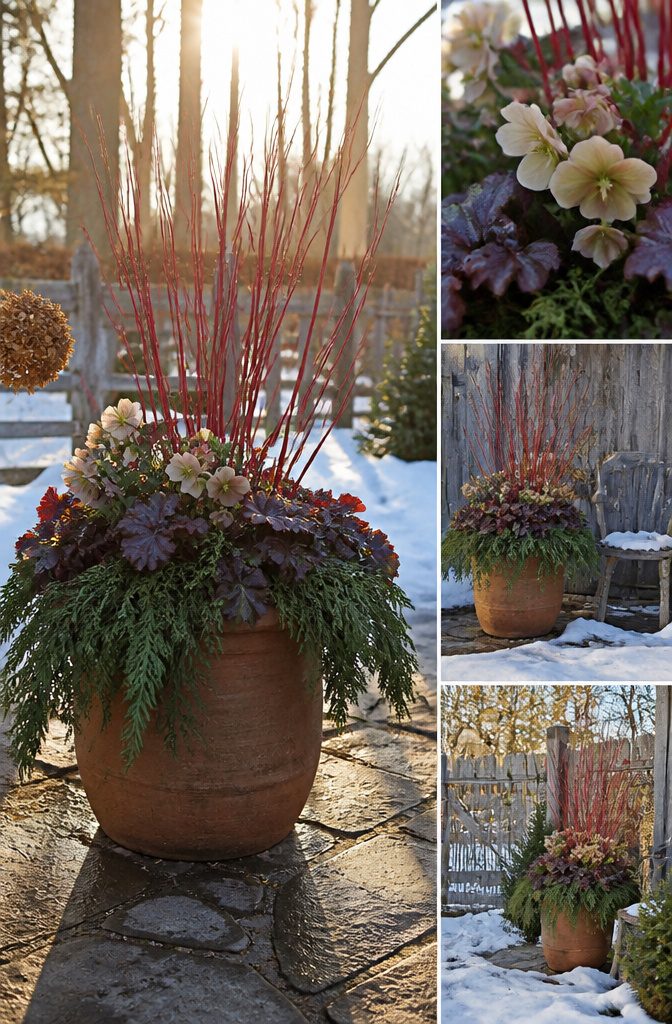
A winter container that looks full rather than sparse starts at the soil line and builds upward in three clear tiers.
The base layer wants something low and spreading, maybe a small evergreen or trailing ivy that laps over the rim and hides the pot edge entirely.
Above that sits the mid-height material, the part your eye rests on first: a compact holly, a cluster of heuchera, or a few forced bulbs if the season allows.
The top layer reaches for vertical lines, birch twigs or red-stemmed dogwood pushing above the foliage to draw the eye skyward.
Each layer should touch the next with no visible gap between them. That overlap is what separates a professional arrangement from three plants sitting in a pot.
When the base foliage creeps into the lower stems of the mid plants, and those mid plants in turn break slightly below the vertical twigs, the whole reads as one continuous mass rather than separate objects staged together.
I learned this the hard way my first winter, spacing everything for its mature size and ending with a container that looked planted by a committee, each element voting in its own direction.
The overflow happens when you slightly overfill at every level.
Not so much that roots compete, but enough that branches and leaves have to lean on each other for room. That pressure creates the lush, uncontained look that makes passersby stop on a gray January afternoon.
17. Thriller, Filler, Spiller
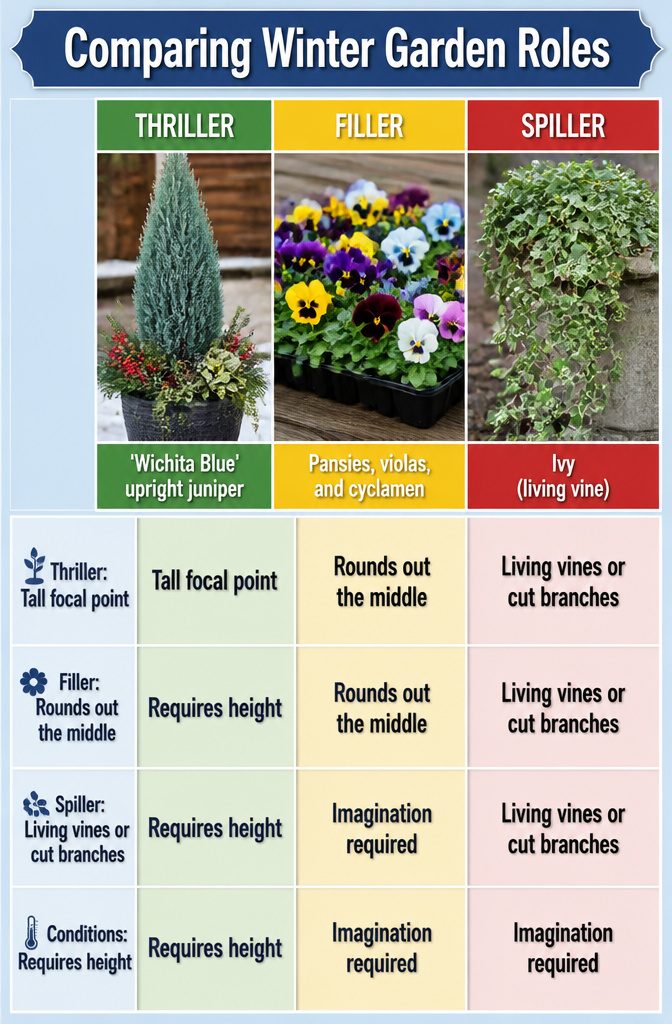
The thriller, filler, spiller rule works in winter the same way it does in summer, though the plants themselves change shape.
A thriller is still your tall focal point, something like a ‘Wichita Blue’ upright juniper or a dwarf holly placed dead center or at the back edge.
I have seen ‘Chief Joseph Pine’ and ‘Wilma Goldcrest Cypress’ used the same way, and in shadier spots ferns or heuchera can carry that height even without direct sun.
Fillers round out the middle.
Pansies, violas, and cyclamen do the job in a classic winter mix, though ornamental cabbage or snaps take over on the sunniest patios. ‘Calgary Carpet’ juniper sits at this height too, and ‘Good Vibrations Gold’ adds a bright note if the rest of the pot runs dark.
Spillers are where winter asks for some imagination. Living vines like ivy or creeping jenny still trail over the edge in milder zones, but in harder cold you swap in cut branches that drape instead of root.
Red-twig dogwood stems, curly willow, or fir boughs give that same cascading line without needing the plant to survive in a frozen pot.
One approach keeps the living spillers and swaps them if a hard freeze hits; the other builds the whole composition from the start knowing some elements are temporary.
18. Window Boxes
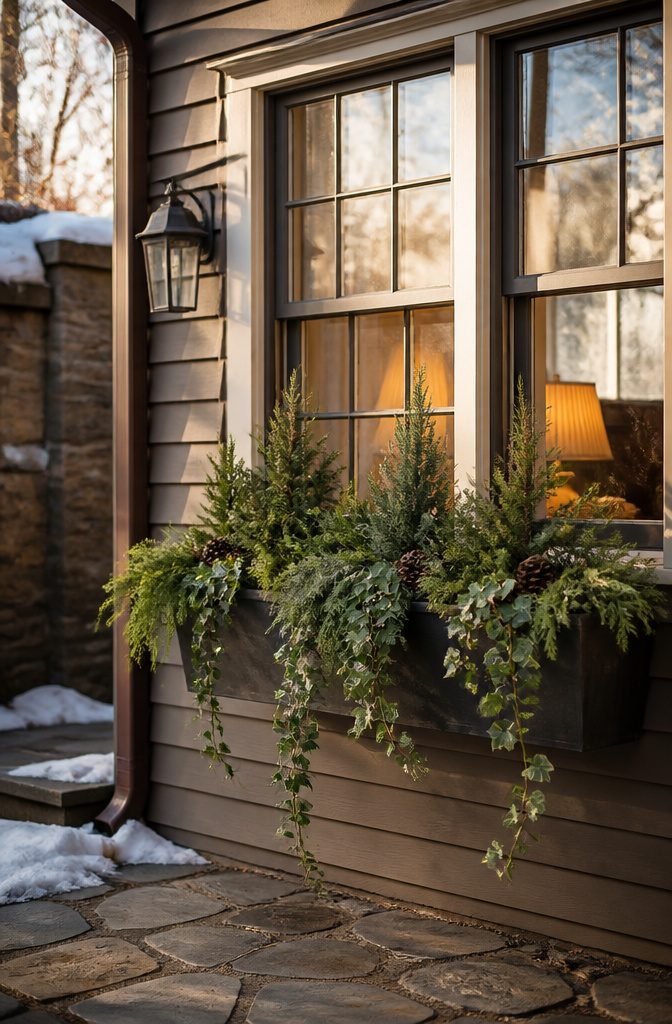
Window boxes sit at eye level from inside your living room, which means the tallest plants need to go in front, not back.
Standard container logic puts height behind so it reads from the street, but these arrangements face the reverse direction.
I learned this the hard way one January when my upright red twig dogwood blocked the entire kitchen window from the inside while looking sparse from the sidewalk.
Shallow soil dries out faster than a deep pot, even in cold weather when evaporation seems slower. Wind strips moisture from the exposed surface, and the limited root mass cannot buffer dry spells.
I check mine twice a week with a finger pushed to the second knuckle; the top inch can look damp while the roots sit in dust.
A small watering can with a narrow spout works better than a hose that blasts soil over the sill.
For depth, stick to plants under twelve inches: dwarf evergreens, small heathers, trailing ivy. Anything taller belongs in a ground-level container where the scale reads right from both sides.
19. Grouping Containers
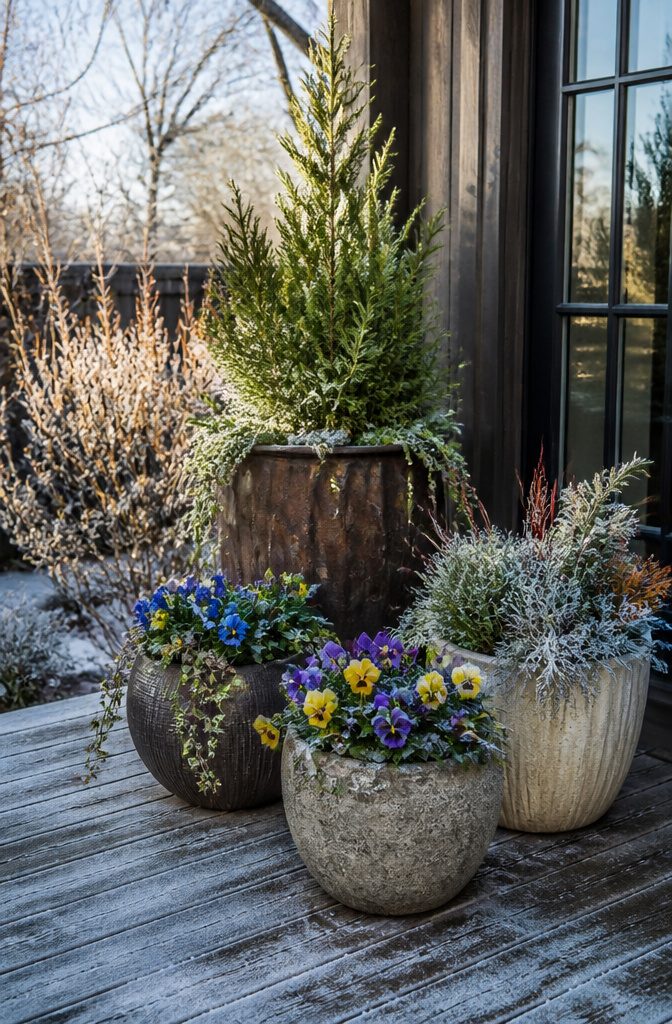
Clustering pots at different heights keeps a winter container garden from looking flat, even when the palette is mostly green and brown.
Odd numbers read as one grouping; even numbers tend to split apart visually, so three or five pots will settle together more naturally than two or four.
The tallest pot anchors the arrangement, and the smallest one needs a lift to reach the same conversation. An overturned empty pot tucked underneath works as a hidden riser; a couple of bricks do the same job.
The viewer sees the planted container, not what holds it up. I learned this the hard way one January when a low bowl of pansies sat ignored at knee level while everything around it drew the eye upward.
A spare terra-cotta pot flipped underneath brought it into the scene, and the whole grouping finally felt finished.
20. Seasonal Color Themes
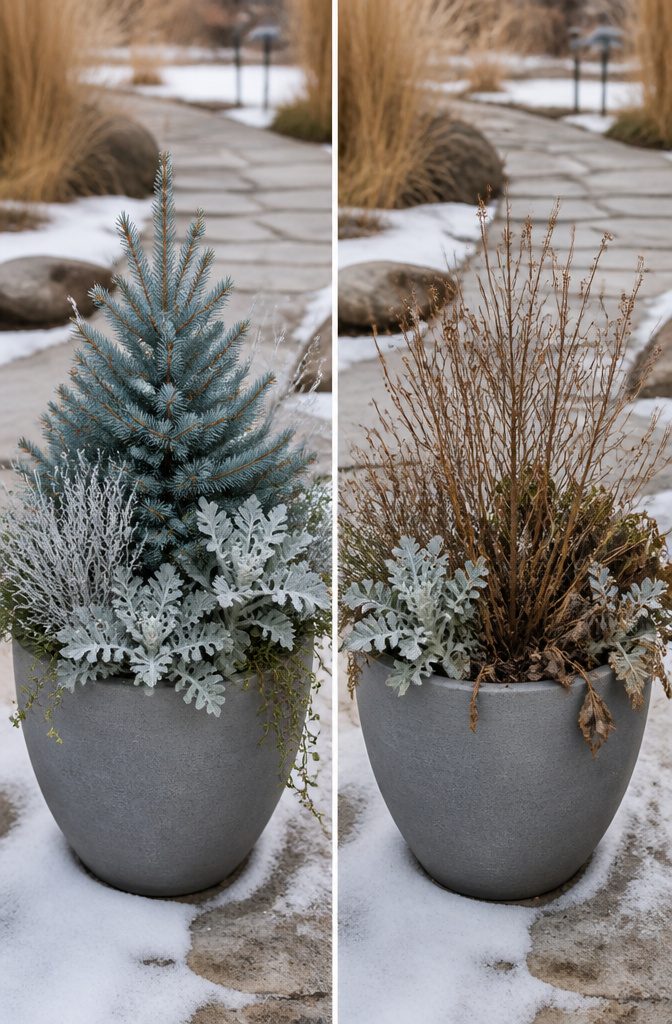
A winter container garden reads louder when you pick two colors and stop there.
Three at most. Any more and the eye bounces around without landing anywhere, which is the exact scattered look that makes amateur arrangements feel accidental.
Silver and blue builds the frostiest palette. Dusty miller catches low light on its gray leaves, and a blue-needled dwarf spruce or two carries the cool tone straight through till March.
Red and gold does the opposite job: a few stems of winterberry against gold-tipped ornamental grass wakes up a gray morning from fifty feet away.
White and green is the quietest choice, mostly variegated ivy and white pansies against a dark pot, and it works because the simplicity itself becomes the point.
Limiting yourself to two or three colors forces every plant to earn its place.
I have stood in front of nursery tables with a cart full of "maybe this too" and ended up with containers that looked like a seed catalog exploded.
The ones I planned with a paint-strip discipline always read better from the sidewalk, even when the individual plants were nothing special.
21. Repurposed Materials
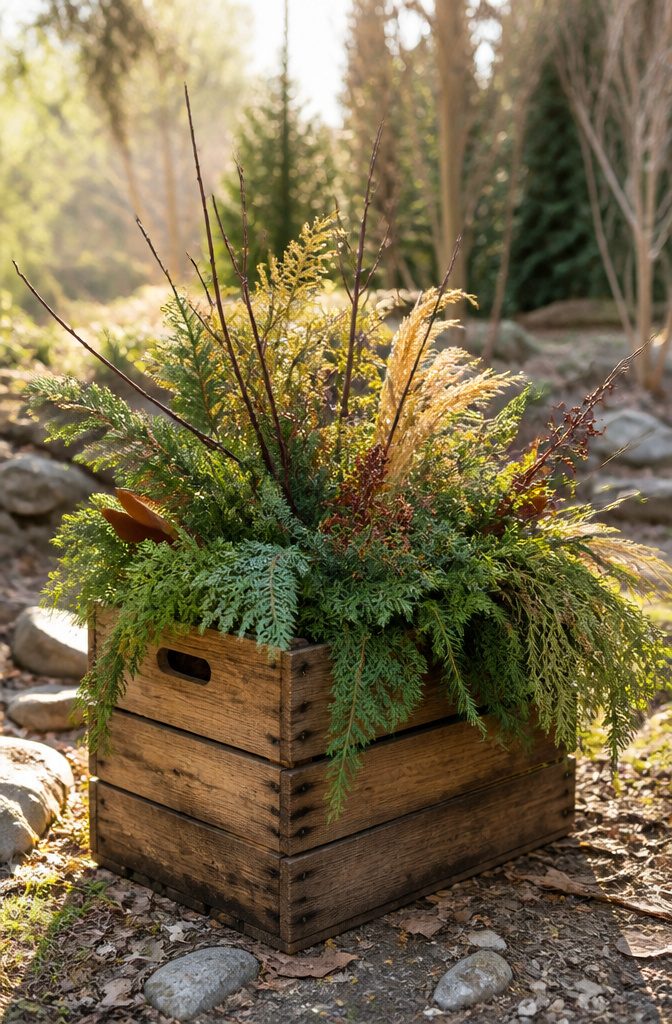
Old wire baskets, wooden crates, and dented metal buckets make some of the most honest winter containers going. I pick them up at estate sales and curbside piles for nothing, and the weathered finish already looks like it belongs outdoors.
The catch is drainage: a solid-bottomed box or pail will hold water and freeze your heuchera or small evergreen into a block of ice.
A few 1/2-inch holes drilled through the bottom fix that, spaced so water escapes but soil stays put.
These pieces are temporary by nature. A wooden berry box might last two winters before the bottom softens; a galvanized bucket with rust spots could make it through one hard freeze before it pinholes.
That limits them to annual arrangements or cut branches rather than anything you plant to keep.
Still, for zero dollars and an afternoon with a drill, the math works. I treat them as expendable, swap in fresh ones when they fail, and never worry about a pot cracking on a January night.
22. Cold-Hardy Herbs
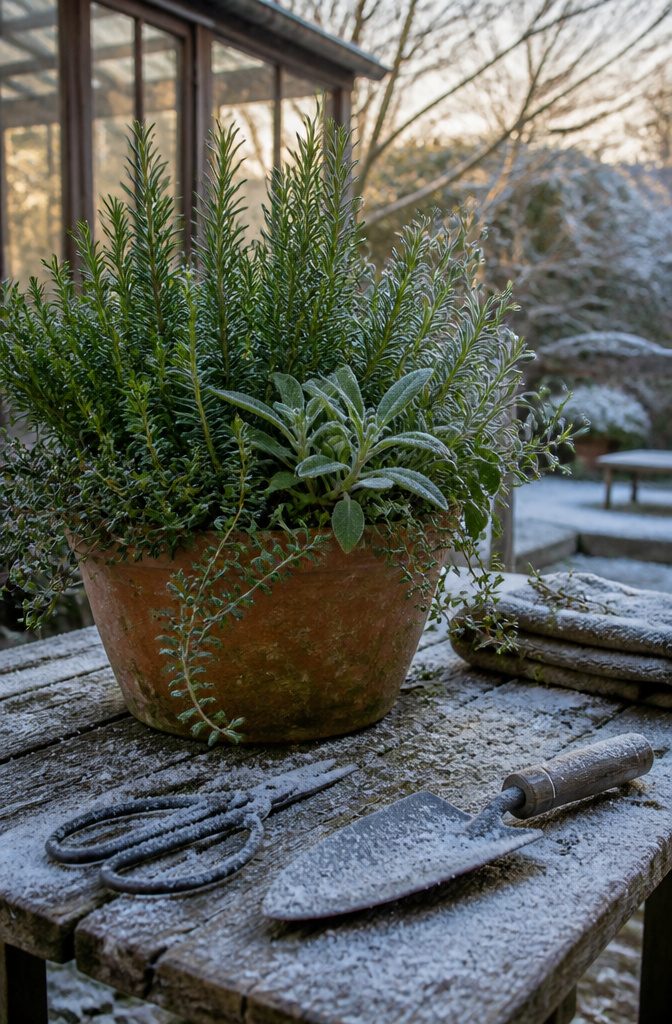
Rosemary, sage, and thyme earn their spot in a winter container garden ideas plan by staying alive through frost and still showing up for dinner.
Rosemary in particular handles cold better than most cooks expect: tuck it against a south-facing wall where brick or siding absorbs daytime heat and blocks wind, and it often sails through zones where the books say it should quit.
The needles stay dark green and resinous, and a quick snip before roasting chicken beats anything dried.
Sage flops less gracefully than rosemary when temperatures swing, but the silvery leaves catch frost light beautifully. Thyme creeps and spills over pot edges, evergreen in most winters, and pairs well with low companions like hens-and-chicks.
All three need less water than they did in July.
Dormant growth and cold air slow evaporation, so the soil stays wet longer. That same stillness makes drainage non-negotiable.
A pot that holds water in August will rot roots by January. I check mine by tipping the container after a rain: anything pooling in the saucer gets emptied that day.
23. Texture Variety
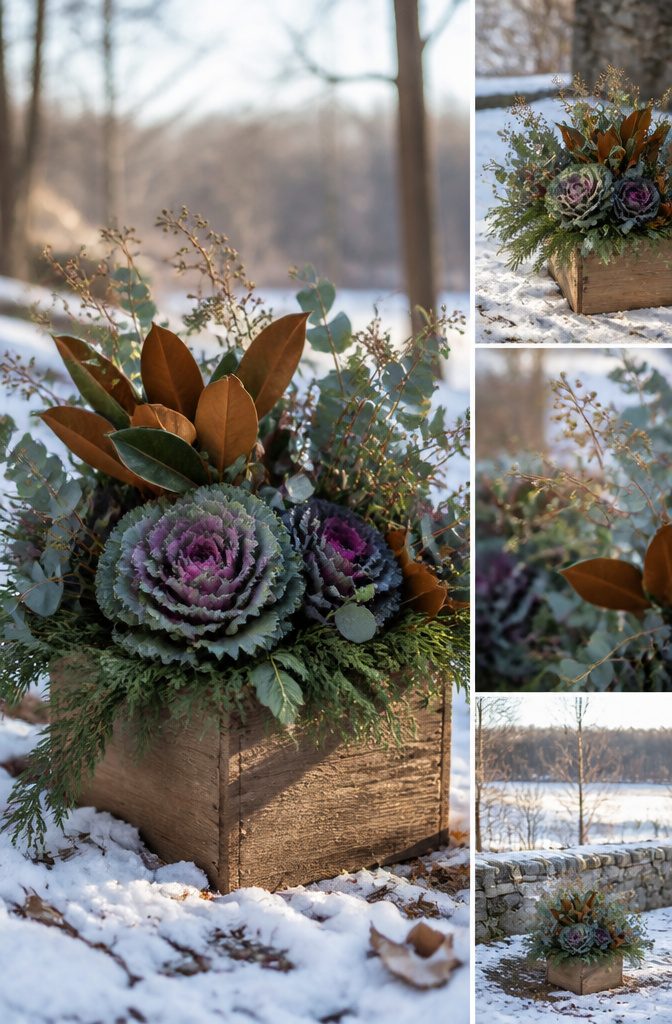
Winter light sits low and gray for weeks at a stretch, and color drains out of everything by three in the afternoon. That is when texture starts carrying the whole arrangement.
A pot filled only with glossy things turns into a sheet of glare; one with all soft foliage collapses into a mound of same. The eye needs something to grip.
I pair magnolia branches with their leathery, brown-backed leaves against the froth of seeded eucalyptus.
The contrast reads even on a dim porch. European wild ginger works the same way: those glossy, circular leaves set off anything feathery planted beside them.
Matte foliage, like the double-sided leaves of variegated holly, catches light differently than a waxy cabbage or a rigid conifer. Fuzzy lamb’s ear against stiff red-twig dogwood twigs gives you the same tension without a single bloom.
Gray days reward the mix. One glossy, one matte, one fuzzy, one rigid in the same pot, and the arrangement holds interest after the pansies have frozen.
24. Colorful Sticks
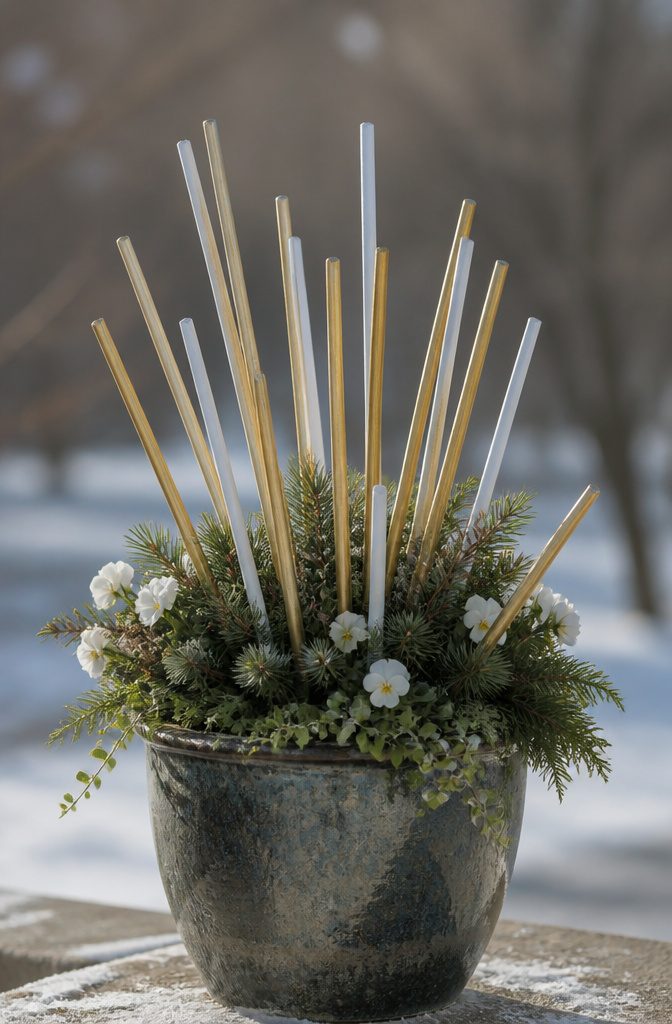
Painted sticks are the closest winter container garden ideas get to free sculpture.
Any pruned branch, spray-painted matte white, red, or gold, and stuck into soil at a sharp angle, gives a pot the height and structure it lost when the annuals died.
The paint has to be formulated for outdoor use, or it flakes by February and the stick looks like a peeled birch pole left in the rain.
I have used red osier dogwood prunings, plain maple twigs, even the stripped branches of an overgrown smoke bush that needed cutting back anyway.
White reads clearest against dark evergreen fillers; gold catches late afternoon light when nothing else in the garden does.
The only mistake I have made is clustering them too upright and too centered, which turns a container into a vase rather than a planting.
Angle them, group them off-center, and let them cross so the eye reads depth, not decoration.
25. Tight Filling
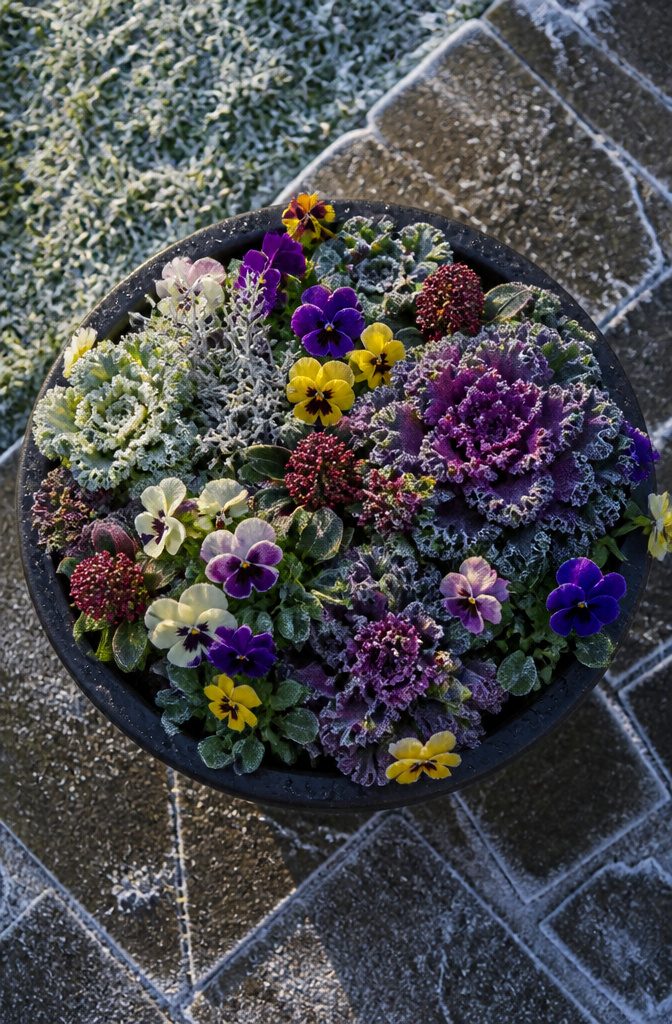
A winter container planted with the same spacing you’d use in May will look abandoned by January.
You need to start with roughly one-third more plants than feels right, because cold soil and short days mean almost no fill-in growth once temperatures drop.
I learned this the expensive way after spacing winter pansies like I would in spring.
By February I had bare soil, weeds, and a container that looked half-finished. The next year I crowded my violas, kale, and sedums shoulder to shoulder.
They looked overfull at first, almost awkward. Six weeks later the foliage had met and merged into a solid mat.
That density works as insulation. Soil in a packed container freezes slower than soil exposed to air, and the root balls buffer each other against temperature swings.
Weed seeds that blow in find no light and no room. The tradeoff is water: tight plantings dry unevenly, so you have to check more often near the edges where the wind hits.
But the visual payoff is a container that reads as intentional and full through the gray months, not a holding area waiting for spring.
26. Natural Color Schemes
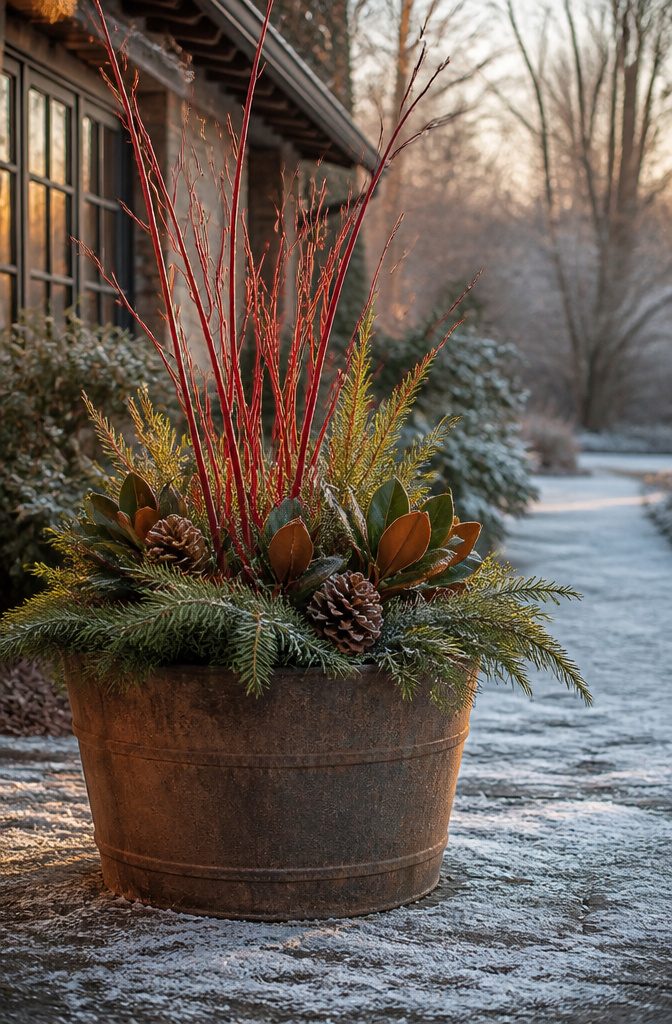
The first winter container I put together looked like a holiday craft project exploded on my patio.
Red plastic berries, glitter-dusted pinecones, and a spray-painted gold branch all fought for attention in a single pot. By January I couldn’t stand looking at it.
Now I stick to one accent color against a base of brown, green, gray, and berry tones. That restraint is what makes a winter arrangement read as a garden rather than decoration.
Last year I used the reddish stems of native dogwood as my single warm note against silvery Russian sage, dried oat grass, and the pewter seed heads of sedum.
The effect held from first frost through mud season because nothing in it asked to be noticed on its own.
Too many bright elements read artificial in winter light, which is already cool and thin.
When everything competes, nothing wins. A neutral base lets the natural textures of bark, dried grass, and evergreen do the visual work, and one deliberate accent gives the eye a place to rest.
27. Zero-Cost Yard Materials
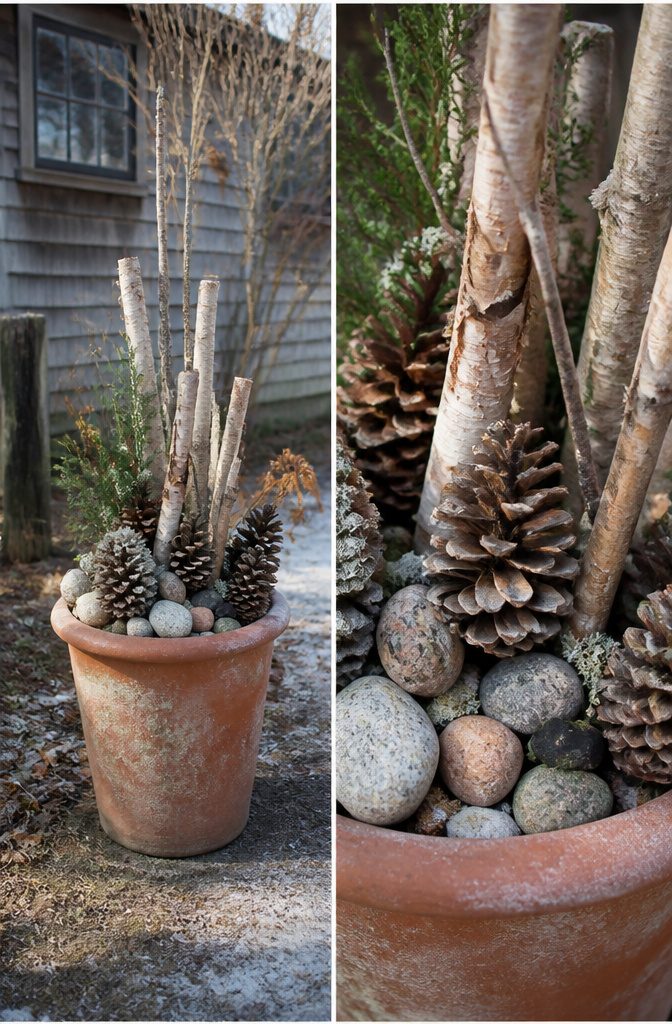
The winter containers I like best start with a walk around the yard after the first hard frost.
Last November I spent maybe two hours gathering what the season had already dropped: spruce cones from the neighbor’s tree that rolls into my bed every windstorm, the dried seed heads of black-eyed Susans I never got around to deadheading, a few stones pressed up from the freeze-thaw cycle along the driveway edge.
That two hours of sorting is the real cost, and it is not nothing on a cold morning.
What you find limits you to your actual landscape, which is the point. My containers that year ran heavy on tannin browns and the gray of lichened branch because that is what grows here.
A gardener on the Gulf Coast might build around magnolia leaves and camellia bud scales. The palette is narrow by definition, but the result reads as belonging to that particular place because it literally does.
I have tried supplementing with purchased picks and always pulled them out by January; they sat on top of the arrangement rather than growing out of it.
The time breaks down roughly: half gathering, half sorting by scale and condition. Cones with damp cores go on the radiator tray for a day.
Branches prune best after a few hard freezes have set the sap, so I cut those in late November and stand them in the garage until I need them.
Choosing Winter Containers
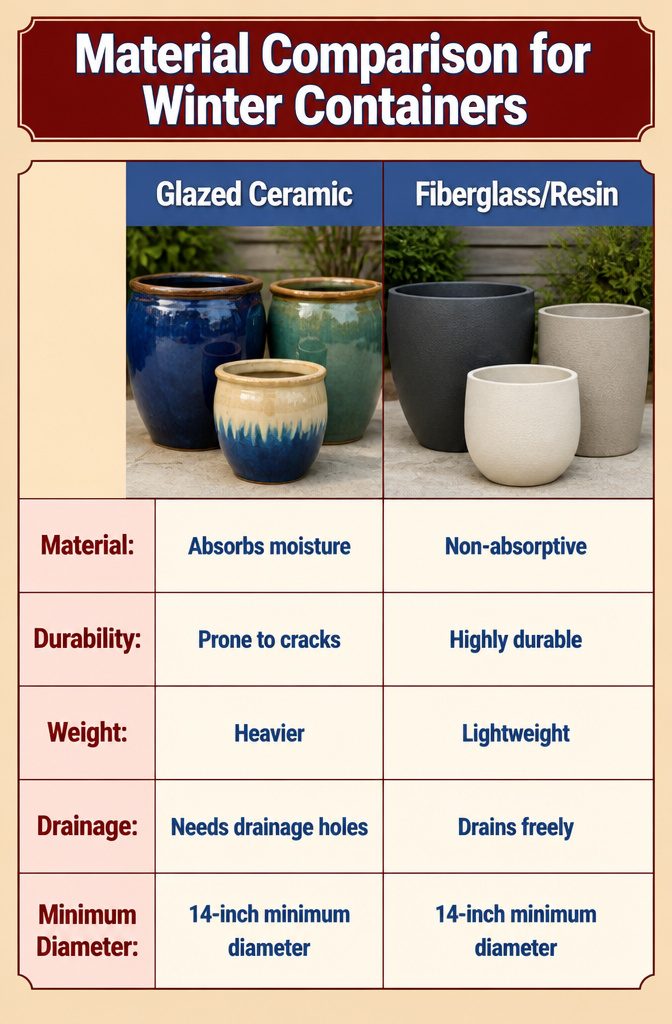
The material a winter container is made from matters more in February than it does in July. Terracotta and standard concrete pull water into their pores, and when that water freezes, it expands.
The pot cracks, sometimes in one dramatic split, more often in a network of hairlines that shows up after the thaw. Glazed ceramic holds up better because the firing seals the surface, though it still needs to drain freely.
Fiberglass and resin are the materials I look for now: they do not absorb water, they do not fracture in freeze-thaw cycles, and they are light enough to carry inside if a cold snap drops below what the planting can take.
Soil volume is the other protection. A 14-inch minimum diameter gives roots enough surrounding soil to buffer against rapid temperature swings.
Smaller pots freeze solid faster, and the roots freeze with them. I learned that with a 10-inch glazed pot of heather years ago, the kind of mistake that costs one plant and one container but sticks in memory.
Watering in Winter
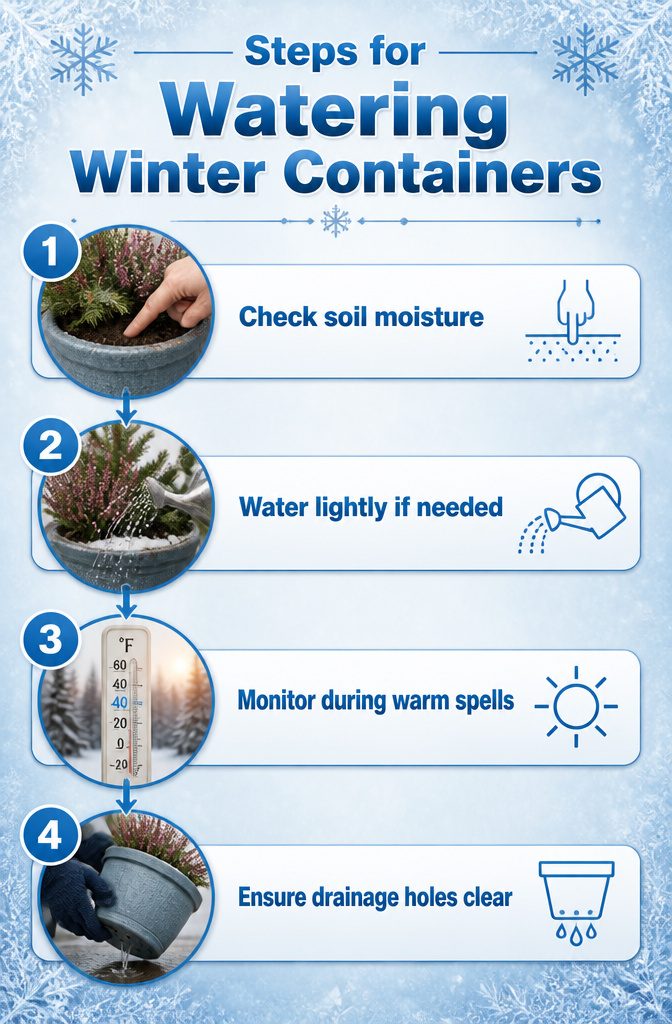
Watering a winter container garden means unlearning the habit of summer. I check mine about once a month when there’s been no rain or snowmelt to speak of.
The soil surface can look dusty and cracked while the root ball below still holds plenty of moisture, so I stick my finger in to the first knuckle or just past, roughly two inches.
If it comes up clean and the plant looks tired, I water lightly. If soil clings, I leave it alone.
Warm spells above 40°F are the only times this matters much. Those are the windows when the plant is actually taking water up, and when evaporation happens.
Dry roots die faster than cold roots, so a January thaw is not the moment to get lazy about checking. I learned that the hard way with a heather I assumed could fend for itself through a dry stretch.
Drainage holes need to stay clear all season. Soggy soil from blocked openings does the same damage in February as in July: roots drown, nutrients stop moving, and the plant stresses or rots.
I tilt my pots after heavy weather to make sure water actually ran out the bottom.
Plant Hardiness Zones
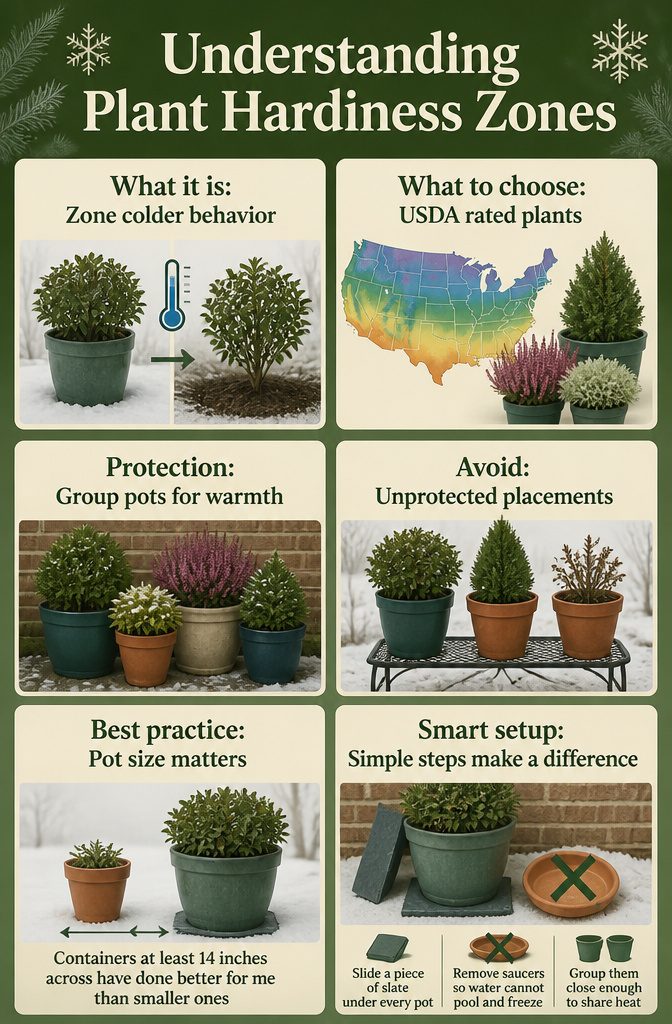
A container in winter behaves like a plant sitting one hardiness zone colder than the ground around it.
The soil mass is smaller, the roots have no earth to buffer them, and the pot itself radiates cold on all sides. Choose plants rated for your USDA zone or one zone lower if you want them to survive January.
The wall of your house changes the math. I cluster my pots on the south-facing side where afternoon sun hits and brick holds daytime warmth.
Under the eaves also works, since it cuts wind chill and stops the freeze-thaw cycle that splits ceramic. The first year I tried winter containers, I left three pots out in the open on a metal stand.
Two came through; the third, an unglazed terracotta with a dwarf juniper, cracked in a single night below 20°F. Now I slide a piece of slate under every pot, remove saucers so water cannot pool and freeze, and group them close enough to share heat.
Containers at least 14 inches across have done better for me than smaller ones; the extra soil volume actually protects roots when the thermometer drops.
Grocery Store Additions
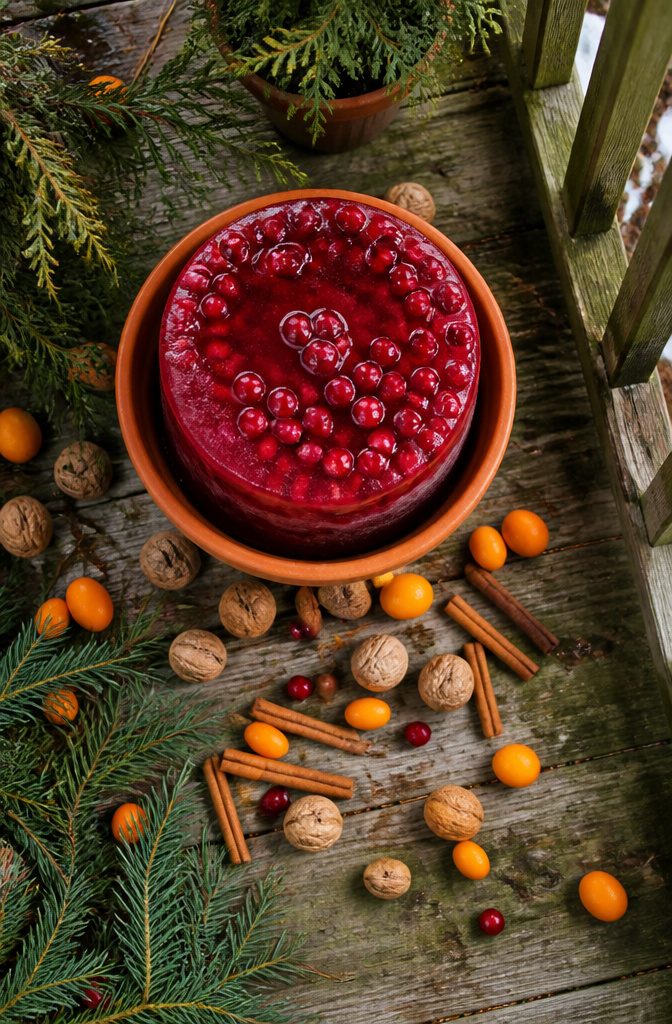
Grocery stores carry the kind of winter container garden ideas that cost next to nothing and read as intentional rather than desperate.
Last December I filled a frost-friendly pot with cranberries and water, let it freeze overnight, and had a solid red cylinder that looked graphic enough to remind me of those Andy Goldsworthy ice pieces.
Artichokes, kumquats, and whole nuts enshrined in ice do the same thing: they buy you texture and color when garden centers are picked over.
These grocery additions last weeks, not months. The cold helps, but only up to a point.
I have learned to keep them in covered entries or use them for holiday-specific displays, then swap them before they turn. Pomegranates, citrus, cinnamon sticks, and whole spices all work as temporary fillers tucked among evergreen boughs or foam forms.
Songbirds and squirrels will find the nuts and fruits fast, which is either the point or the problem depending on your porch setup. If you are after the look without the wildlife traffic, stick to spices and non-edible coatings.
When to Plant Winter Containers
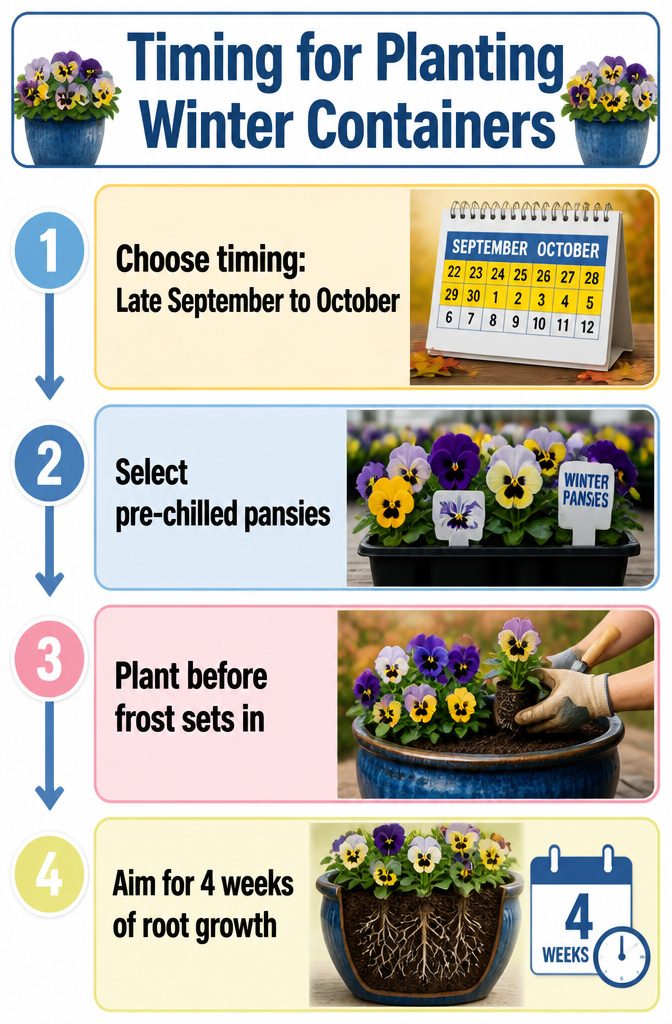
Late September to early October is the window that has worked for me.
Soil still holds enough warmth then for roots to knit into the new container before the real cold arrives. Wait much longer and you are planting into cold soil that shocks the roots and leaves them limp through winter.
Pre-chilled pansies handle a later planting better than most.
Garden centers sell them as "winter pansies" in some regions, and that chilling changes their response to dropping temperatures. Even so, I would not push past mid-October where I garden in zone 6.
The survival difference between a plant that rooted in warm soil and one that did not is visible by January; the established ones sit firm and keep their leaves, while the late-planted ones lift out of the pot with a tug.
Aim for at least four weeks of root growth before your first hard frost.
Check your local frost dates, then back up from there. If you are in a warmer zone where hard frost comes later, you gain flexibility, but the principle stays the same: roots first, cold later.
Frequently Asked Questions
What plants thrive in winter containers?
Pansies and violas survive down to 23°F, hellebores bloom as early as January in milder zones, and winterberry holly carries bright fruit on bare stems for months.
Cyclamen prefers cool nights below 60°F, while ornamental kale tightens its color after a hard frost.
For structure, dwarf Alberta spruce and other evergreens rated one to two zones colder than your own provide the backbone that holds a winter pot together.
How do I design a winter container garden?
Build upward in three tiers: a low base layer that laps over the rim, mid-height plants for the eye to rest on, and vertical twigs or branches that reach above the foliage.
Each layer should touch the next with no visible gap.
The thriller-filler-spiller rule still applies in winter, though you may swap live spillers for cut branches that drape without needing to survive in frozen soil. Odd numbers of containers group more naturally than even.
What materials should I use for winter containers?
Non-porous containers like glazed ceramic, fiberglass, resin, and thick plastic resist cracking through freeze-thaw cycles better than porous terracotta or clay.
Concrete works but is heavy to move if you need to shelter plants. Whatever the material, ensure it drains; a saucer left underneath will pool, freeze, and split even a durable pot.
How do I care for winter container plants?
Water minimally and check soil moisture with a finger pushed to the second knuckle, since wind strips moisture even when evaporation seems slow.
For living evergreens, choose varieties rated one to two zones colder than yours, since roots have less protection in a pot than in ground.
When hard freeze threatens, drop plastic-potted plants into display containers so you can lift the whole arrangement indoors overnight without disturbing frozen soil.
Can I use grocery store materials in my winter planters?
Items like fruits and nuts add color and interest, though the article focuses more on gathered natural materials such as pinecones, stones, bark, and moss.
These add weight that keeps lightweight arrangements from tipping in wind, and they cost nothing if collected from your own yard or nearby woods. A light coat of clear lacquer on dried seed heads prevents shedding across the patio.






