
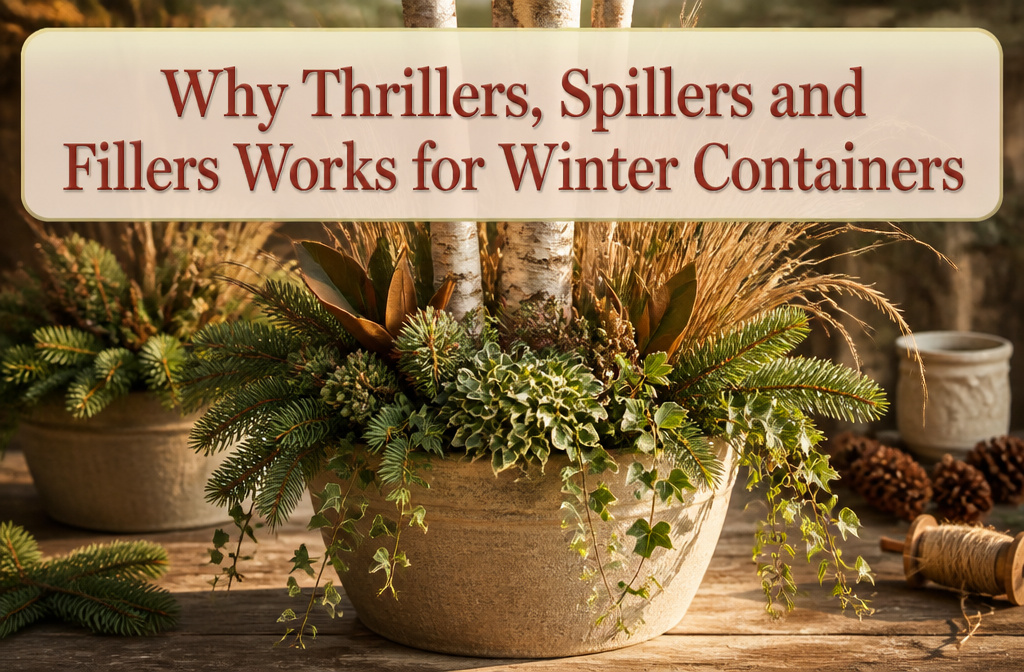
The thrillers, fillers, and spillers formula is a three-part planting method that builds winter container arrangements with layered height, bulk, and trailing edges. It works in cold months because structure matters more than color once blooming plants go dormant. A 12-inch pot takes one thriller, two fillers, and three spillers: the same ratio holds whether you are pushing living plants into soil or anchoring cut branches against winter wind.
Why the Thrillers Fillers and Spillers Formula Works in Winter
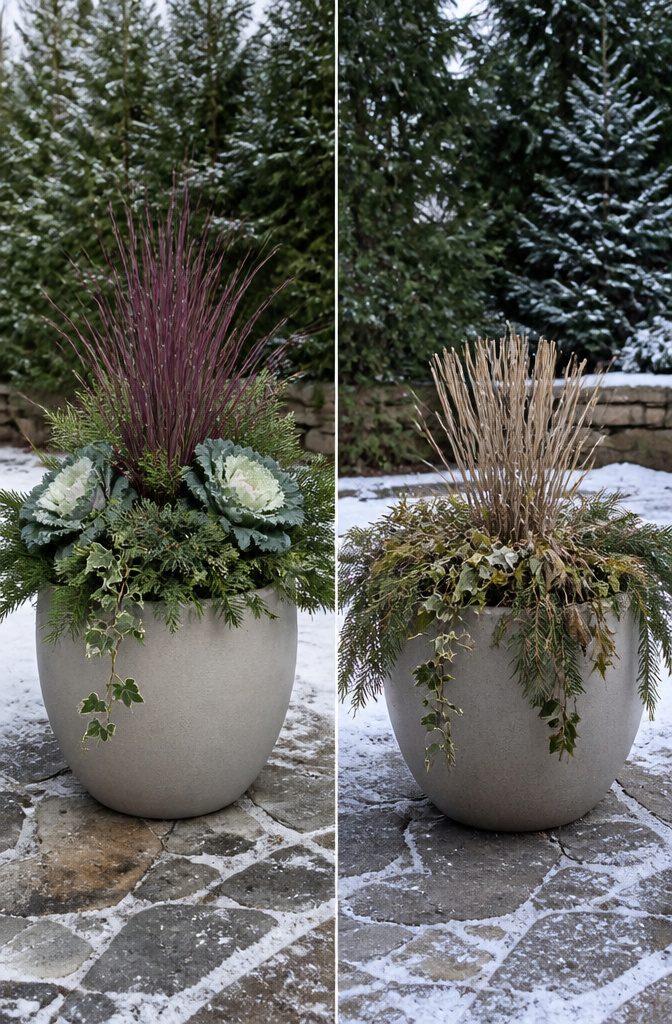
A flat winter arrangement, all boughs cut to the same height and stuck in a pot, reads as a leftover holiday decoration by February. The thrillers, fillers, and spillers formula fixes this because it builds structure first and color second, which matters when most plants have gone quiet.
A 12″ pot fits six plants: one thriller, two fillers, and three spillers. The thriller gives you height where everything else has dropped back, the filler adds the bulk that keeps the pot from reading sparse, and the spiller softens the rim so the whole thing looks grounded rather than perched. In winter, when you are working with pine and spruce boughs, holly, or magnolia leaves rather than blooming plants, that layered shape does most of the visual work. Color is scarce, so balance carries the arrangement.
I secure branches into the soil itself, the same way I would plant living material, because winter winds will lift anything loose. The formula still applies even though nothing is growing; you are building the same three-tier shape with cut material, and the result looks intentional rather than like a grocery store bundle dropped into a bucket.
Thrillers Height and Structure When Everything Else Dormant
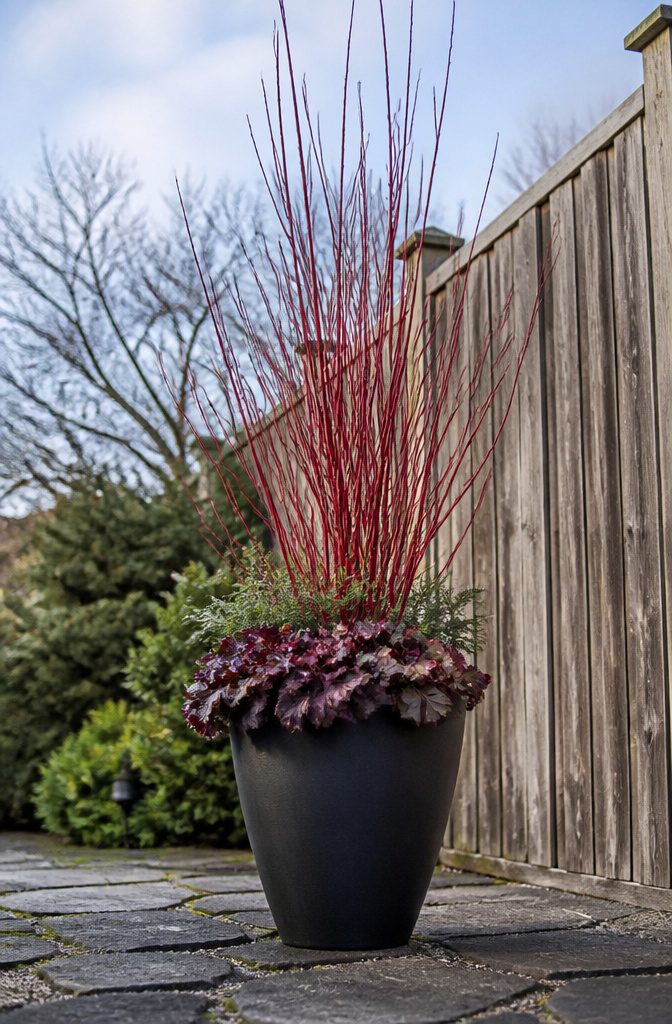
Tall focal points carry the whole arrangement when flowering plants have checked out for the season. Place the thriller in the center for 360-degree viewing, or at the back if the pot sits against a wall. Purple fountain grass gives you that vertical line with its narrow, arching blades, though in my zone it behaves as an annual and needs replacing each spring. Evergreen shrubs like boxwood or holly do the heavy lifting longer term; a spiral topiary from the garden center works as the single star with only minimal filler around the base.
Red twig dogwood branches are the cheat code for winter. You buy them bare at the garden center, stick them deep into the soil, and they give you that shock of color plus height without any root system to nurse through frost. Birch branches add a paler, more textural contrast if the reds feel too loud against your door paint.
The thing that convinced me, reading through enough of these arrangements, is how much visual weight a single vertical element pulls when everything else has dropped leaves or gone brown. Without it, a winter container reads as a low mound of stuff. With it, the eye travels up and the whole pot feels intentional rather than abandoned.
Fillers Bulk and Color Between the Extremes
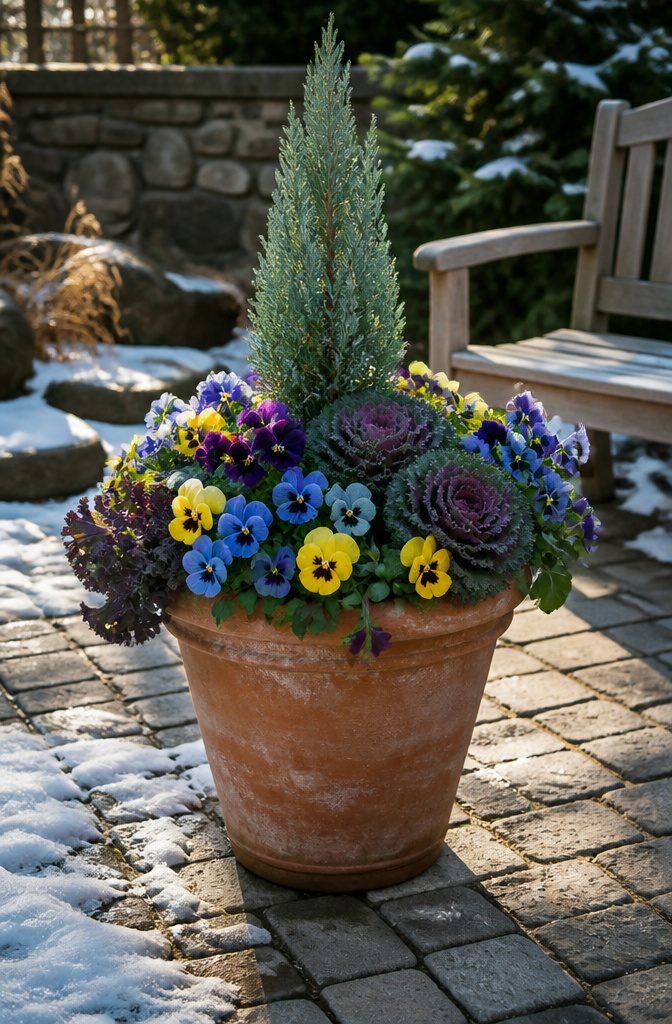
Pansies and ornamental kale are the workhorses I’ve leaned on when the thrillers are set and the spillers are picked out but the pot still looks empty. Their rounded, mounded forms sit midway between the thriller and the pot’s edge, bulking up the middle zone so the arrangement reads as full rather than gappy. Coral bells, Heuchera, do the same job with foliage that holds through cold snaps where flowers give up.
Placement matters more than variety here. These fillers go around or just in front of the thriller, leaving the outer rim free for whatever trails. In a pot where the thriller sits dead center, the fillers ring it; off-center thrillers get them clustered to the front. Either way, they bridge the vertical structure and the cascading edge, softening the jump from tall to trailing so the eye moves through the container instead of stopping at each layer.
Cool-season annuals like pansies and kale won’t always cruise through every freeze unblemished. Some winters they look rough by January and need swapping. Evergreen or semi-evergreen perennials such as Heuchera spare you that gamble, though the color range runs narrower. I’ve used both, and the annuals win for bold color in mild stretches while the perennials earn their keep when I don’t want to fuss through the coldest months.
Spillers Movement Over the Pot Edge
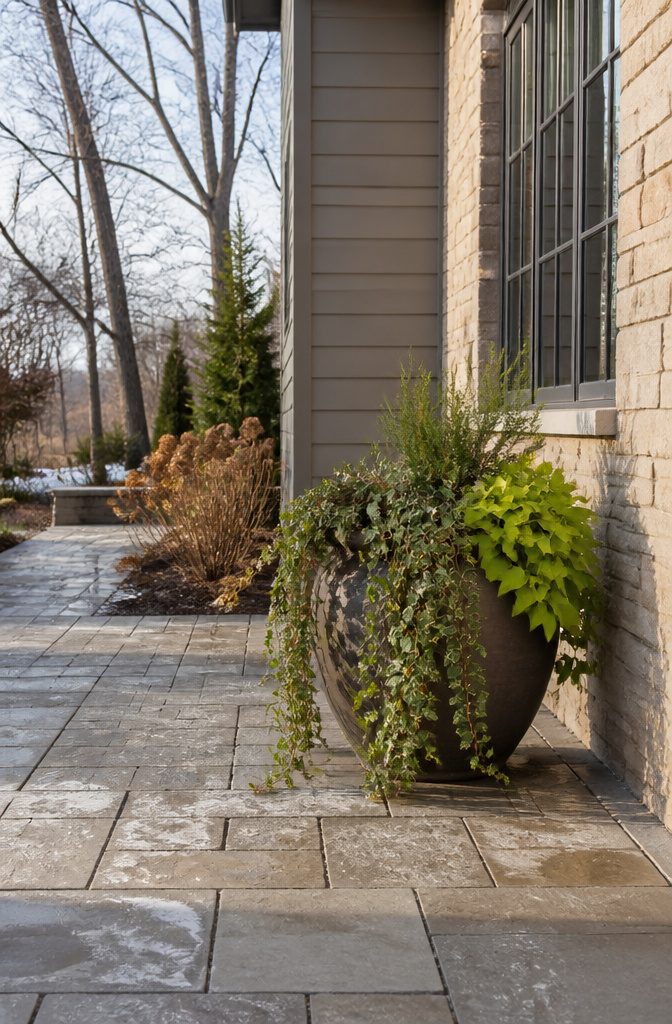
Ivy, creeping jenny, and sweet potato vine each soften the hard rim of a winter pot in their own way. Ivy drapes in long, deliberate ropes that pool on the surface below, while creeping jenny sends out thinner threads of chartreuse that catch low winter light. Sweet potato vine, with its heart-shaped leaves in lime green or deep purple, falls in thicker curtains that can hide the container almost entirely.
The spillers do more than decorate. They break the straight line where pot meets patio, so the arrangement reads as one shape instead of a plant sitting in a vessel. Viewed from above, the trailing growth pulls your eye outward and makes the container look wider than it is. At eye level, the cascade creates depth that a thriller and filler alone cannot manage.
Some of these plants need caution. Creeping jenny and ivy can run aggressively in garden beds, so keeping them contained is often the safer choice. A pot with spillers all around works when you walk around it; planting only the front edge keeps the view clean from one direction. I have seen variegated ivy pull together a whole arrangement that otherwise sat flat, the white edges catching gray winter light and giving the eye somewhere to travel.
Plant Selection for Cold Tolerance
The three roles do not disappear in winter. They shift to what survives when the thermometer drops.
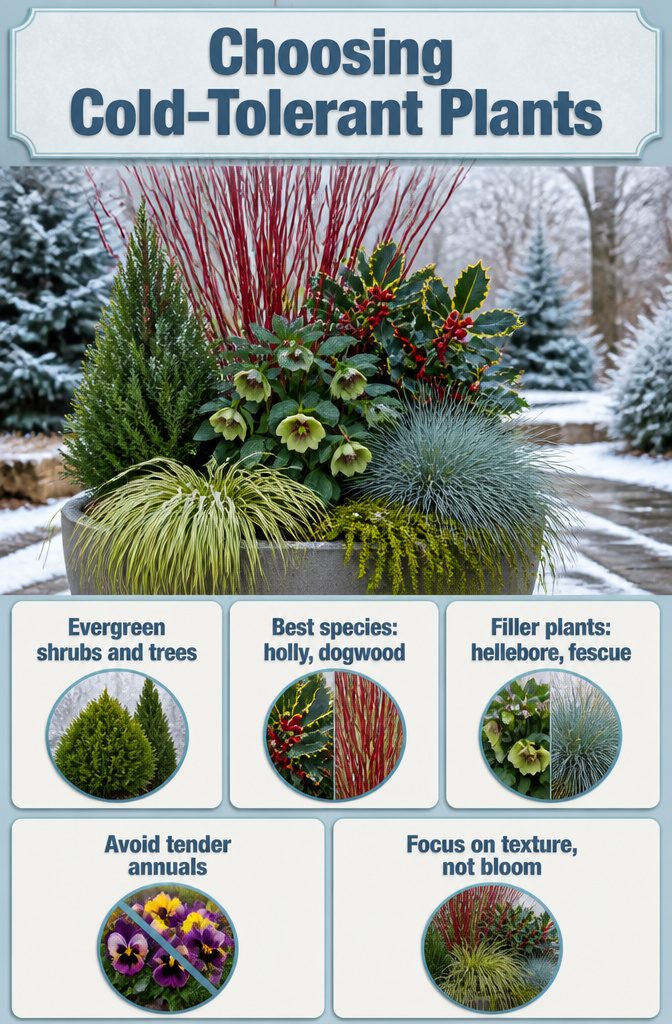
Evergreens are the name of the game for winter containers. That is not limited to trees; evergreen shrubs, perennials, grasses, ferns, and vines all keep their structure through freeze and thaw. A holly bush or red twig dogwood branches can carry the thriller height. Blue fescue, hellebore, or coral bells fill the middle. For spill, carex or golden mop cypress softens the edge with color that reads even under gray skies.
What to leave out: the tender annuals that carried your summer pots. Pansies and snapdragons work for fall color but do not count on them lasting once hard frost arrives. The same container that looked abundant in October can turn to wet mush by January if you lean too hard on cool-season annuals.
What convinced me, reading through a dozen of these arrangements, is how much the winter formula depends on texture over bloom. The Cheekwood example that stuck with me layered deep purple dogwood twigs against chartreuse carex and medium-green hellebore. No flower in sight, and it still reads as designed.
The mistake I would have made my first season: assuming thrillers had to be upright evergreens alone. Branches cut from a shrub in your own yard cost nothing and give the same vertical lift. The filler and spiller choices are what keep it from looking like a holiday decoration you forgot to take down.
Arrangement Tips Based on Viewing Angle
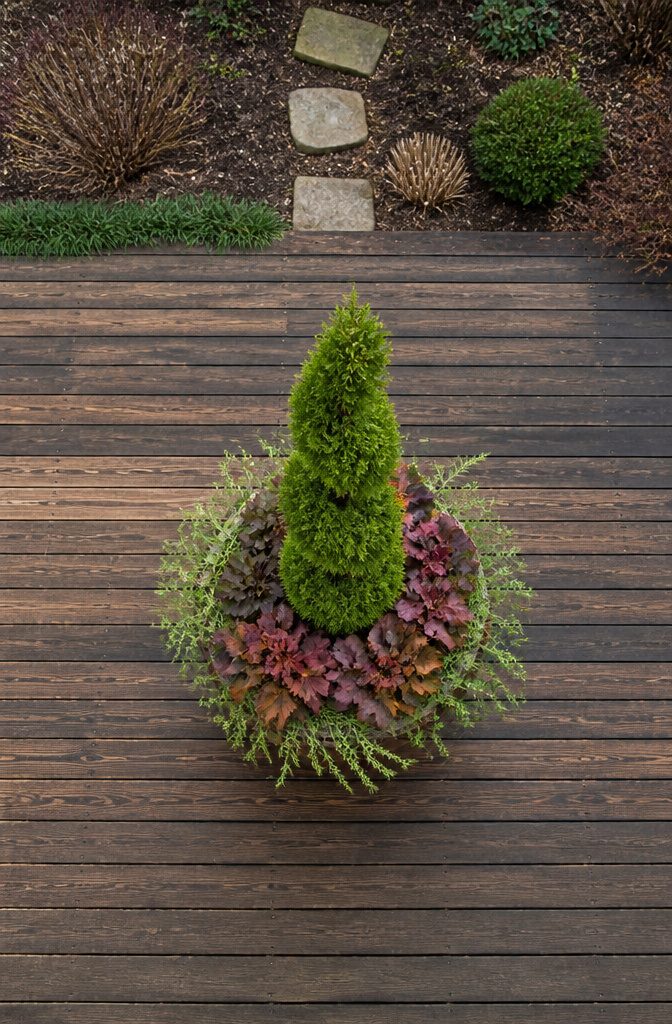
The thriller belongs either dead center or at the back edge, and that choice depends on where someone will stand to look. For a pot that sits on a porch step or in the middle of a patio where people walk all around it, centering the tall element gives every angle something to orbit. Against a wall, the thriller goes in back, with fillers shifted forward and spillers queued at the front lip.
Fillers take the space between thriller and rim, rounded enough to read as volume without stealing the vertical line. Spillers want the actual edge, not near it, because their whole job is to break that hard rim and let the planting look like it grew there instead of being staged.
This is where the method earns its keep in winter, when a container has to carry more visual weight to compete with bare ground and flat light. The structure stays the same even as the plant names change.
"The thriller is your bold focal point that adds the wow and grounds the arrangement; the fillers weave around it to provide lushness, fullness, and visual cohesion; and the spillers trail over the edge, softening the look and adding a sense of movement."
Knowing which role each plant plays means you can place it once and trust the sight line to hold until spring thaw.
Frequently Asked Questions
What is the thriller, filler, spiller method?
It is a formula for designing container gardens using three plant roles: a tall focal point (thriller), mid-height plants that add bulk (fillers), and trailing plants that soften the rim (spillers). In winter, this same structure works with cut branches and evergreen material instead of blooming plants. The layered shape carries the arrangement when color is scarce.
Do all container gardens need a thriller, filler, and spiller plant?
No, it is a guideline rather than a strict rule. Some containers may rely more heavily on dramatic foliage or trailing plants alone. The goal is balance and visual interest, not a mandatory three-part formula.
How do I keep my winter container garden looking good?
Choose cold-hardy material such as evergreen shrubs, branches, and perennials rather than tender annuals that collapse after hard frost. Secure all branches deep into the soil so winter winds cannot lift them. Check cool-season annuals like pansies during mild stretches and swap them if they deteriorate.






