
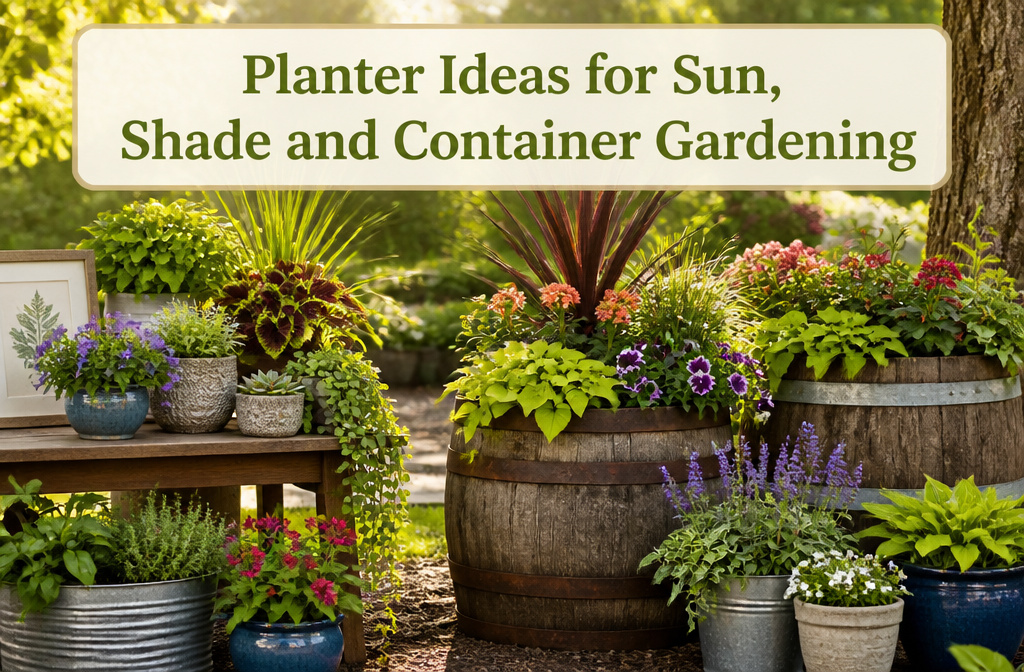
The right planter ideas depend on whether your spot bakes all afternoon or stays cool and dim, and getting that match wrong wastes the whole season.
A 10-inch pot in July heat can dry out twice daily and stall a tomato plant before it ever fruits, while the same container in shade might drown roots with half the waterings.
What separates a finished arrangement from a half-empty pot is the thriller-filler-spiller geometry, and that formula scales from a 12-inch balcony container to a whiskey barrel without changing shape.
1. Thriller, Filler, Spiller Method
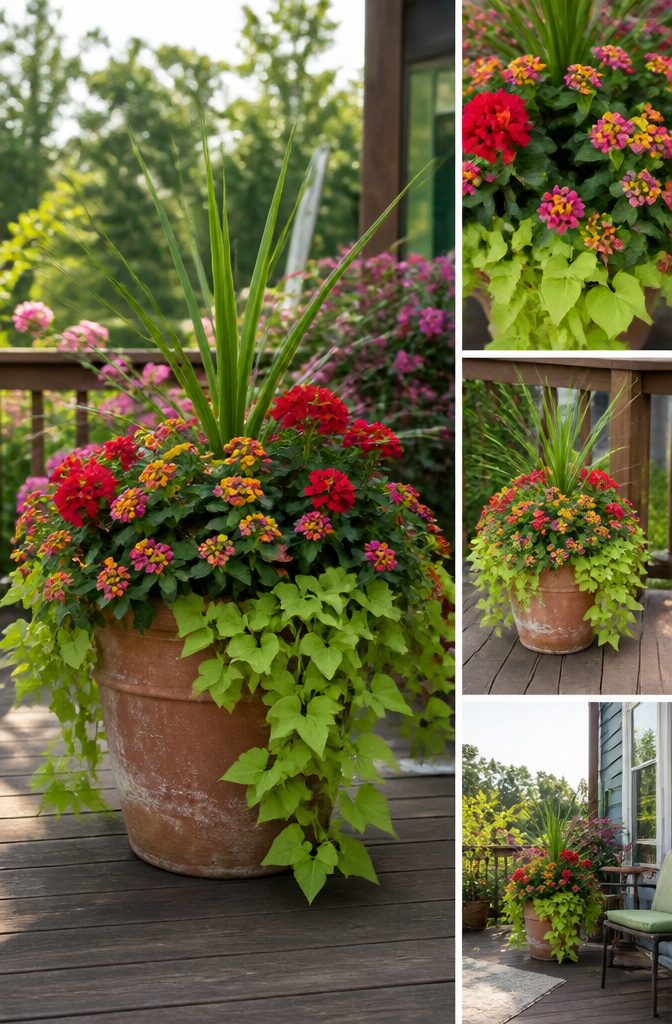
The thriller, filler, spiller method is the three-part formula most nursery designers rely on, even if they never name it out loud.
One tall plant gives the arrangement its backbone and height, medium plants fill the middle with color or bulk, and trailing plants soften the edges by spilling over the rim.
Together they read as a finished piece from the day you set them in place, not a half-empty pot waiting to grow up.
A thriller might be a calla lily or a grass for vertical structure. Fillers like lantana or geranium occupy the middle ground.
Spillers such as sweet potato vine, creeping Jenny, or asparagus fern cascade down to hide the container’s hard lines. The balance matters more than the particular plants: height in back or center, body around it, flow over the sides.
What convinced me, looking through how the pros build these, is that the formula works in a 12-inch balcony pot or a whiskey barrel with equal ease. The scale changes; the geometry does not.
2. Best Plants for Full Sun
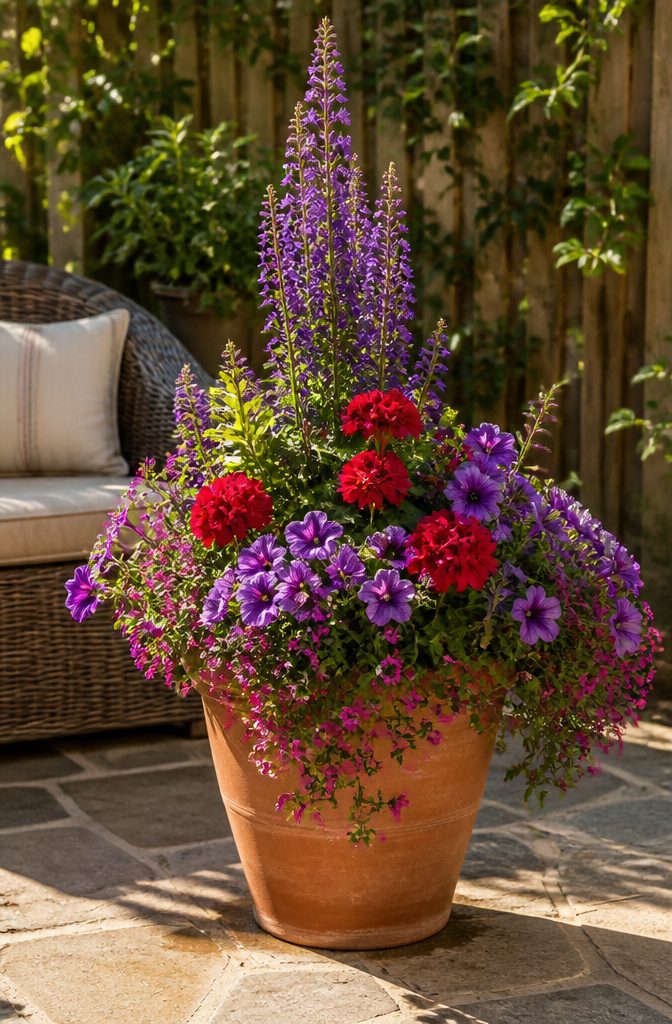
A south-facing patio in summer can punish a container fast, so the plants inside need real heat tolerance. These four have held up for me in direct sun:
- Spike gives the pot its backbone. The upright, grassy form works as a thriller in almost any arrangement, and it barely notices 95-degree afternoons.
- Purple Wave Petunias fill space with long-blooming color. The "Wave" series specifically; standard petunias fry where these keep going.
- Geraniums take midsummer heat and bloom for months if you pinch off spent flowers. Deep red reads as classic, though pink or white soften the look.
- Calibrachoa (mini petunias) trail and rebloom without the deadheading. They handle the same reflected heat that wilts larger-flowered cousins.
One caveat: afternoon sun west of the Rockies or in the Southwest changes the math.
What counts as "full sun" in Ohio becomes scorched soil by 3 p.m. in Arizona. In those zones, spike and geranium still hold, but the petunias want partial shade during peak hours or they stop flowering until evenings cool.
3. Best Plants for Partial Shade
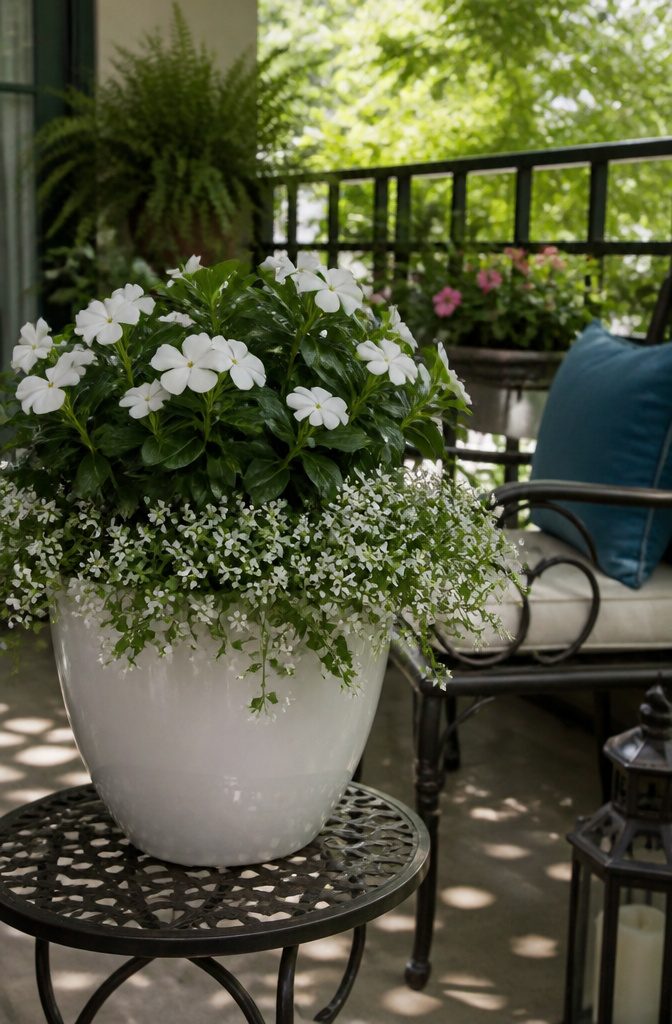
Partial shade means your planter gets roughly 3 to 5 hours of sunlight, but the timing matters more than the total.
Morning sun blocked by a neighboring building, dappled light filtering through a tree canopy, or an east-facing balcony that goes dark by noon all count.
The light is bright enough to read by, yet soft enough that leaves never feel hot to the touch.
I keep two plants on standby for these conditions, because they forgive the guesswork:
- Diamond Frost works as a spiller, sending out airy white blooms that read as mist against darker foliage. It wants steady moisture but bounces back from a missed watering better than most annuals I’ve tried.
- Vinca Vine fills the same trailing role with glossy, dark leaves that look sharp against lighter planters. The sources list it as a backup when Mezoo Trailing Red is out of stock, which happens often enough that I’ve learned not to count on finding the Mezoo.
Both handle the swing from a few hours of direct morning light into full afternoon shade without dropping buds or stretching toward the sun.
That adaptability matters on a patio where the light shifts with the season as the tree canopy fills in.
4. Best Plants for Full Shade
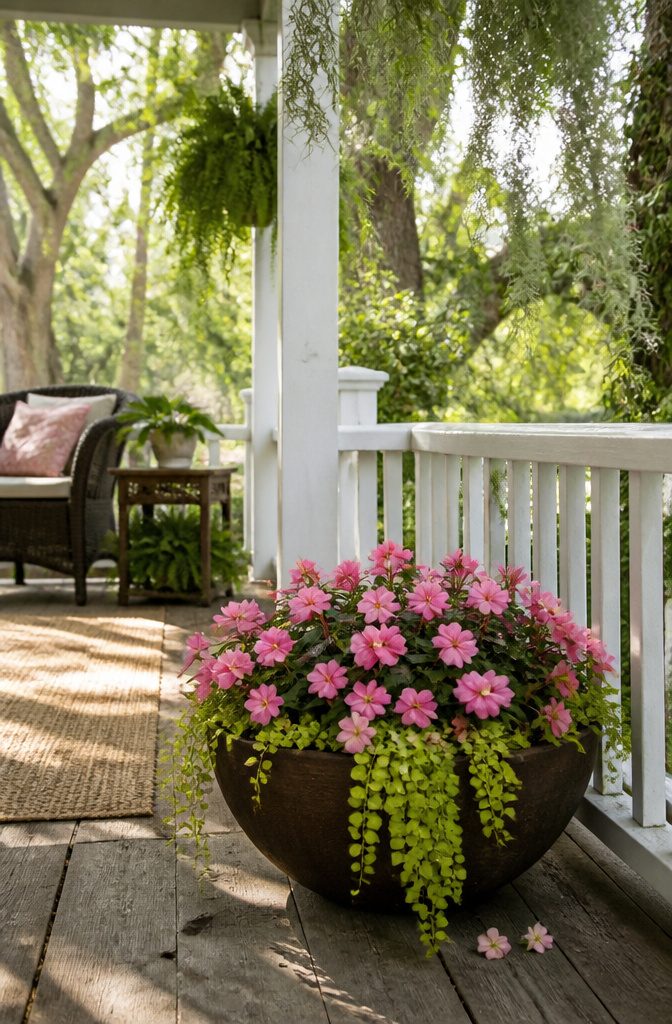
Full shade still gets light, just not direct sun.
A north-facing wall, a covered porch, or a spot under dense tree canopy can work if the space stays bright enough to read a newspaper during the day. Without that indirect light, even shade plants will stretch and stay thin.
These two have worked reliably for me in those conditions:
- Impatiens – the classic filler for porch pots. Standard varieties handle deeper shade than New Guinea types, which want more sun to keep blooming. I use the pink ones against white railings where they get reflected light but never a direct ray.
- Jenny (Lysimachia) – a chartreuse spiller that trails over the edge of tabletop bowls. The color pops in dim corners where darker foliage disappears. It fills fast, so I trim it back before it smothers its neighbors.
One warning from experience: creeping Jenny escapes.
I only grow it in containers, and I still check weekly that stems haven’t rooted where they touch soil. In beds it turns invasive fast.
5. Unique Planter Ideas
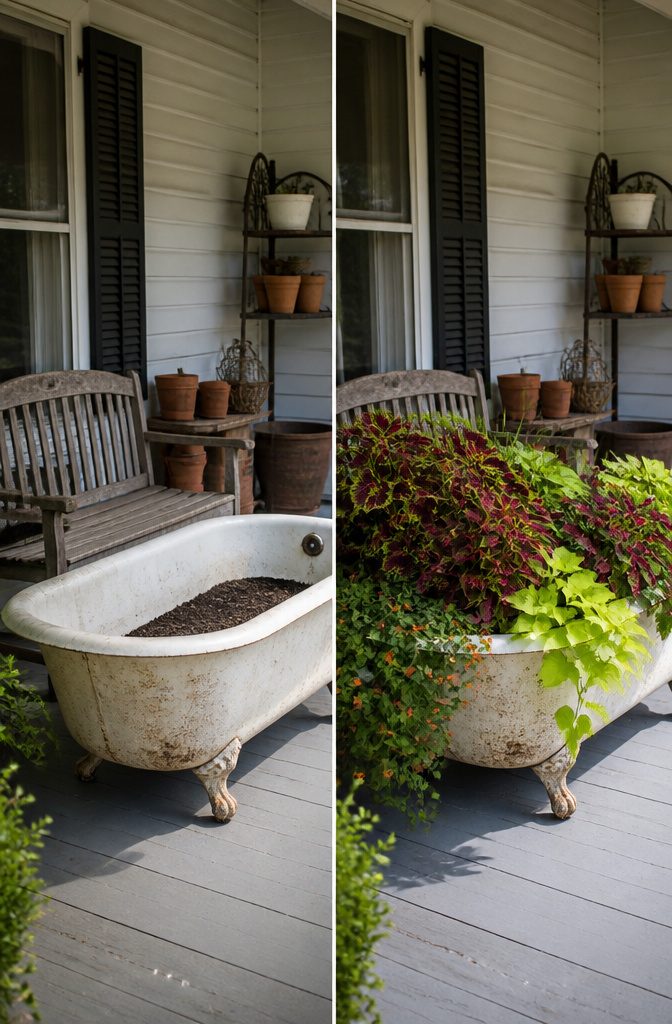
The most interesting planters in my neighborhood last summer were the ones that started life doing something else entirely.
An old clawfoot tub on a front porch in Albany held a small jungle of coleus and sweet potato vine, and a pair of painted tires stacked along a driveway in Richmond were spilling over with dwarf zinnias.
What these projects share is the work of turning a found object into something that keeps plants alive.
Any solid container needs drainage holes, and most repurposed pieces do not come with them.
A standard half-inch drill bit works through metal toolboxes and enamel bathtubs; tires need holes bored through the sidewall with a spade bit or simply left open at the top if they are cut into a U-shape and lined.
Without drainage, roots sit in water and rot within days of the first hard rain.
Weight matters more than people expect. A cast-iron tub filled with damp potting mix can exceed 300 pounds and will mark or crack a wood deck.
Tires are the exception; at roughly 20 to 30 pounds empty, two people can roll them into place and roll them back for winter. Toolboxes split the difference.
A 19-inch steel model holds enough soil for annuals but still lifts when the season ends. Mobility is worth planning for: nothing that heavy should sit where you will need to move it to sweep or repaint.
6. Container Gardening Tips
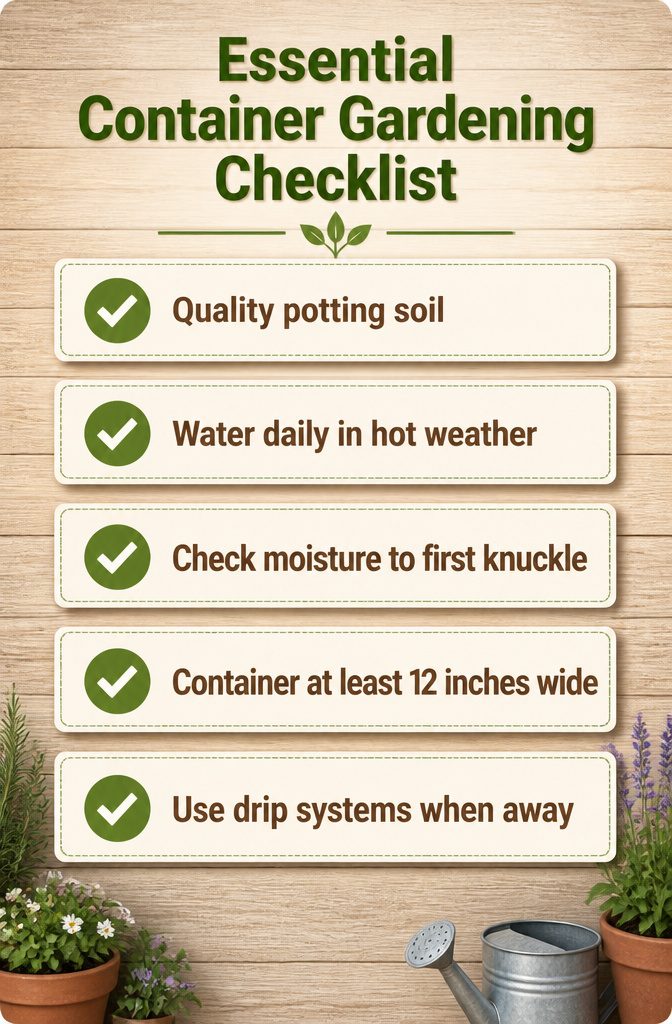
Quality potting soil matters more than the container itself. Garden soil compacts in a pot, choking roots and blocking drainage; a bagged potting mix stays light enough for roots to spread.
Espoma Organic Potting Mix or Miracle-Gro Potting Soil with Moisture Control are two I’ve had consistent luck finding at hardware stores and garden centers.
Most containers need watering once a day in hot weather, especially smaller pots.
A finger check to the first knuckle tells the story: dry means water now. Drip systems save the guesswork if you’re gone weekends.
Size sets the limit. A container should be at least 12 inches wide for most flowers or vegetables.
Anything smaller dries too fast and leaves roots crowded. I learned that with a 10-inch pot of cherry tomatoes that never fruited; the plant spent all summer struggling instead of producing.
7. Seasonal Planting Ideas
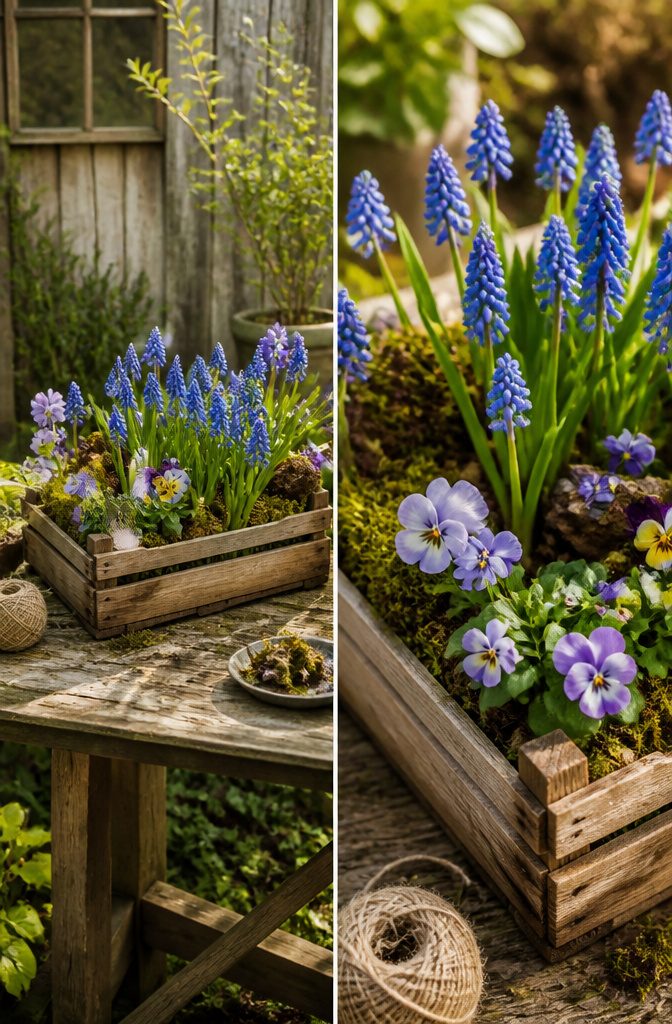
Spring cool-weather starts belong to the bulbs that need that six to eight weeks of cold exposure.
Grape hyacinths grouped tight in a crate with violas underneath give you the earliest color, and the wood and moss soften the whole thing enough that the cool palette doesn’t read as cold.
Overwinter the crate in a cool, dark spot and pull it back out in January rather than rebuilding from scratch.
Summer is where I swap. The pansies or muscari foliage comes out, and in go the heat survivors: pincushion flower, lantana, petunias.
What stays is the evergreen base, English ivy or whatever you’ve got acting as your permanent understory. That continuity saves money and root space.
Fall transition pots can reuse that same structure. The ivy keeps its shape while you slot in whatever’s finishing at the nursery.
Winter interest in mild zones means leaning on structure and what you’ve already grown. The violas self-seed if you left them.
The bulbs return. The crate comes back out.
What I actually replace versus overwinter comes down to root crowding and whether the summer annuals left anything worth saving. Most years, the ivy and the crate survive; the flashy stuff gets composted.
Plant Combinations
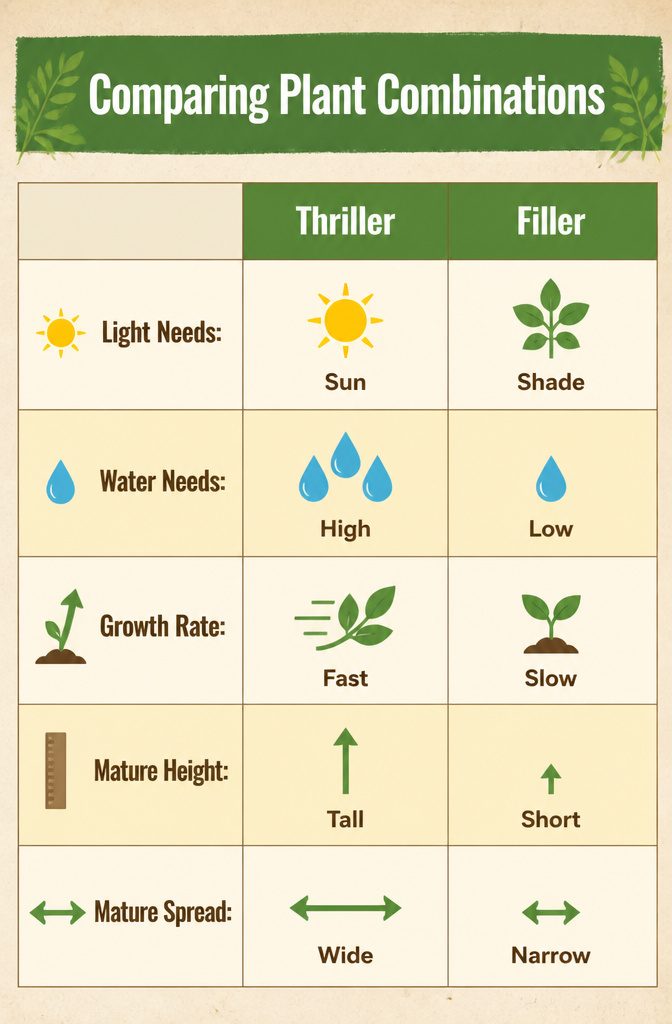
Thriller-filler-spiller only works when the three players share the same conditions. Last spring I matched a sun-hungry spike with a shade-craving coleus, and by July the coleus had melted to pale strings while the spike baked in reflected heat.
Group plants by their light, water, and growth-rate needs before you ever think about height.
Water compatibility matters as much as sun. A thirsty filler like impatiens will sulk or rot if paired with a succulent spiller that wants dry soil between drinks.
Growth rate is the quieter killer: a fast, mounding petunia can swallow a slow thriller before the thriller ever gets its vertical act together. Read the tags for mature spread and pace, not just bloom color.
The framework is simple.
Pick your thriller first, since it sets the scale. Choose a filler that reaches half to two-thirds that height and spreads at a similar clip.
Add a spiller whose stems move at the same speed as the filler’s expansion. When all three match in care and tempo, the pot fills in evenly instead of becoming a rescue mission by August.
Container Selection
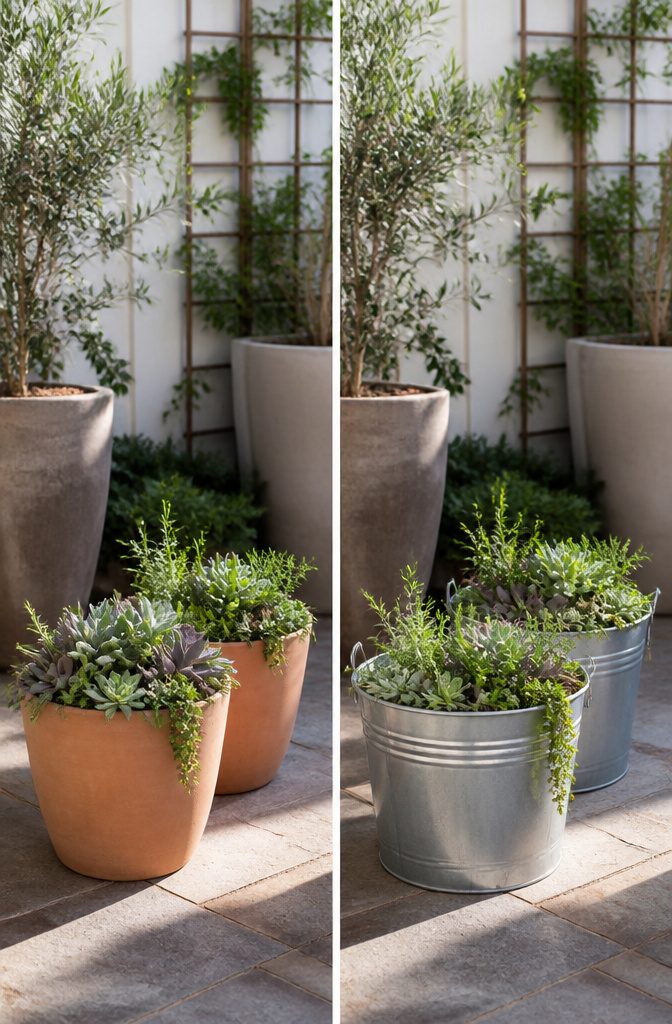
A container that is too small in summer heat is a root oven. I learned this the hard way with a 10-inch pot that dried out twice daily in July.
The soil mass simply could not hold enough moisture to get from morning watering through afternoon sun. Twelve inches is the practical floor for most annuals and leafy herbs; anything smaller demands either constant attention or plants bred for abuse.
Material matters more than color.
Terracotta breathes, which sounds good until you realize it is pulling water away from roots faster than the plant can drink. In 90-degree weeks, unglazed clay can need water twice as often as plastic.
Plastic holds moisture and stays cool to the touch, though cheap pots grow brittle after two seasons of UV. Wood splits eventually, but cedar or redwood buys you several years and insulates roots better than either clay or resin.
Drainage holes are non-negotiable.
Drill through wood, plastic, or fiberglass with ordinary bits. Clay takes a masonry bit and a light touch; squeeze too hard and the pot cracks from the vibration.
Saucers underneath save the deck but breed mosquitoes if water sits more than a day. I leave them off in peak summer and let runoff fall where it may.
Maintenance Tips
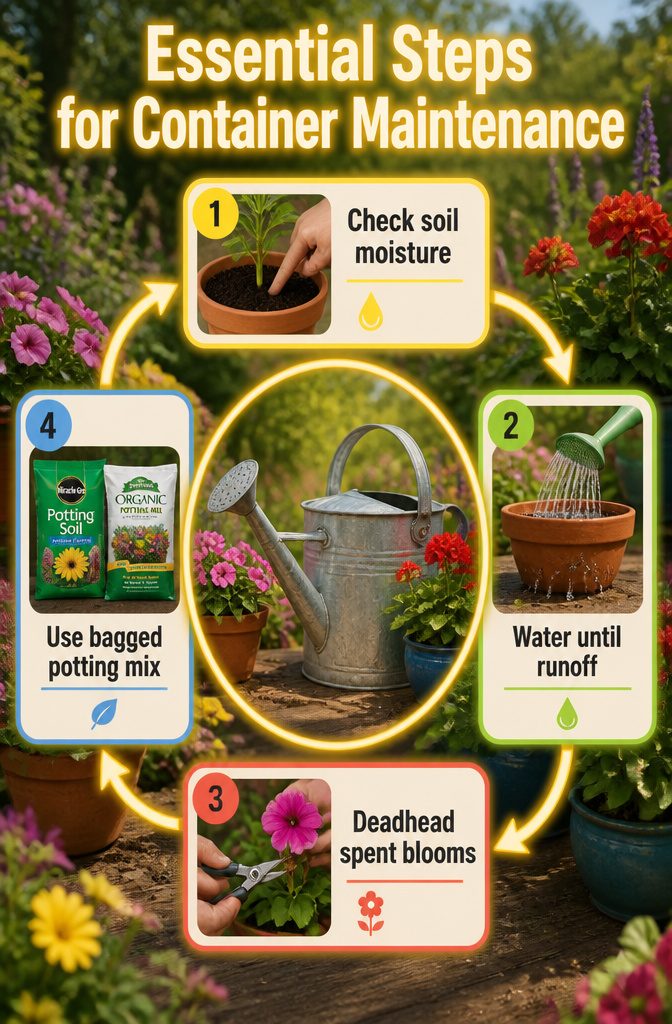
A container garden lives or dies on three habits, and I learned the hard way that skipping one undoes the other two.
- Check soil moisture with your finger, not your eyes. I push my index finger two inches down near the stem. Dry potting mix feels light and crumbly, almost dusty between my fingers. If it still clings or feels cool, I wait. In July heat, that check happens every morning. In milder stretches, a pot that held water yesterday gets a pass today.
- Water until it runs from the drainage holes. A quick splash on top teases roots upward and leaves the bottom half parched. I count to ten on each pot, moving slowly.
- Deadhead before seeds form. Snipping spent blooms just above the next leaf node keeps a plant putting energy into flowers instead of finales. Petunias and geraniums especially turn sullen without it.
- Start with bagged potting mix, not backyard dirt. Garden soil compacts in a pot, choking roots and trapping water. I have used both Miracle-Gro Potting Soil with Moisture Control and Espoma Organic Potting Mix. The first buys me a half-day of grace if I miss a morning; the second suits herbs I plan to eat. Either beats the clay I tried once from behind my garage.
Color Schemes
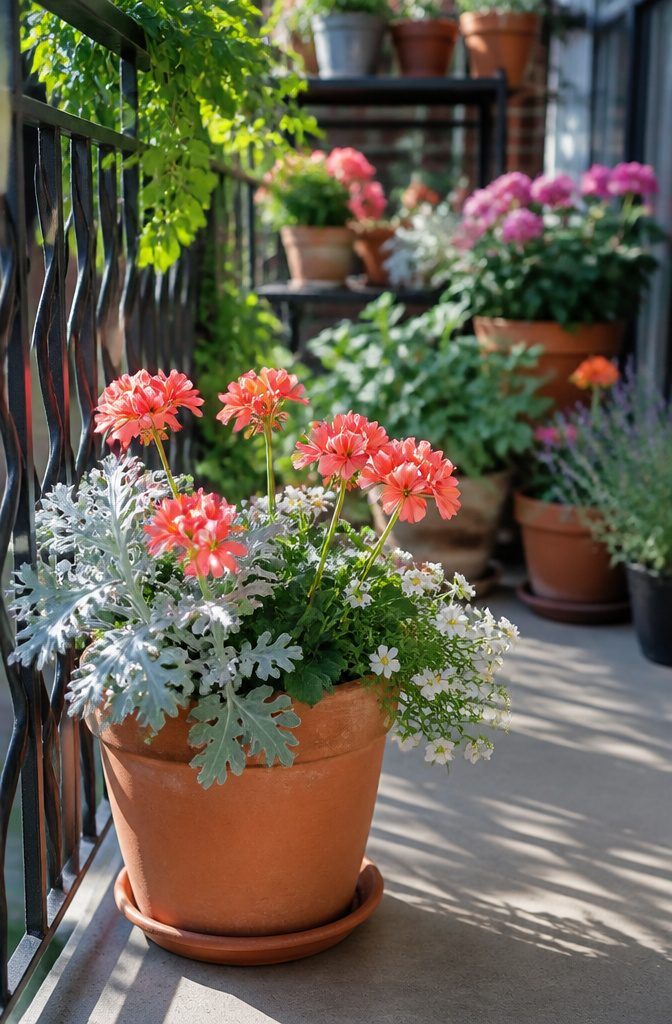
Pinks, blues, and purples settle together without fighting for attention, while reds, oranges, and yellows need space between them or they glare.
White, silver, pale yellow, and chartreuse will bridge almost any gap. The container itself counts as color too; a terracotta pot warms everything in it, and glazed cobalt can turn into the loudest voice in the arrangement.
My first season I planted one of each bright thing I could find: coral geranium, scarlet dianthus, electric blue lobelia, and a yellow marigold that practically buzzed.
From the sidewalk it looked like four arguments happening at once. No shape read, no flower stood out, and the whole pot seemed smaller than it was.
I pulled three plants and kept the coral geranium with a silver dusty miller and a white bacopa. Suddenly there was a shape, a depth, a reason to look.
Threading a single color through different plants does the same work a scarf does with an outfit.
Purply pink pineapple lilies echoed in calla lilies, with oregano bloom edges picking up the note again. The repetition lets the eye rest and move at the same time.
Frequently Asked Questions
What are the best plants for container gardening?
The best plants for container gardening are ones that match your light conditions and won’t outgrow their pot. For full sun, try spike, Purple Wave petunias, geraniums, and calibrachoa.
Partial shade suits Diamond Frost and vinca vine, while full shade calls for impatiens and creeping Jenny. Group plants by their shared needs for sun, water, and growth rate before you worry about height or color.
How often should I water container plants?
Most containers need watering once a day in hot weather, especially smaller pots.
Check soil moisture by pushing your finger two inches down near the stem; dry and crumbly means water now, cool or clingy means wait. Water until it runs from the drainage holes, not just a quick splash on top.
Do containers need drainage holes?
Yes, drainage holes are essential to prevent waterlogged roots and rot.
Drill a standard half-inch hole through metal, wood, or plastic; clay needs a masonry bit and a light touch. Without drainage, roots sit in water and rot within days of the first hard rain.
Can I use garden soil in containers?
No, garden soil compacts in a pot, choking roots and blocking drainage.
Use a bagged potting mix that stays light enough for roots to spread. Espoma Organic Potting Mix or Miracle-Gro Potting Soil with Moisture Control are two widely available options that work well.






