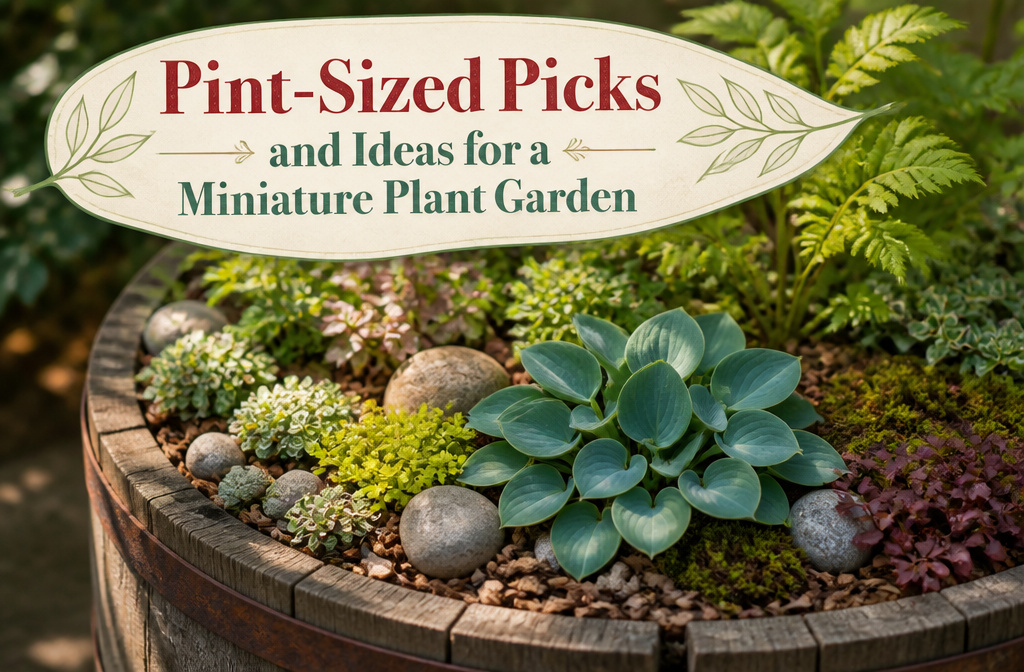
A miniature plant garden lives or dies by scale, and the wrong plant will colonize a whiskey barrel until its neighbors disappear entirely. The difference between a scene that holds and one that collapses by July is knowing which varieties stay genetically small rather than merely young. ‘Blue Mouse Ears’ hosta tops out at eight inches; anything taller reads as a shrub and throws off the whole composition.
1. Miniature Hostas
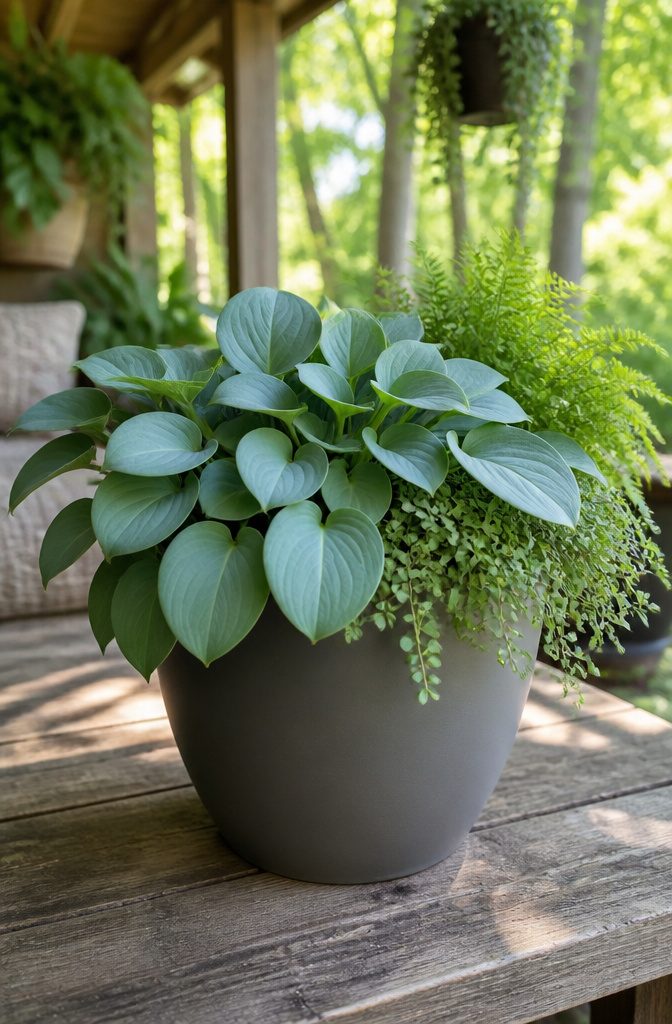
Hostas in a miniature garden live or die by scale, and ‘Blue Mouse Ears’ tops out at 8 inches, which is exactly the ceiling you want. Anything taller reads as a shrub in a small container and throws off the whole composition. I learned this the hard way with a standard hosta that looked modest at the nursery but colonized a whiskey barrel until the surrounding saxifrage disappeared entirely.
The compact habit of miniature hostas is only half the story. Their shade tolerance opens up real estate under a porch overhang or on the north side of a balcony where sun-hungry miniatures wilt by July. The foliage carries structure too; those rounded leaves give the eye something solid to rest on between finer textures like creeping thyme or small ferns.
Placement matters more than you’d think. I keep mine toward the middle of a container, not the edge, so the leaves arch over neighboring plants rather than flatten them. In my zone 6 patio, one ‘Blue Mouse Ears’ has survived three winters in a 10-inch ceramic pot with standard potting mix and no special protection.
2. Dwarf Conifers
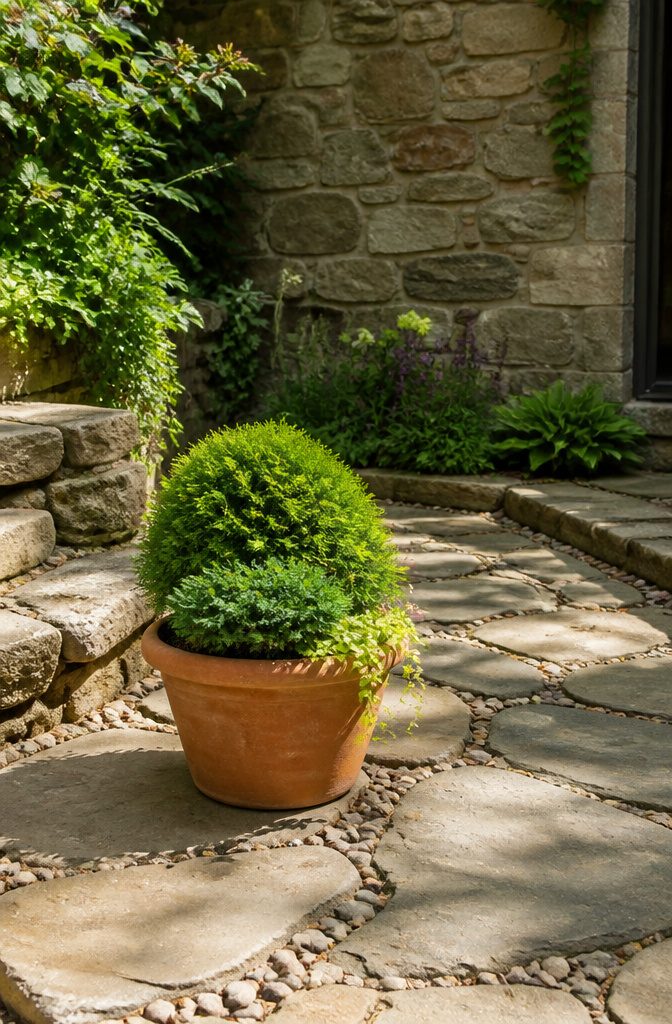
A miniature garden without something green in January looks like a tray of dirt. That is where dwarf conifers earn their keep as the bones of the planting.
I started with Dwarf Hinoki Cypress ‘Just Dandy’ and Miniature Juniper ‘Miniature’ for exactly this reason. Both stay under a foot tall for years, growing so slowly that you will not need to replace them season after season. The Hinoki carries soft, fan-shaped sprays in a tight mound; the Juniper spreads low and dense, more like a mossy rug than a shrub.
Perennials in a small garden disappear entirely after frost. Hosta leaves melt, tiny flowers finish, and suddenly your careful scene is a collection of pots waiting for spring. Conifers do not do that. They hold color and mass straight through the gray months, giving the eye something to land on while everything else sleeps.
Place one toward the back or center of your container, depending on its shape, and build the rest of the planting around it. That evergreen anchor makes the miniature garden read as a real landscape in miniature rather than a summer-only novelty.
3. Miniature Perennials
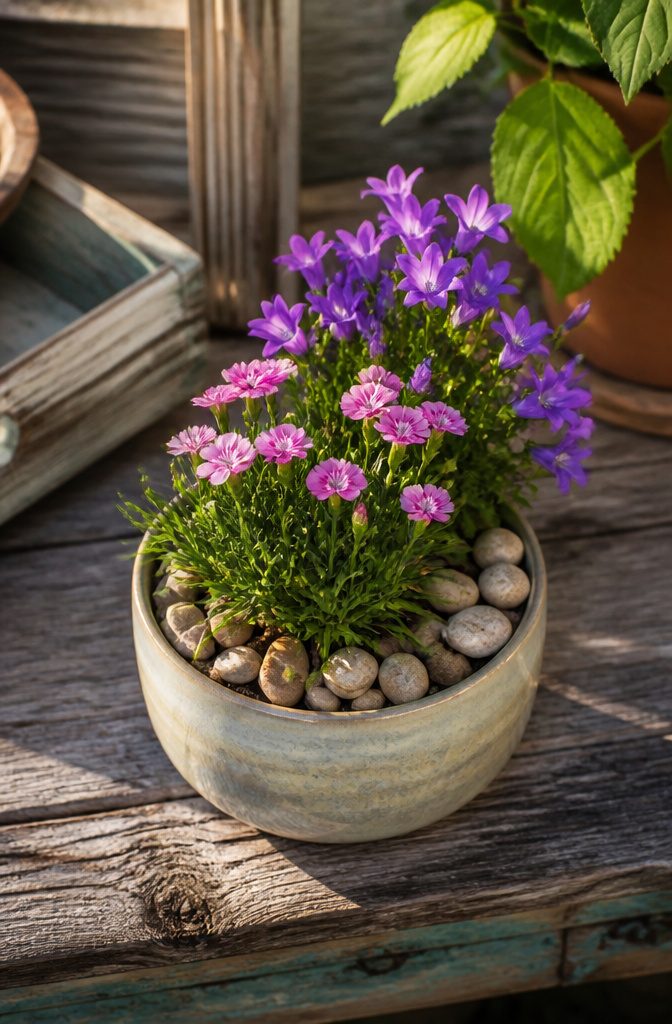
Most perennials sold at garden centers are bred for border beds and will outgrow a miniature garden within a single season. A standard coral bells or dwarf aster still wants twelve to eighteen inches of elbow room, and in a small container that means constant dividing or watching one plant swallow the whole design. What convinced me, reading through a dozen growing guides, is that mature height under six inches and a clumping habit matter more than any flower color.
Clumping roots stay where you put them. Spreading runners, even slow ones, become a yearly excavation job in a pot barely wider than a dinner plate. I now look for varieties described as tight mounds or cushion-forming, the kind that return each spring from the same crown without sending scouts across the soil surface. The rebloomers are harder to find at this scale, but they exist: small campanulas, certain dianthus, and the lower-growing thrift varieties can give you two or even three waves of flower in a season if deadheaded promptly. Skip anything labeled "vigorous" or "fills in quickly." In a miniature garden, that energy is a problem, not a virtue.
4. Ground Covers
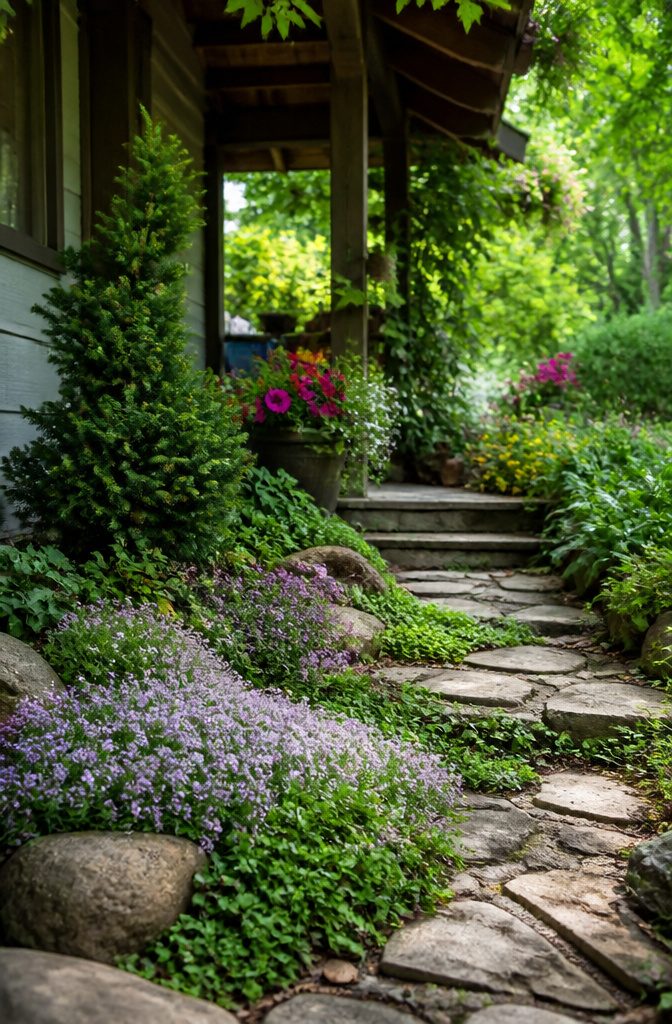
Woolly thyme and creeping thyme earn their keep in a miniature garden by doing the jobs you did not think to assign. Planted between stones or tucked at the base of a dwarf conifer, they spread into a low mat that blocks weeds and keeps soil from drying out, the same work a layer of bark mulch would do except this mulch stays alive. The foliage stays tight to the ground, rarely climbing past two inches, so it never overwhelms the scale of the scene you are building.
I brush past my own patch nearly every morning with the hose, and the scent still stops me. It is resin and summer heat, not perfumed or sweet, and it lingers on your fingers if you touch the leaves. That makes creeping thyme worth routing a fairy garden path through; it tolerates light foot traffic without dying back to bare stems, and the texture underfoot is softer than gravel. Woolly thyme is the fuzzier of the two, with silvered leaves that read as moonlit in the right light, though it is slightly less tolerant of being stepped on. Either one handles a container through winter in the zones where they are hardy, which saves the replanting that annual ground covers demand.
5. Fairy Garden Plants
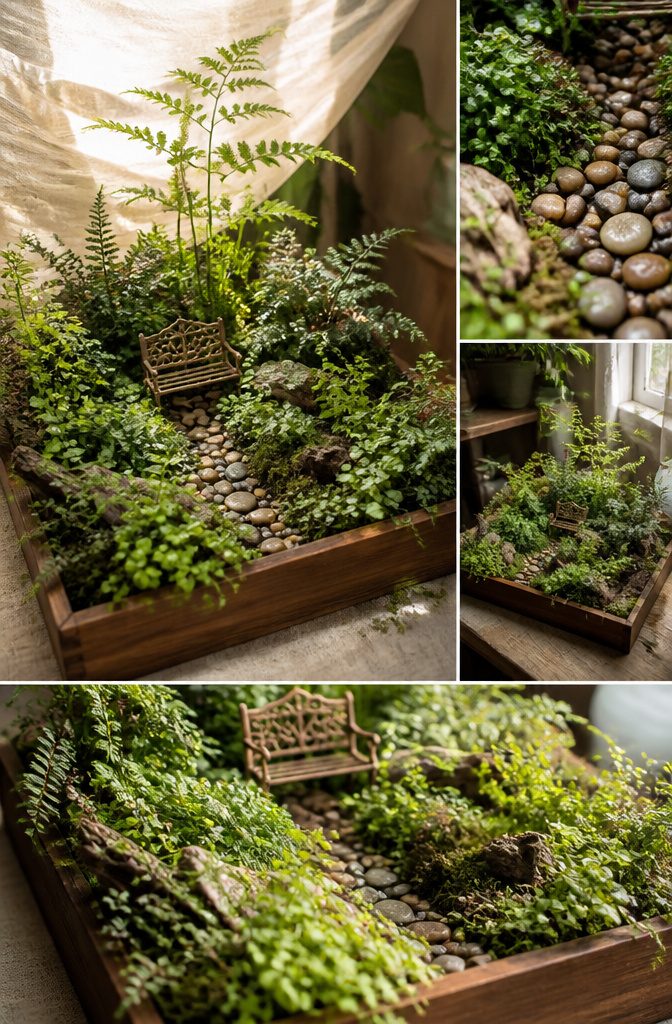
The smallest-leaved plants read as full-sized trees when you drop to fairy scale. Baby tears, creeping thyme, and dwarf mondo grass fill in the understory; a single tiny fern becomes a prehistoric canopy overhead. What breaks the spell is a six-inch plastic bench parked beside a two-inch stem: the accessory dwarfs the "tree," and the eye snaps back to reality. I learned this the hard way after planting a crevice garden with a miniature arbor that turned out to be garden-center "fairy" size, not true 1:12 scale. The arbor looked like a bus shelter. True miniature garden accessories, or at least pieces sized to your chosen ratio, keep the illusion intact. Two Green Thumbs and a few specialty mail-order growers ship plants that top out under four inches; local garden centers may push young plants that outgrow the pot in a season, so the plant list matters more than the "fairy garden" endcap label. Match the plant’s mature spread to your accessory’s door height, not its current nursery size, or you will be editing with scissors by July.
6. Succulents
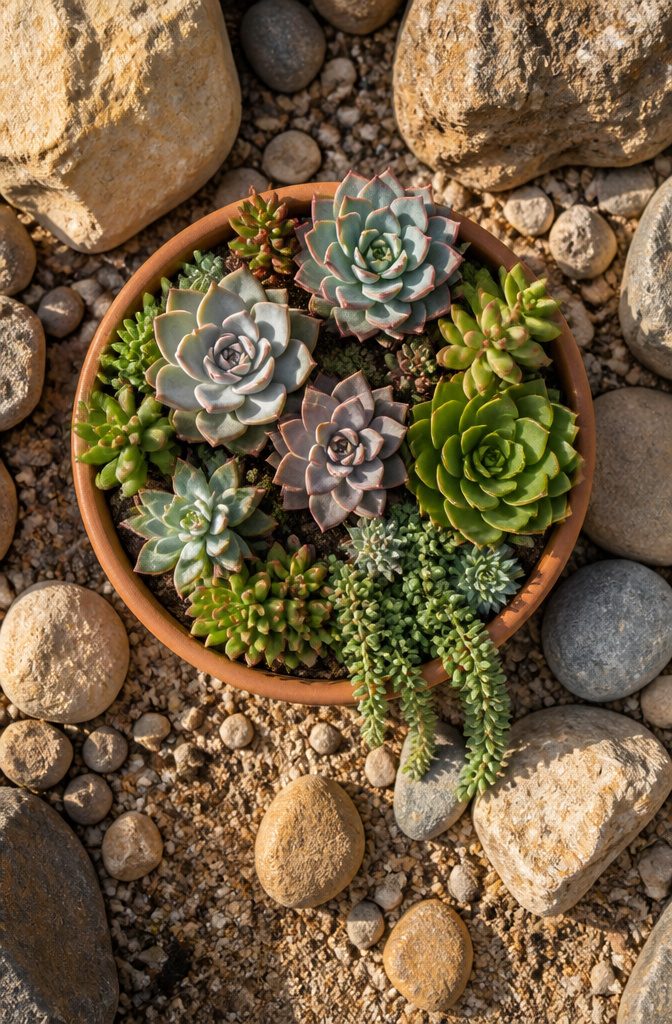
Succulents read as living sculpture at three inches tall, which is why they anchor most of my miniature plantings. Their slow growth and low water needs mean a tiny container stays balanced for months without the constant pruning herbs demand. The architectural forms help too: echeveria rosettes mimic shrubs, while trailing sedum softens edges like ground cover.
The maintenance reality is less forgiving than the marketing. Most varieties winter hardiness stops around USDA Zone 6 in containers, since root balls freeze harder than soil in the ground. I lost a pot of haworthia one January in Zone 7 when rain soaked it before a cold snap; the cells burst, and the plant turned to mush. Humid summers bring the same risk from overwatering, especially in shallow dishes without drainage. I let the soil stay dry three days past what feels right, then water sparingly. Rot sets in fast when roots sit wet in cramped quarters.
For beginners, start with sedum or jade. They forgive the learning curve on moisture, and their woody stems give structure that softer succulents lack.
7. Miniature Trees
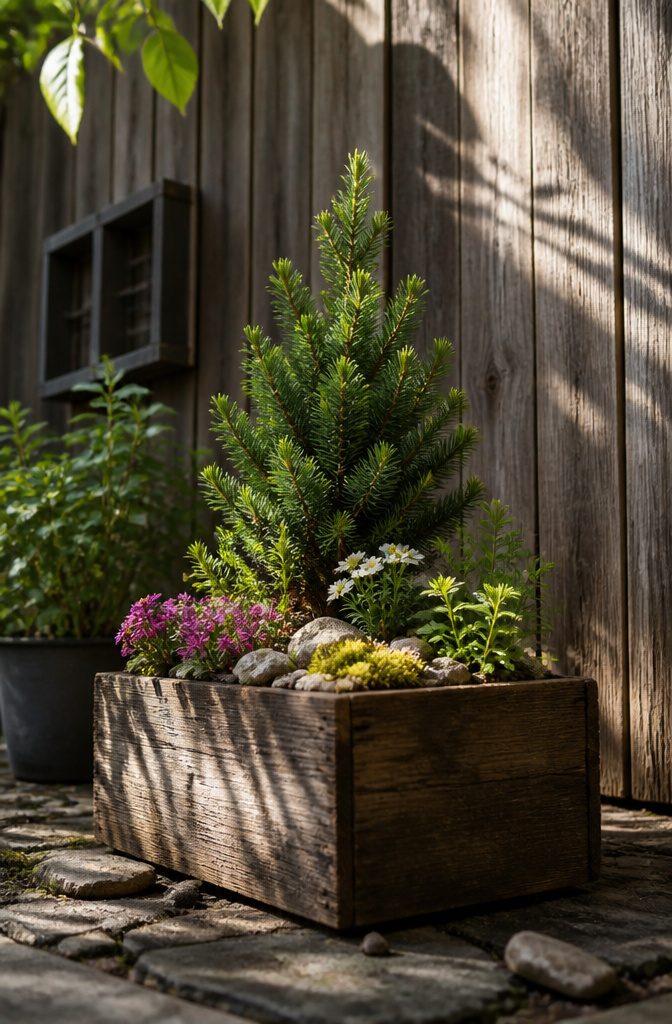
True miniature trees carry their small size in their genes, not in the shears. A pruned standard kept tiny through constant clipping will eventually rebel with a flush of out-of-scale growth; genetic dwarfs like Chamaecyparis obtusa ‘Just Dandy’ or Picea glauca ‘Jean’s Dilly’ stay proportioned without the fight. I learned this distinction the hard way after trying to bonsai a regular spruce into submission, only to watch it outgrow its fairy-garden neighbors in a single season.
For outdoor miniature gardens, dwarf and miniature conifers earn their place because they already read as shrunken versions of the trees we know from full yards. A 3-inch ‘Jean’s Dilly’ spruce at five years old carries the same visual weight as a 30-foot Colorado blue spruce does against a house. The math is patience, not magic; even miniatures grow, just slowly enough that you can build a scene around them and trust it holds for years.
Hardiness matters as much as scale. Juniperus communis ‘Miniature’ and Pinus mugo ‘Slowmound’ handle zones where winter actually happens, and Ilex crenata ‘Sky Pencil’ gives vertical structure without the eventual bulk of its standard cousins. The tree sets the garden’s sense of distance the same way a mature oak anchors a backyard: get the scale wrong and the whole illusion collapses.
8. Miniature Roses
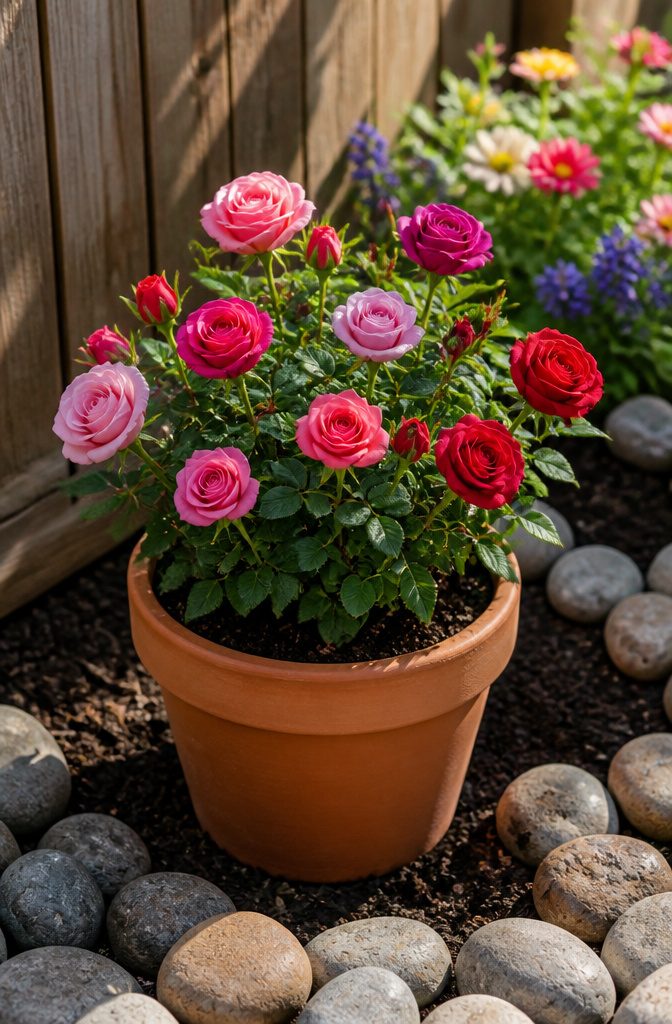
True miniature roses stay under 12 inches at maturity, a distinction that matters because garden centers often label patio roses as miniature when they will outgrow a small container within a season. I check the mature height on the tag before buying, and I look for varieties bred from Rosa chinensis minima rather than standard roses grafted onto dwarf rootstock. The latter will eventually behave like full-sized plants with full-sized appetites.
The tradeoff with roses in tight plantings is air. In humid climates, black spot and powdery mildew spread fast when foliage sits crowded and damp. I lost a whole trough of them one July after a rainy week taught me that lesson. Leave at least six inches between miniature rose plants so breezes can dry the leaves, and site them where morning sun burns off dew quickly. The flowers are worth the vigilance, but only if you plan for the disease pressure from the start.
9. Artificial Plants
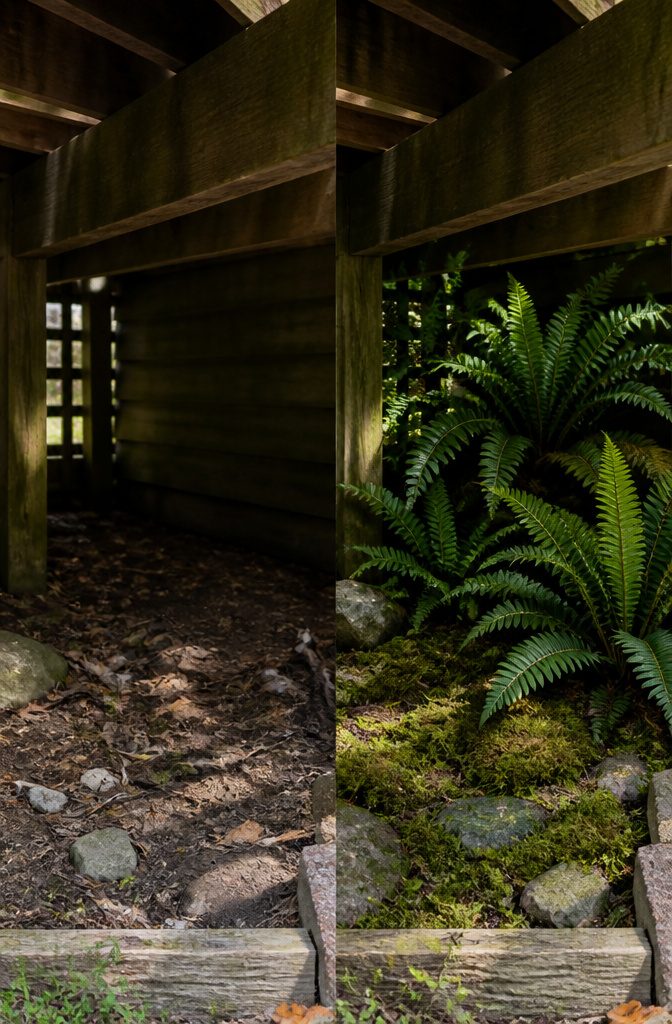
Artificial plants earn their spot in a miniature garden when light is too scarce for anything living, when travel keeps you away for weeks at a stretch, or when a design element needs to hold the same shape and color through every season. I have tried the cheap ones, the kind sold in three-packs for the price of a coffee, and they fail the test every time: the plastic sheen catches light wrong, the edges are stamped too uniform, and up close the whole thing reads as discarded party decor. Spending enough to get weighted stems and convincing leaf variation is the dividing line between a miniature scene that rewards attention and one that collapses it.
In my own attempts, the artificial option worked best tucked under a covered porch where moss and ferns had repeatedly browned out. The fern replica I settled on after two failed purchases still reads green from three feet away, though I would never place it where a visitor might handle the fronds. Where they disappointed was in a sun-exposed fairy garden; UV-faded synthetic leaves turn a sickly blue-green no living plant ever managed, and the shift happens faster than you expect. Use them for permanence, not for fooling anyone who looks twice.
Indoor vs. Outdoor Planting
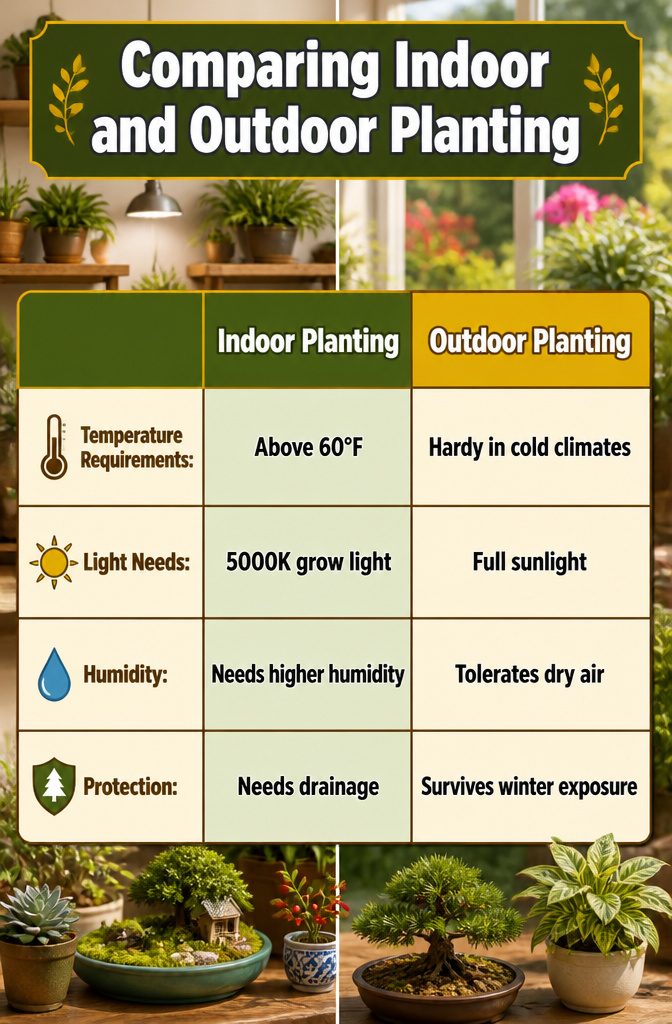
Where you set a miniature garden changes almost everything about what will live in it. Outdoor plantings give you the cold-hardy backbone plants, the dwarf conifers and slow-growing broadleaf evergreens like boxwood and Japanese holly, that read as real trees at small scale. Those same species, left outside through a zone 5 winter, can brown out or die back to the roots entirely; a miniature garden has no buffer of soil mass to protect its roots the way a yard planting does.
Indoor gardens trade that risk for a different set of limits. Tropical plants that need temperatures above 60°F year-round become your only option, and the dry heated air of most homes in winter will crisp the foliage of anything that liked humidity. A 5000K grow bulb, the same thing sold as a full-spectrum bulb, will keep an indoor miniature garden from stretching and thinning if you lack a south-facing window. Drainage holes matter more indoors than out; a saucer and a plant coaster beneath it saves the furniture from the water that has to pass through.
The same variegated boxwood that works in both settings is the exception. Most of the time, choosing the location first saves you from watching a planting fail for reasons you cannot adjust away.
Scale and Design Layout
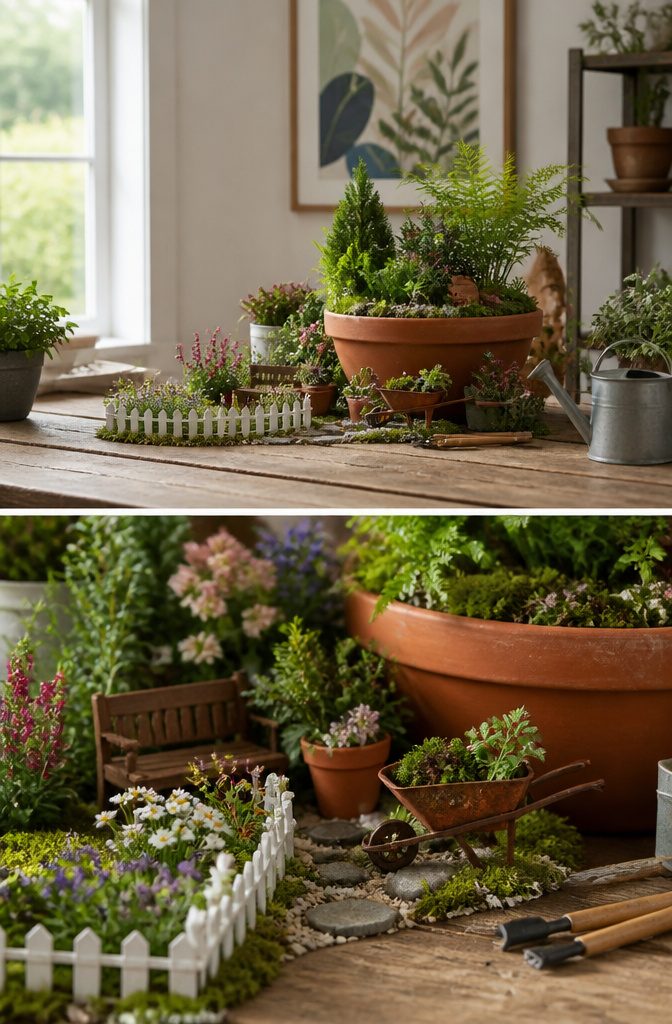
The 1:12 rule of thumb for fairy gardens means one inch in your miniature world equals twelve inches in the real one. A one-inch-tall bench reads as a twelve-inch garden seat, and a two-inch picket fence stands in for a two-foot border. Stick to this and the illusion holds; drift from it and the eye catches the lie immediately.
I learned this the hard way with a terracotta pot that looked modest on the shelf. The miniature wheelbarrow I dropped inside it was sized for a dollhouse, not a garden, and the thing read like a toy truck in a flower bed rather than a forgotten tool. The scale broke because I checked the pot’s width but not the visual height of its rim against the accessory.
For containers 10 inches in diameter and larger, large accessories or 1-inch scale fit. Drop below 10 inches and you need medium or half-inch scale. Tiny pots from 2 to 4 inches demand quarter-inch, HO, or N scale. A single man-made piece, a birdbath or bench, tells the viewer what size world they are looking at.
Layering works the same as a full garden. Tallest plants or structures sit toward the back, mid-height in the middle, ground-hugging stuff forward. The sight line runs from your usual viewing angle, not from above; what reads as a full canopy from standing height flattens to a green pancake if you always look down. One focal point, a miniature arbor or a dwarf conifer reading as a full tree, gives the eye a place to land. Without it the scene scatters into a collection of small objects rather than a place.
Maintenance Through the Seasons
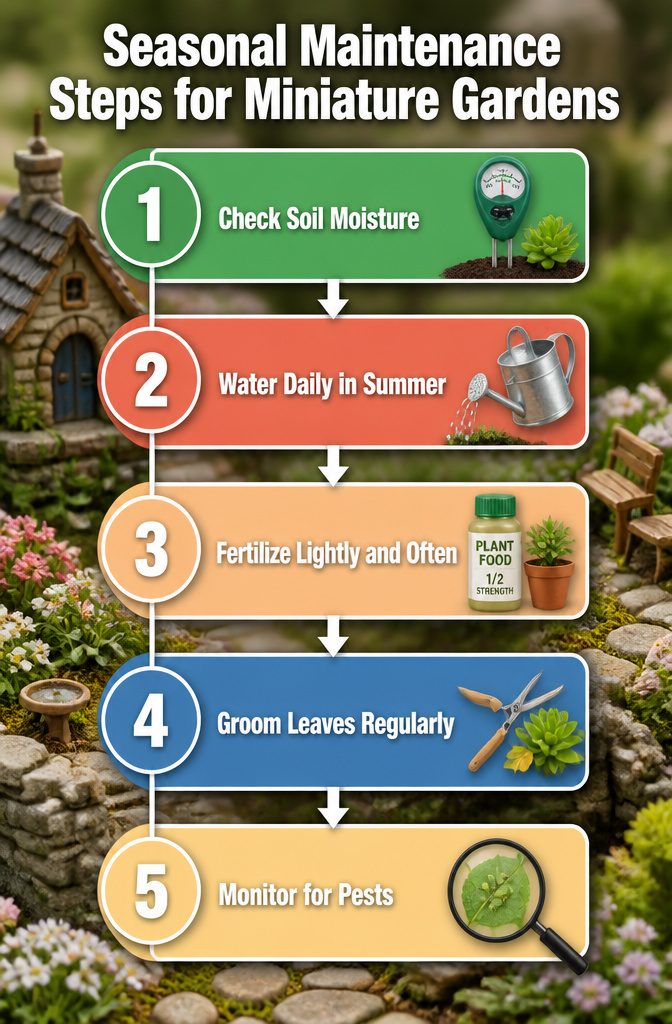
Small pots dry out faster than you’d think, and the gap between "moist" and "crispy" can be a single hot afternoon. Watering miniature containers usually means checking daily in summer, not the twice-a-week rhythm of a border bed. I learned this the hard way with a window trough of dwarf sedum that went from perky to papery between morning coffee and dinner.
Fertilizer needs the same scaling down. Full-strength feeds burn roots in tight quarters, so half the label’s rate and apply more often works better than one strong dose. Grooming matters more too: a yellow leaf on a full-size hosta barely registers, but on a miniature variety it throws the whole proportion off, and spent blooms left too long invite rot in cramped quarters.
The real cost of a miniature garden is attention, not money. Small soil volumes hold small reserves of moisture and nutrients. Skip a weekend, and the whole scene sags. That trade-off suits some gardeners fine and exhausts others. Know which you are before you commit to the scale.
Frequently Asked Questions
What types of plants are best for miniature gardens?
Miniature hostas like ‘Blue Mouse Ears’ stay under 8 inches and handle shade, while dwarf conifers such as Hinoki Cypress ‘Just Dandy’ and Juniper ‘Miniature’ provide year-round structure. Miniature perennials under 6 inches at maturity, creeping thymes for ground cover, and genetic dwarf conifers like ‘Jean’s Dilly’ spruce all hold scale without outgrowing their space. Succulents work well too, though most need protection below Zone 6 in containers.
How do I maintain a miniature garden?
Check moisture daily in summer, since small pots can go from moist to crispy in a single hot afternoon. Feed at half the label rate but more often, and remove yellow leaves or spent blooms promptly because flaws throw off proportion in tight quarters. Winter hardiness is trickier in containers than in the ground; dwarf conifers and hostas may survive without protection in Zone 6, but succulents often need shelter or indoor placement where cold settles in.
What are some design tips for creating a miniature garden?
Stick to a single scale ratio, with 1:12 as the standard rule of thumb: one inch in the garden equals twelve inches in reality. Choose one man-made accessory, a bench or birdbath, to establish that scale for the viewer, then layer tallest plants toward the back and ground-hugging ones forward. Match the plant’s mature spread to your accessory’s door height, not its nursery size, and view the arrangement from your normal standing angle rather than looking straight down.