
Pruning spring-blooming shrubs means cutting them in the narrow window right after flowers fade, usually late May to early June. Wait until July or August and your shears remove next year’s buds already forming on old wood.
The one-third rule governs everything: remove more than a third of the oldest stems at ground level and the plant stresses, blooms thin, and recovery takes years.
Old Wood, New Wood
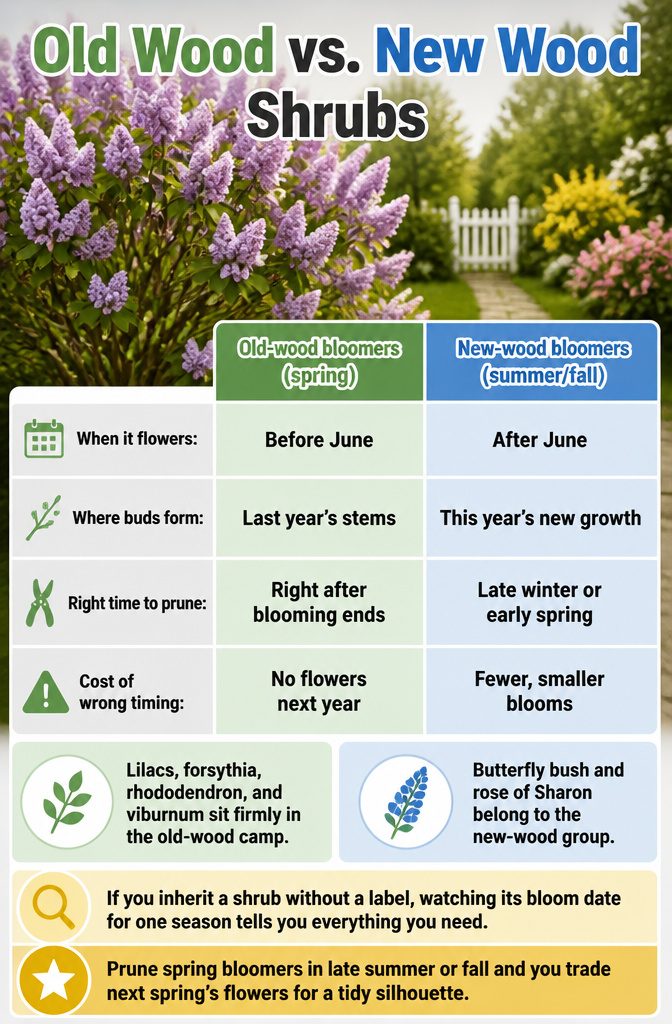
Shrubs that bloom before June set their flower buds on wood that grew the previous summer and fall.
Prune them after flowering finishes, or you cut off next year’s blooms before they open. Summer and fall bloomers work differently; they form flowers on fresh growth from the current season and get pruned in late winter or early spring.
A simple June rule separates the two groups.
If flowers appear before June 15, the shrub blooms on old wood. After that date, new wood carries the show.
| What you check | Old-wood bloomers (spring) | New-wood bloomers (summer/fall) |
|---|---|---|
| When it flowers | Before June | After June |
| Where buds form | Last year’s stems | This year’s new growth |
| Right time to prune | Right after blooming ends | Late winter or early spring |
| Cost of wrong timing | No flowers next year | Fewer, smaller blooms |
Lilacs, forsythia, rhododendron, and viburnum sit firmly in the old-wood camp. Butterfly bush and rose of Sharon belong to the new-wood group.
If you inherit a shrub without a label, watching its bloom date for one season tells you everything you need. Prune spring bloomers in late summer or fall and you trade next spring’s flowers for a tidy silhouette.
The Week After Blooming Ends
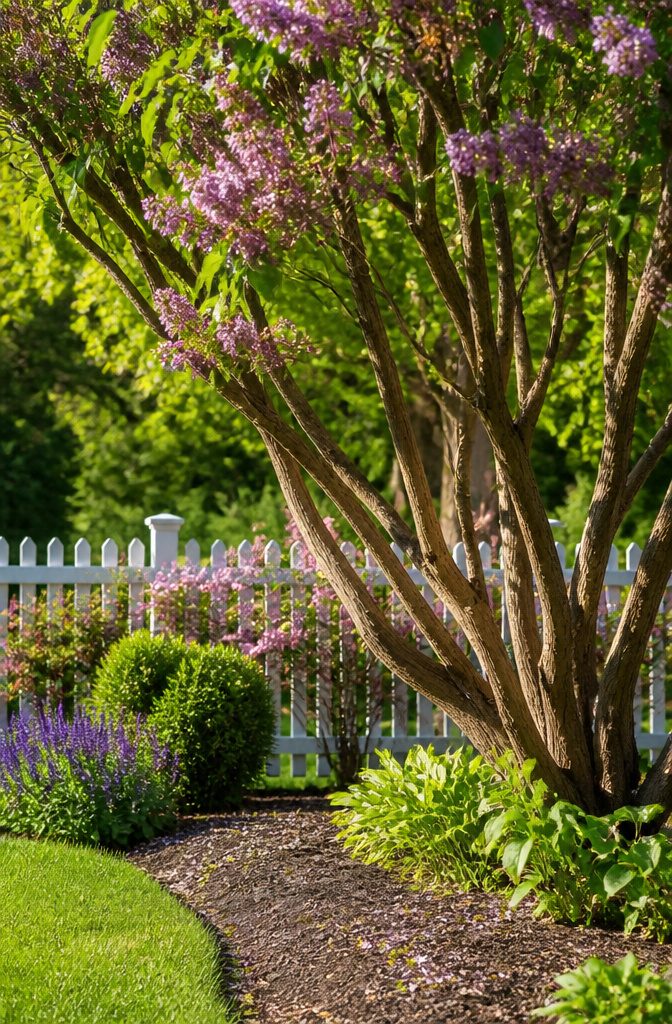
Spring-blooming shrubs set next year’s flower buds on the growth they put on during the current season.
Prune immediately after the flowers fade, usually late May to early June, and the plant has the full summer and fall to form those buds.
Wait until July or August, or worse, the following spring before bloom, and your shears cut off the buds already in place. You get healthy green growth and no flowers.
I learned this the hard way with a lilac I trimmed in September, thinking I was being tidy.
The next May, every branch that had been shortened ended in leaves instead of bloom clusters. The plant was fine; the display was gone.
The same rule holds for forsythia, azalea, rhododendron, flowering quince, and the rest of the shrubs that flower before mid-June: old wood carries the buds, so the pruning window closes when the petals drop.
Cut Out the Dead and Damaged First
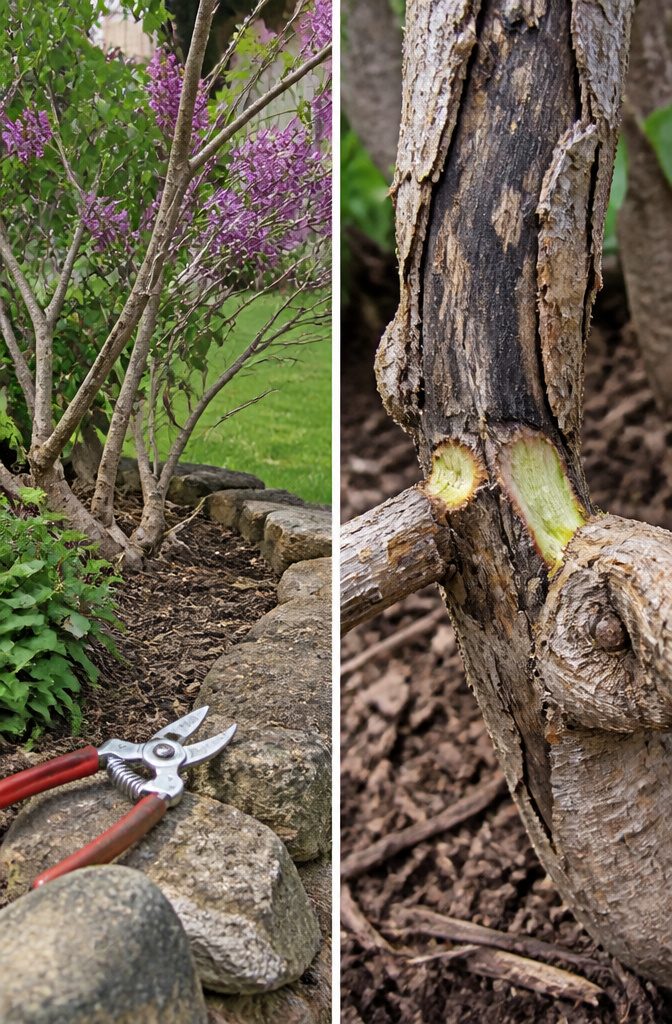
Dead wood has a look, but the sure test is the scratch.
I nick the bark with my thumbnail where a branch meets the trunk. Live cambium shows green; dead tissue is tan, dry, and gives no resistance.
A truly dead branch snaps clean with no bend, and the buds, if any remain, are shrunken and dark. No green under the bark means that branch is not coming back.
I always remove these first, before any thought of shape or size.
Cut dead branches at the base, or back to where they meet healthy wood. The same goes for anything damaged by winter load or split by wind, and for wood showing obvious disease.
On diseased cuts, I go at least six inches below the visible problem into clean tissue, then wipe my blade with a ten-percent bleach solution before the next cut.
Doing this before shaping matters more than I understood my first season. Dead branches hide the living architecture underneath, so you cannot see where the shrub wants to go.
Worse, diseased wood left in place keeps the infection cycling through the plant. Once the dead and damaged are out, the real structure stands clear, and only then does thinning or shaping make sense.
Thin the Oldest Stems
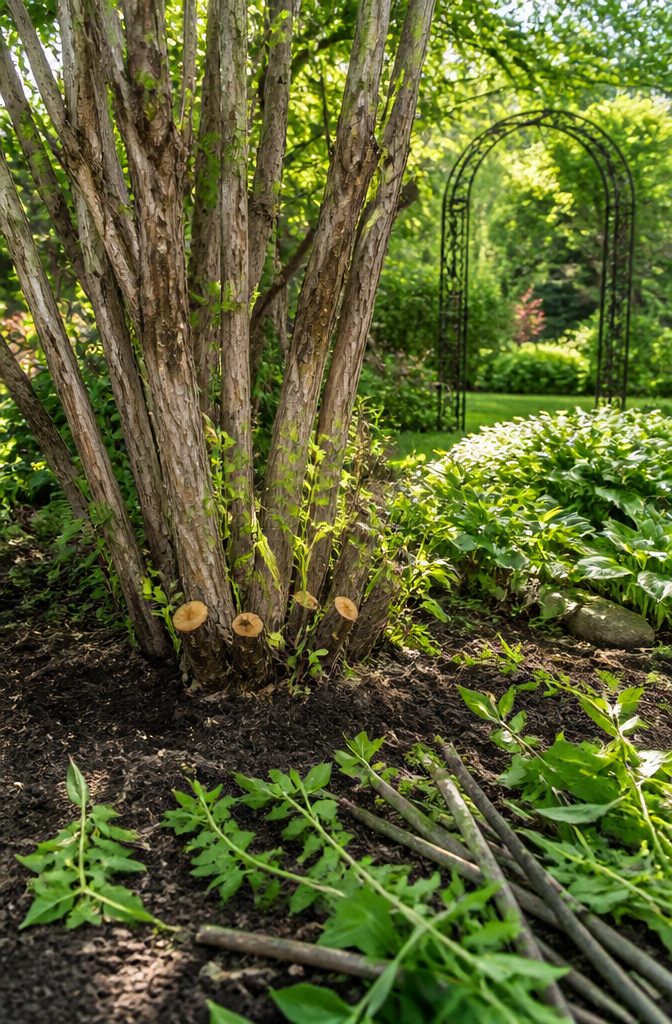
Annual thinning means taking out the oldest stems right at ground level, not shortening them partway. The Colorado State University Extension puts the principle plainly:
Annual thinning removes one-third of the oldest wood to the base each spring. This encourages new growth from the base, keeping the shrub youthful looking.
That one-third limit matters. Cut more and you stress the plant; cut less and you leave too much aging wood that flowers poorly.
I look for stems thicker than my thumb, gray or peeling bark, or branches that bloomed sparsely this spring even though they had plenty of light. Those are the ones coming out.
This approach renews the shrub from below instead of shearing the top into a ball. Air moves through the center again, and lower buds get the light they need to break.
It takes longer than a quick hedge-trimmer pass, but the shape stays loose and the flowers come back stronger on wood that is actually young enough to set them.
Spirea and other twiggy, multi-stem shrubs do not respond well to this method; save it for lilacs, forsythia, and other spring bloomers with distinct, woody trunks.
Shape by Following the Form
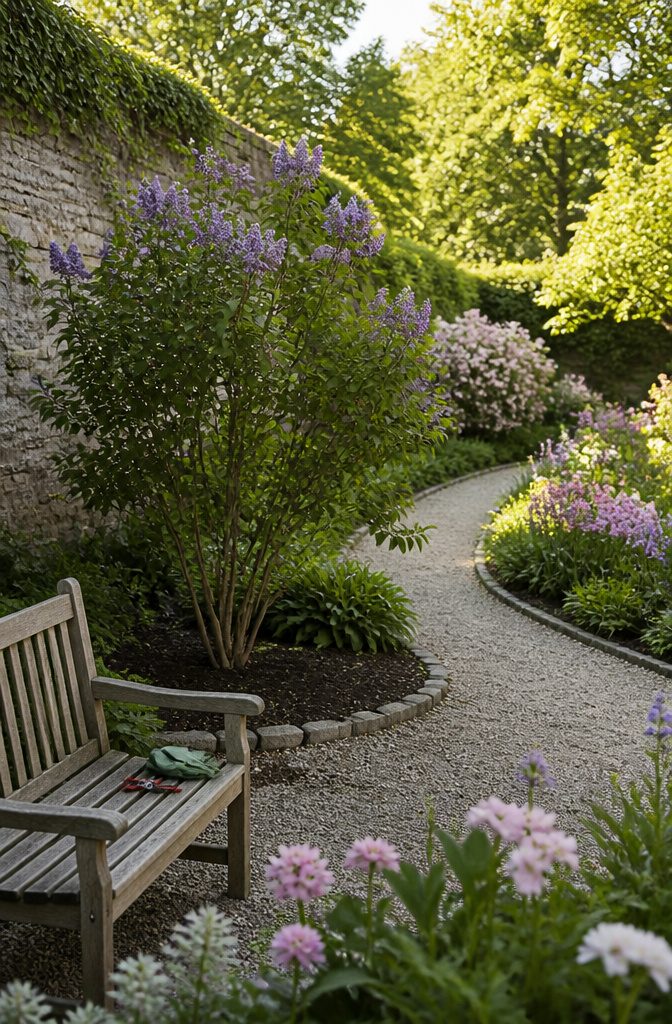
Lightly trimming branch tips to maintain shape means cutting just above an outward-facing bud or branch, never shearing the whole shrub into a rounded ball.
The direction of that top remaining bud determines where new growth heads, so facing it outward keeps the interior open instead of tangled.
I step back after every few cuts to see the whole plant, because close-up work flatters every angle and only distance reveals the lie.
Shearing destroys what you’re trying to save. It removes most flower buds, encourages a thick shell of foliage at the outside, and shades out the interior until the base goes woody and bare.
A few species like privet or barberry tolerate formal shearing, but spring bloomers do not. Cut one quarter inch above the leaf you want to keep, and let the shrub look like it grew that way.
When the Shrub Is Past Saving
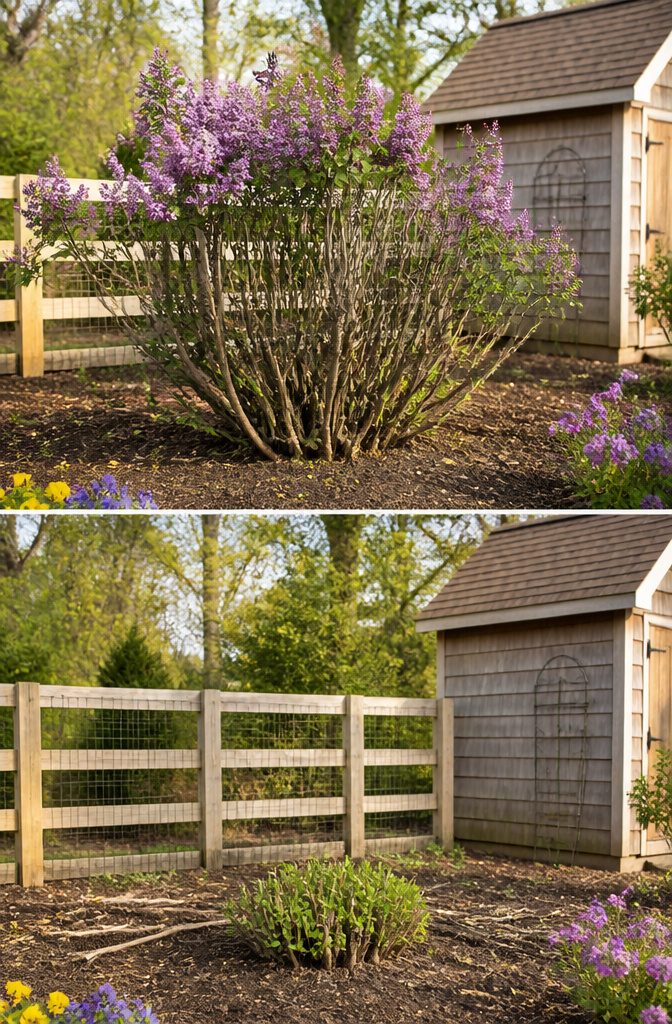
Sometimes a shrub is so far gone that gentle thinning will not fix it.
Rejuvenation pruning means cutting the whole plant back to 6–12 inches above ground, done right after flowering finishes. The old wood is gone, and new shoots replace it from the base.
That hard cut comes at a cost.
Spring bloomers pruned this way will not flower for one to two years while they rebuild. For something like a large lilac, that wait feels even longer because the regrowth from bare stubs is slow.
A three-year gradual approach works better there: remove one-third of the oldest stems at ground level each spring, repeating until every old trunk is gone.
The shrub keeps some shape, you still get some flowers each year, and the stress on the root system is lighter.
Not every plant can take even this. Shrubs with many dead branches, or more than one-third of the wood bare of healthy foliage, often fail to respond.
And anything structurally like a small tree, such as certain viburnums or euonymus with one or few main trunks, should never be cut to the ground; thin back to side branches instead.
Clean Up and Water In
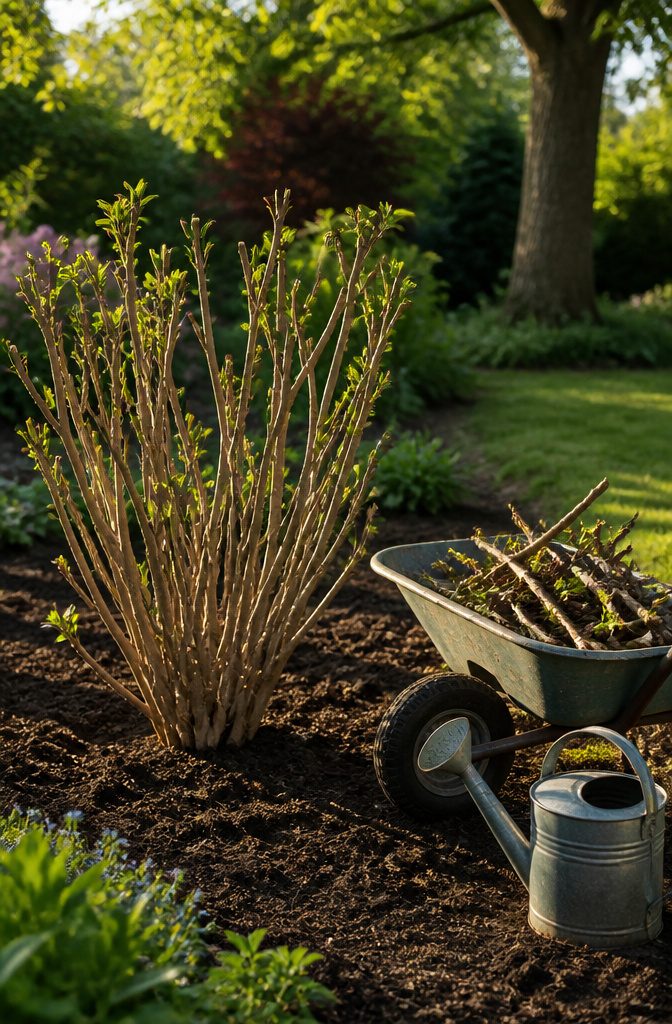
The pruned branches left lying under a shrub become a hiding spot for borers and a landing pad for fungal spores that winter over.
I rake every cut stem into a wheelbarrow the same afternoon; my early years of leaving cleanup for later cost me a deutzia to wilt disease that moved in on the debris.
Water the shrub deeply after the last cut, enough that the soil is wet to the depth of the root ball.
The plant has open wounds and a smaller canopy, so it loses moisture faster while it works to seal those cuts. Hold off on fertilizer for at least four to six weeks.
A heavy prune already forces the shrub to redirect stored energy toward new buds; adding nitrogen on top of that burns the roots and pushes soft growth the plant cannot support.
Let it leaf out on its own first. The feeding can wait until midsummer, when the new wood has hardened and the shrub has enough leaves to use what you give it.
Spring Bloomers Worth Naming
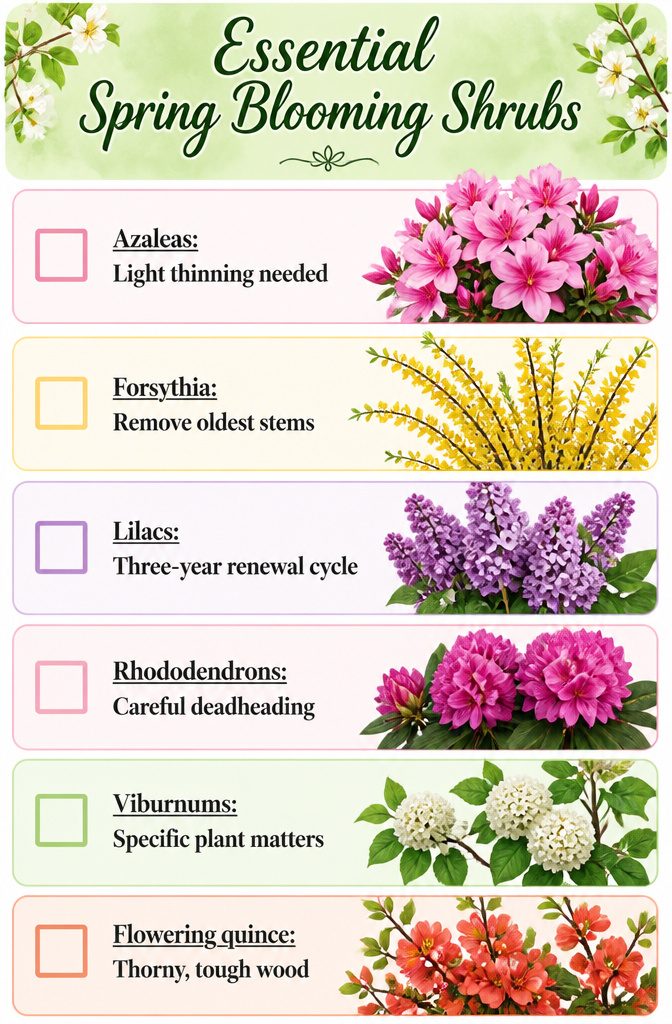
Spring-blooming shrubs worth knowing fall into a short list that covers most yards. Each has its own habit, and the pruning matches that habit rather than following one rule for all.
- Azaleas need light thinning with hand pruners. Shearing them into balls or boxes removes next year’s buds and leaves a dense shell with bare centers.
- Forsythia grows in long arching canes. Remove the oldest stems at ground level to keep the fountain shape open; cutting the tops off ruins the natural form.
- Lilacs send up suckers from the base and bloom on wood that ages out after a few years. A three-year renewal cycle, cutting the oldest third to the ground each spring after flowering, keeps flowers coming without stripping the plant bare.
- Rhododendrons reward careful deadheading: snap the spent truss off just above the new growth buds, taking care not to damage the soft shoots forming beside it.
- Viburnums vary by species enough that the specific plant matters more than the genus; some want the same renewal as lilacs, others need almost none.
- Flowering quince has thorny, tough wood. Loppers beat hand pruners for the oldest canes, and thick gloves are not optional.
Three Mistakes I Made Early
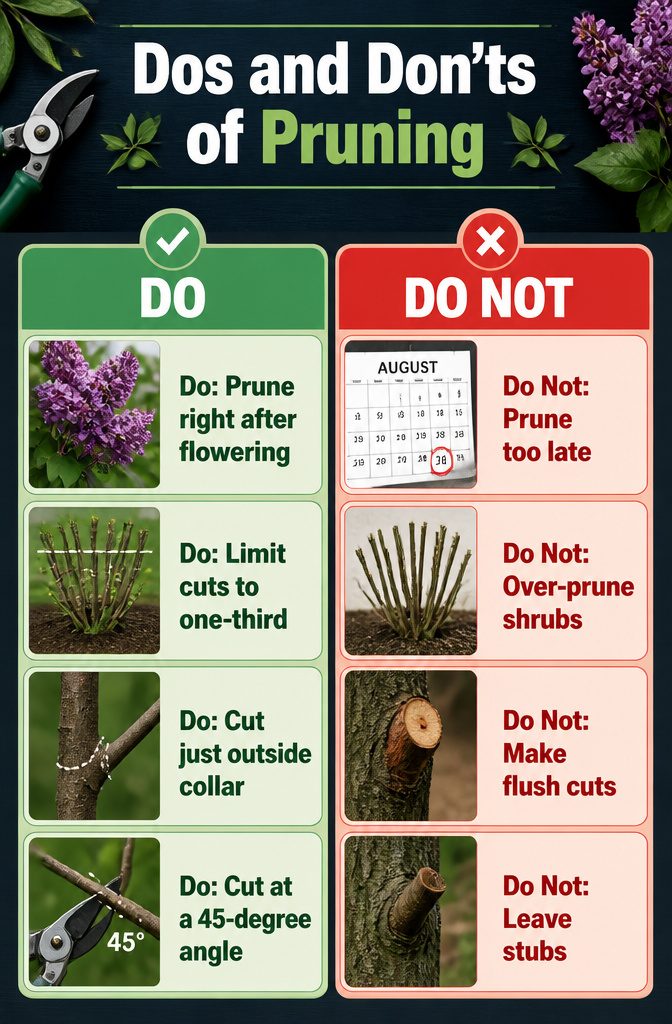
My first lilac taught me the calendar matters more than enthusiasm. I grabbed loppers in late August, sure I was being tidy, and cut away half the branches.
The next spring brought half the flowers; the shrub had already set its buds on old wood, and I had pruned them off without knowing.
July and August are too late for spring bloomers because the plant spends summer building next year’s display.
Over-pruning came next.
A forsythia in my second year looked gangly, so I took it down by half, thinking fresh growth would fill it out. Instead it sulked, threw out thin water sprouts, and barely bloomed for two seasons.
The rule I learned: remove no more than one-third of a shrub at once. The plant needs stored energy to recover, and greed costs years.
The cuts themselves matter too.
Flush cuts against the trunk tore the branch collar on my quince, leaving wounds that rotted slowly. Stubs I left elsewhere died back, inviting disease.
Now I cut just outside the collar, close enough to heal, far enough to keep the tissue alive. The angle slopes down and away from the bud, about forty-five degrees, so water runs off.
What I Use and Sharpen
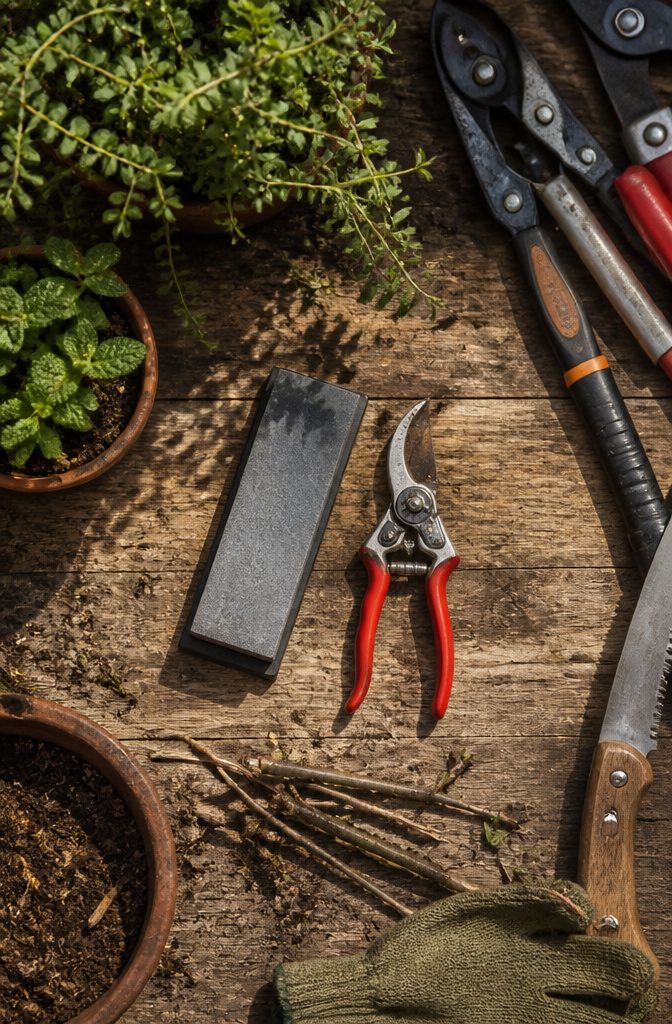
A pair of hand pruners handles most of the work on spring bloomers, anything up to 3/4 inch across.
For thicker branches I reach for loppers, and when I need to take out the oldest, woodiest stems at the base, a pruning saw is the only tool that fits.
Rubbing alcohol on the blade between cuts matters most when I am cutting through diseased wood, though I clean them regardless before I move to the next shrub.
A dull blade tears bark instead of slicing it clean, and that ragged wound is an open door for infection. I sharpen mine once a year, usually late winter before the season starts, and I can feel the difference immediately.
A sharp tool means less strain on my hands and a cut that heals flat without the frayed edges that slow a shrub down.
What a Healthy Shrub Looks Like Before You Start
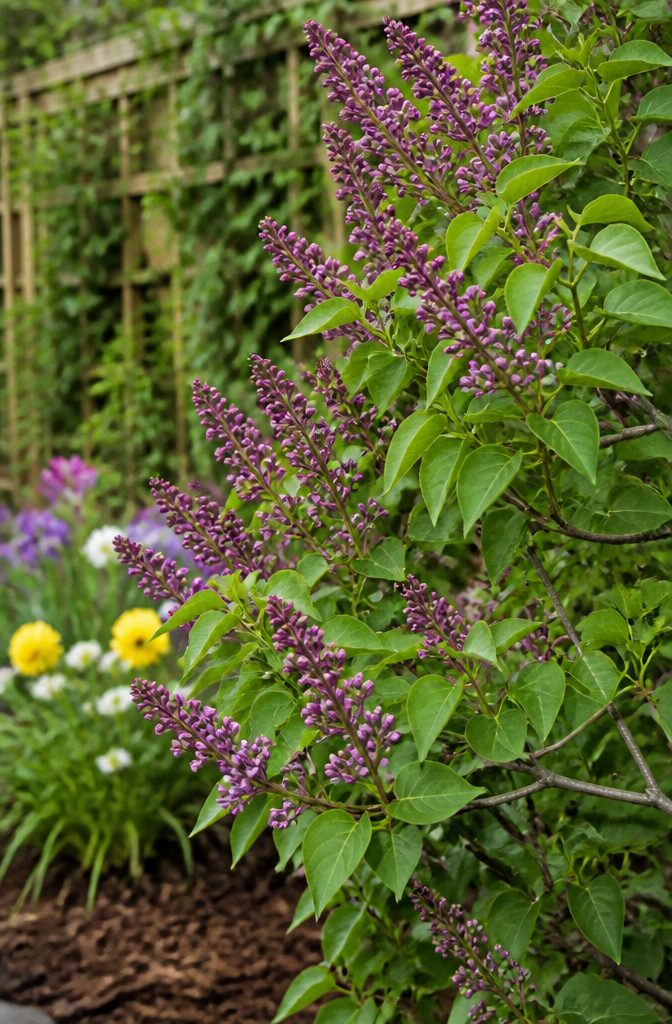
Dead branches snap clean when you bend them, and they show no green inside the cut. That is the first thing to check, but not every bare stick means it is pruning time for spring blooming shrubs.
A branch that bends and shows pale, moist wood may simply need water or a forked mulch ring to keep roots cool.
Crossing or rubbing wood is different: two stems pressed together wear away bark and open a door to disease, and no amount of watering fixes that.
Crowded interior growth blocks light so completely that lower leaves drop and the shrub hollows out, while a lopsided shape from reaching toward a window or away from a neighbor’s fence is a structure problem, not a soil one.
Declining bloom density after years of steady flowers tells you the oldest stems have stopped producing, not that fertilizer is missing.
If the buds are still plump and the soil is damp six inches down, the shrub needs a saw, not a hose.
Frequently Asked Questions
When is the best time to prune flowering shrubs?
The best time depends on when the shrub blooms. Spring bloomers need pruning right after their flowers fade, usually late May to early June, because they form next year’s buds on old wood during summer and fall.
Summer and fall bloomers get cut in late winter or early spring since they flower on new growth from the current season.
How do you prune flowering shrubs without losing blooms?
Wait until the flowers drop, then prune within that first week or two.
The plant needs the remaining summer and fall to set buds on the growth it puts on after cutting. Shear in July or later and you remove the buds already in place, so next spring brings leaves without flowers.
Can you prune flowering shrubs in summer without harming next season’s blooms?
No, not if they bloom in spring. By summer those shrubs have already started building next year’s flower buds on the current season’s growth.
A late-season cut costs you the display you were waiting for. Mark your calendar to prune right after bloom time instead, then leave the plant alone.
What are the signs of a healthy shrub that needs pruning?
Look for dead branches that snap dry and show no green inside, stems that cross and rub bark away, crowded interior growth blocking light, or a lopsided shape from reaching toward sun.
Declining bloom density after years of steady flowers means the oldest stems have aged out. If buds stay plump and soil is damp six inches down, reach for a saw rather than a hose.






