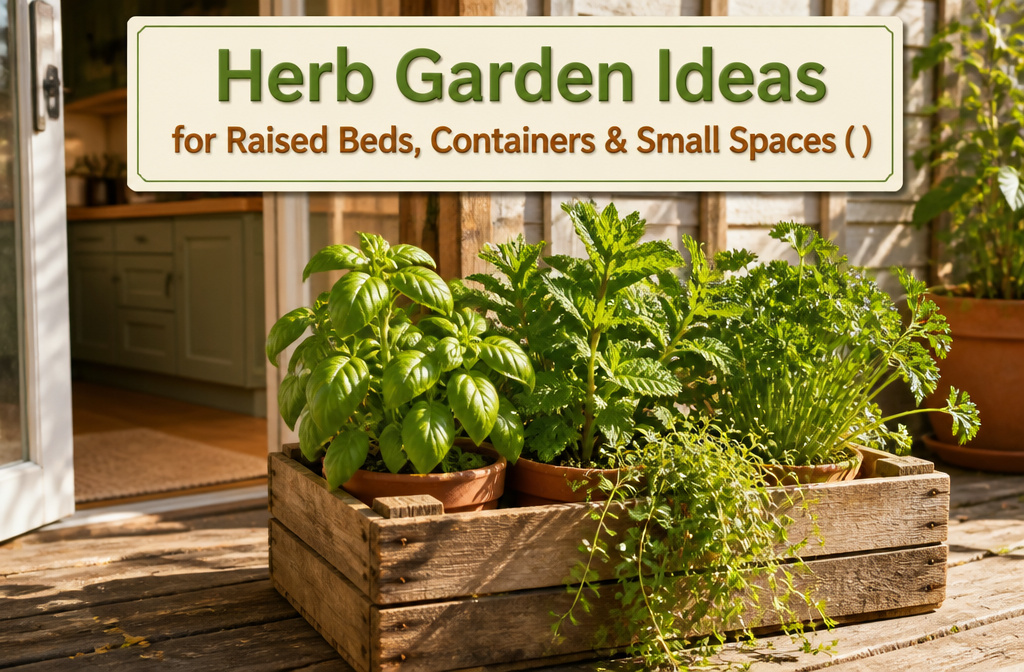
The most useful herb garden you build will be the one close enough to your kitchen door that you actually snip from it.
That proximity only works if you match the plant to the light the spot gets; six hours of sun for basil, four for parsley and mint.
A cluster of six-inch terracotta pots fits most doorsteps and costs less than a single failed raised bed.
1. Raised Bed Herb Garden
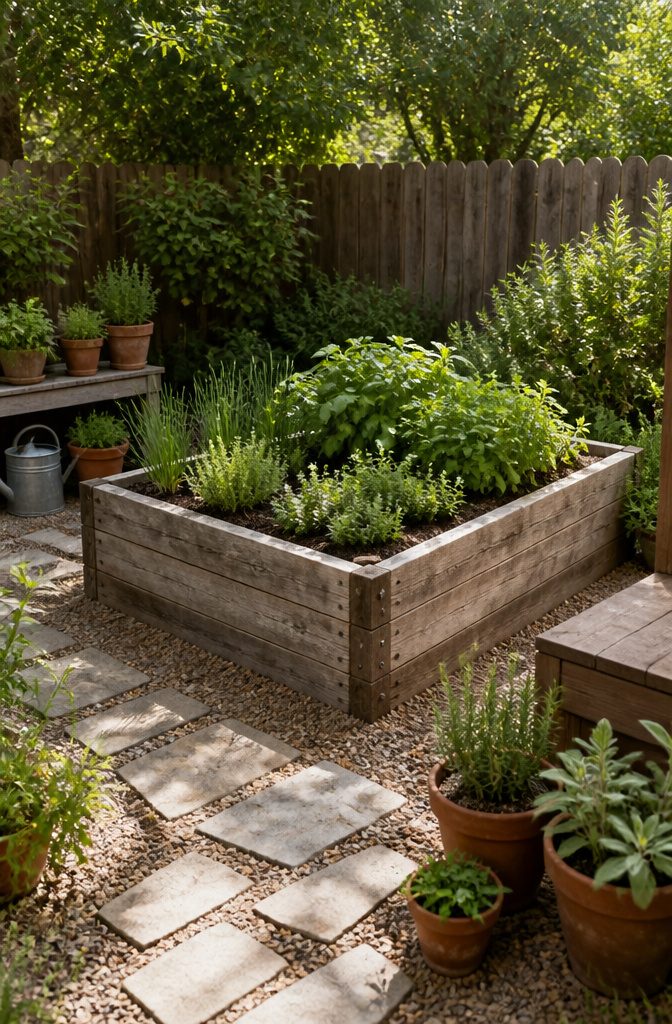
A raised bed sits higher than the surrounding soil, and that single change solves two problems that sink most beginner herb gardens: cold, soggy ground and the creeping chaos of plants that refuse to stay where you put them.
Water drains fast.
Roots warm faster in spring. And because the bed has edges, you stop mint from colonizing your sage by accident.
The soil mix matters more than the wood you build with. I fill mine half-and-half with organic compost and a blend of vermiculite, sustainably harvested peat moss, sand, blood meal, wood ash, leaf mold, and bone meal.
That combination keeps the mix light enough for root expansion and rich enough that you will not be chasing yellow leaves with fertilizer all summer.
One herb per square foot is the spacing rule I measure by. Thyme and chives stay polite at that density.
Basil and cilantro need every inch of it. I learned to group by thirst, not just height: rosemary and lavender at the dry end, parsley and mint where the soil holds moisture a half-day longer.
The bed looks tidy. The plants stay alive.
2. Container Herb Garden
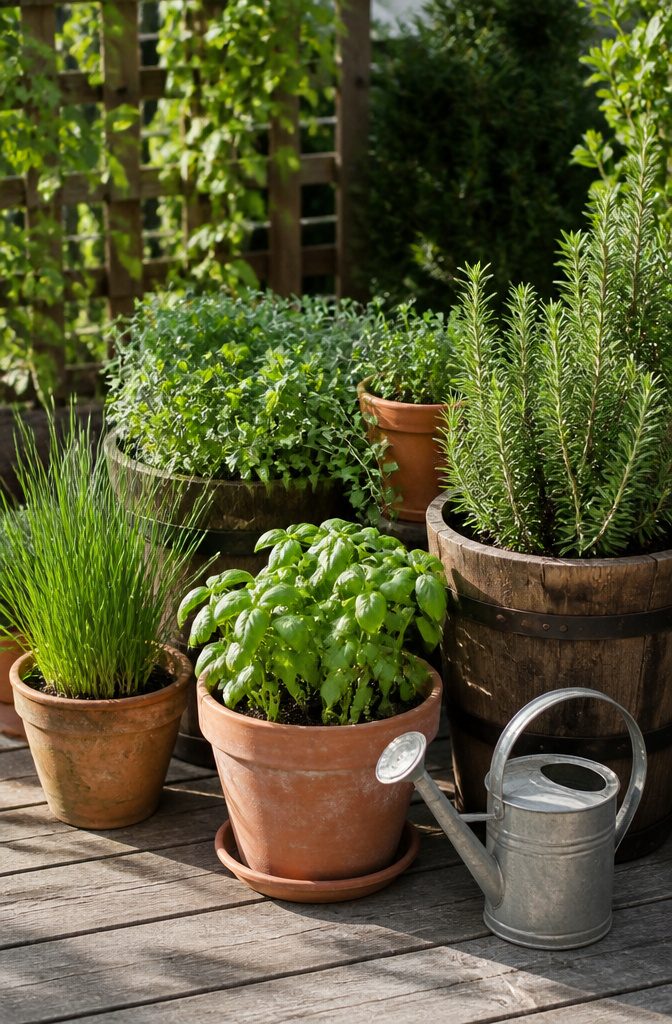
Container growing is the most adaptable way to keep herbs when you are working with a patio, balcony, or small yard.
Most herbs grow just as happily in pots as they do in the ground, so the choice is really about what suits your space.
Drainage holes are non-negotiable; without them, soil stays wet and roots rot. A four-foot-wide hexagonal planter works well for grouping several herbs, but ordinary terracotta pots grouped together do the same job and cost less.
The real advantage is control over soil. Leafy herbs like basil, parsley, and cilantro want richer, moist soil, while Mediterranean herbs like rosemary and thyme need leaner, drier conditions.
Separate pots let you give each group exactly what it needs instead of forcing compromises. Mint is the classic case for isolation: it will overtake anything planted nearby, so its own container saves you from constant trimming.
Mobility matters too. Pots can shift with the sun through the day or season, and in colder zones you can bring them indoors for winter.
A half wine barrel, a simple four-by-four raised bed, or even individual pots you already own all work. The only rule is that each container drains freely and gets filled with good organic soil and compost rather than garden dirt.
3. Vertical Herb Garden
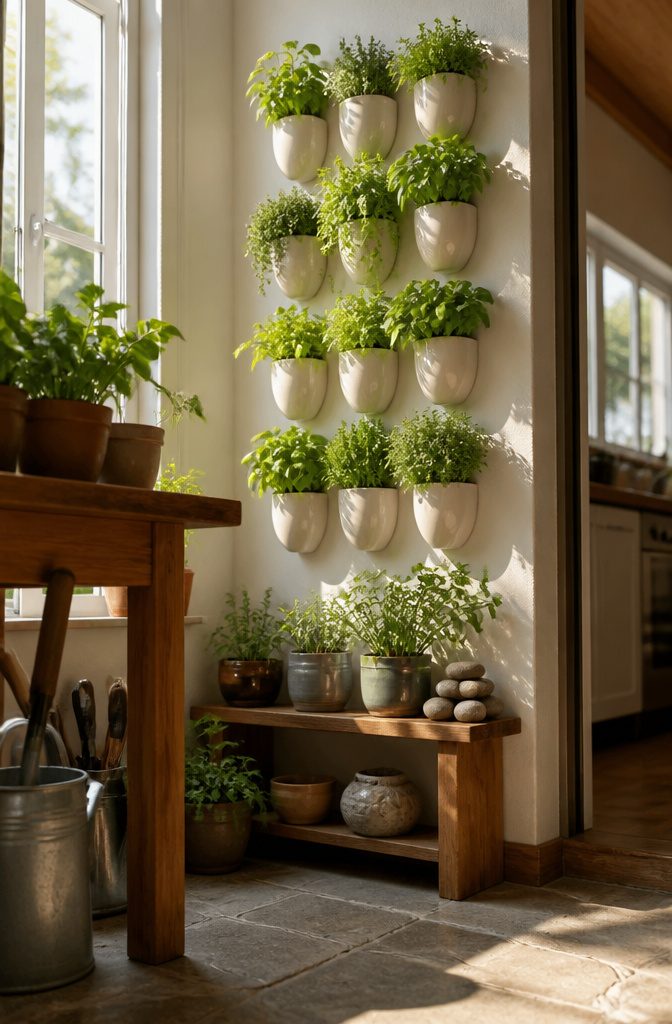
A vertical herb garden turns the one direction most small patios and balconies ignore into usable growing space.
Wall-mounted pockets, recycled wooden pallets, or tiered shelving systems all work, and the shallow soil suits herbs with smaller root systems like basil, cilantro, and parsley.
Ceramic planters mounted directly on a kitchen wall give the same effect indoors, though lining each pot with small stones before adding soil keeps drainage from becoming a problem on drywall.
What convinced me, reading through a dozen setups, is that weight matters more than height.
A pocket planter loaded with wet soil and mature herbs can pull a mount off stucco fast. Wall-mounted systems need anchors rated for the load, not the plant tag, and renter-friendly adhesive strips are not the answer here.
Tiered structures sitting on the floor sidestep the hardware question entirely, though they eat the square footage the wall approach saves.
The shelf route is the most forgiving. An old storage shelf that will not rot, positioned where it gets light, handles more plants per dollar than most dedicated vertical kits.
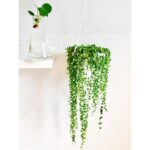
Hanging propagation stations scaled up for full-sized but compact herbs are another option if ceiling hooks are available.
4. Hanging Herb Planters
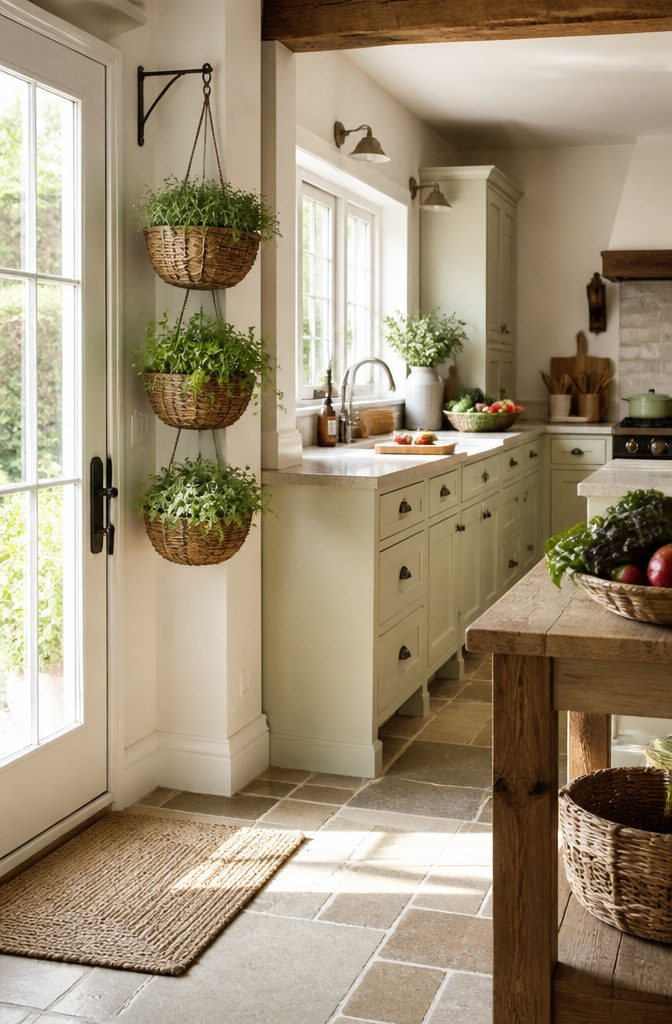
Hanging planters pull herbs up where you notice them, and that visibility means you actually use them.
I learned this the hard way after tucking basil into a ground-level bed I kept forgetting to check; the plant went to flower before I harvested twice.
A basket at eye level or just above fixes that. Thyme, mint, and oregano spill over the sides and look full even when you have been snipping hard.
Placement matters more than the container. Coconut coir lining keeps drainage honest in a woven basket, but no lining saves a pot already drilled.
The spot needs sun, of course, but it also needs to be a place your hand reaches without a step stool or a negotiation with furniture.
A wall hook beside the kitchen door, a short rail bolted to a balcony, or the side of a cabinet you pass anyway: these make the cut.
A sheltered porch works if the herbs still get four to six hours of direct light; otherwise the growth stays thin and the flavor flat.
I have seen the rail-and-basket setup work well on narrow balconies where floor space is already claimed by a chair and a grill. The baskets hang at staggered heights so lower ones do not steal light from upper ones.
Mason jars on cabinet sides use the same logic of dead space claimed for living plants. The harvest habit forms when the scissors live in the same room as the herbs.
5. Herb Garden Pathway
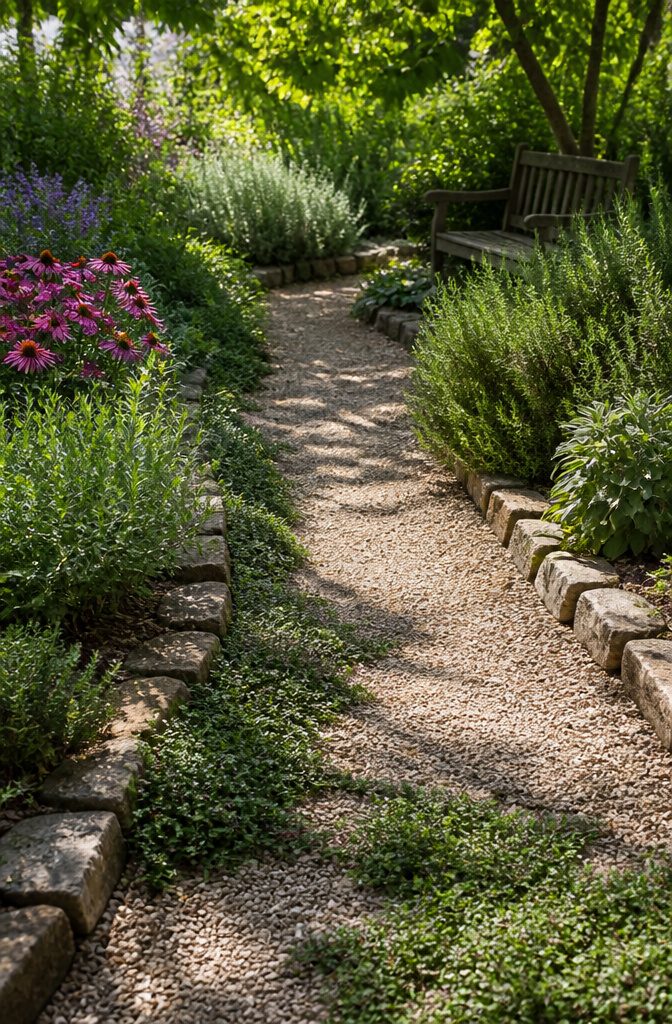
A pathway planted with herbs turns an ordinary walk into something you use with your nose as much as your feet.
Creeping thyme is the classic choice for this, spreading low enough to tolerate light foot traffic and releasing that warm, resinous smell when a shoe brushes through it.
Other ground-cover herbs like prostrate rosemary or the smaller mound-forming sages can fill the same role, though they will not take being stepped on as readily.
The practical catch is what happens when guests wander through. One moment of inattention and a heel comes down on a tender clump you have been coaxing along for two seasons.
A low stone edging or a subtle change in paving material can signal where the path ends and the planting begins without turning your garden into a cordoned-off display.
If you are working a narrow side yard or a tight space along a patio, this approach also lets you keep the bed to 4 feet wide or less, the dimension that lets you reach the center from either side without compressing the soil by stepping in.
The herbs you edge with, thyme included, can be the same ones you cook with; the only difference is that here you are harvesting with your shoes first and your scissors second.
6. Rosemary Hedge
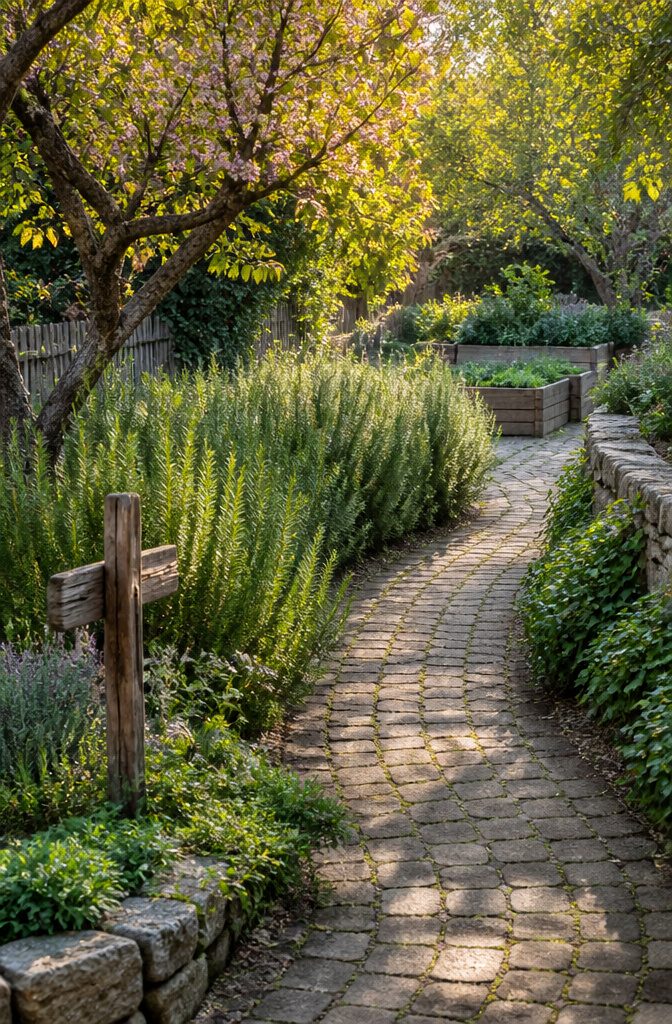
A rosemary hedge turns a border into something you can run your hand through every time you walk past.
I saw one first at a community garden in Portland, where the gardener had planted a double row of upright rosemary along the path edge.
It smelled like a kitchen and a garden at once, and it was clearly doing the work of keeping foot traffic off the beds.
Rosemary is perennial in most zones where it survives winter, which means the hedge builds structure year over year rather than needing replanting.
The plants want the same lean, well-drained soil that lavender demands; both are Mediterranean herbs that rot in wet ground.
Space plants 2 to 3 feet apart, the same spacing you’d use for a lavender hedge, so each bush gets airflow and room to fill out without crowding.
In my own attempt I planted too close at 18 inches, and by year three I was cutting out the center plants that had died from the humidity trap.
A rosemary hedge needs full sun, six to eight hours minimum, and once established it wants almost no supplemental water.
The mistake is treating it like basil or parsley, which want richer soil and steady moisture. Let it go slightly hungry and slightly dry; the flavor concentrates and the wood hardens.
Prune lightly after flowering to keep the shape dense, but never cut back into bare wood, rosemary does not resprout from old stems the way lavender sometimes will.
For a small yard or patio, even a four-foot stretch of rosemary hedge gives you a visual wall and enough clippings for a month’s worth of roasting.
7. Window Box Herb Garden
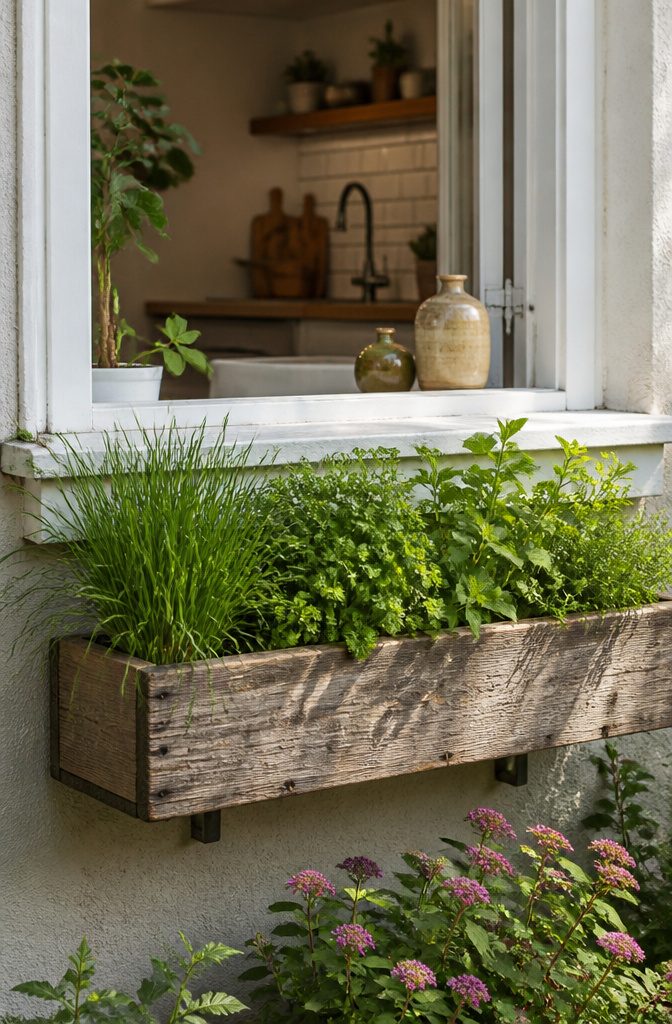
A window box herb garden gives you the classic cottage look even if the only outdoor space you own is a sill.
Most herbs want more than 6 hours of direct sun per day, so a south- or west-facing window is the one to use.
Parsley, chives, mint, and cilantro are the exceptions; they manage on 4 to 6 hours and will keep producing in partial shade where basil or rosemary would stretch and sulk.
In an apartment with no outdoor ledge at all, a kitchen windowsill is the fallback. The same light rules apply.
I have watched a basil plant on an east-facing sill turn leggy by midsummer while the mint beside it stayed bushy and usable, so the match of plant to exposure matters more than the container style.
A box that overhangs the outside earns you more sun hours than a glass barrier indoors, but either setup works if you choose the herbs that fit what the window actually gets.
8. Picnic Table Herb Centerpiece
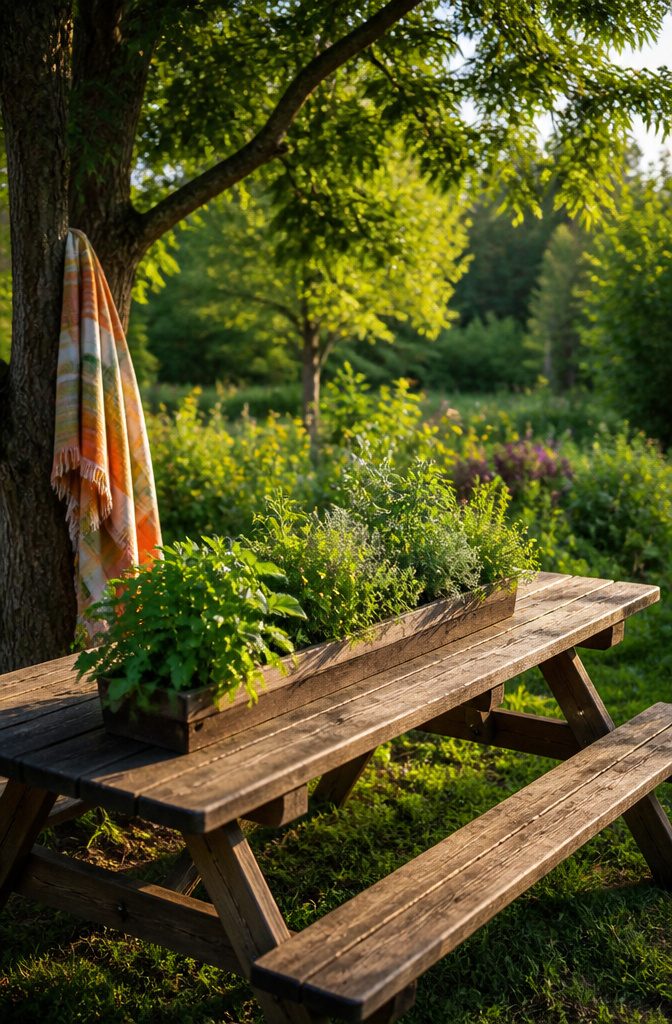
A picnic table with herbs running down its center turns every meal into something you can pinch and tear from.
I started doing this after watching guests hover at my kitchen counter instead of sitting outside; the parsley and thyme in the middle of the table gave them permission to stay.
Built-in planters or simple placed containers both work, though built-ins keep the soil from sliding onto someone’s plate when the wind picks up.
Basil, chives, and oregano tolerate the drier soil that comes with container life, and their stems stay short enough that you are not ducking under branches to pass the potato salad.
The real payoff is not the cooking convenience, which is real enough, but the way people lean in and start talking about what their grandmother grew.
That only happens when the plants are within arm’s reach of where you are already sitting.
9. Tiered Herb Garden
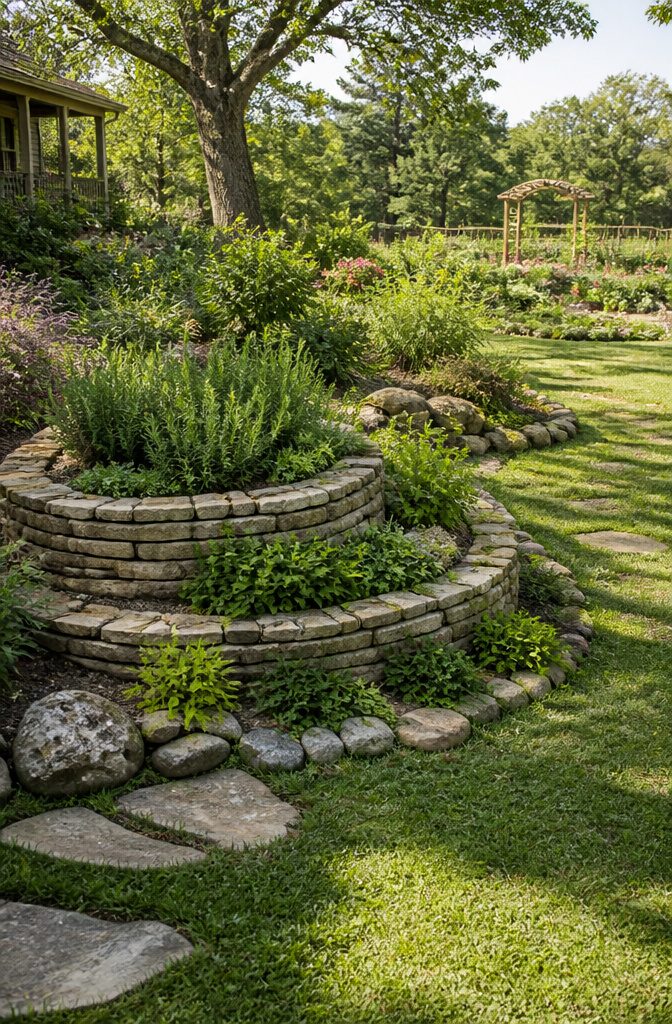
A sloped yard that used to send potting soil downhill after every rain turned into the steadiest herb bed on my property once I built it in tiers.
Retaining walls or stacked stones hold each level flat, so water soaks in instead of carrying nutrients away, and the drainage improves with every step down.
Dry-loving herbs such as rosemary and thyme belong on the top tier, where the soil dries fastest. Parsley, mint, and other herbs that want more consistent moisture can sit lower, since gravity and runoff collect there.
I arrange plantings from top to bottom by water need, driest to wettest, and skip the guesswork about which roots are sitting in soggy soil.
Raised beds stacked in steps achieve much the same look with less digging into the existing grade. Either way, the slope becomes workable ground rather than a washout waiting to happen.
10. Polytunnel Herb Setup
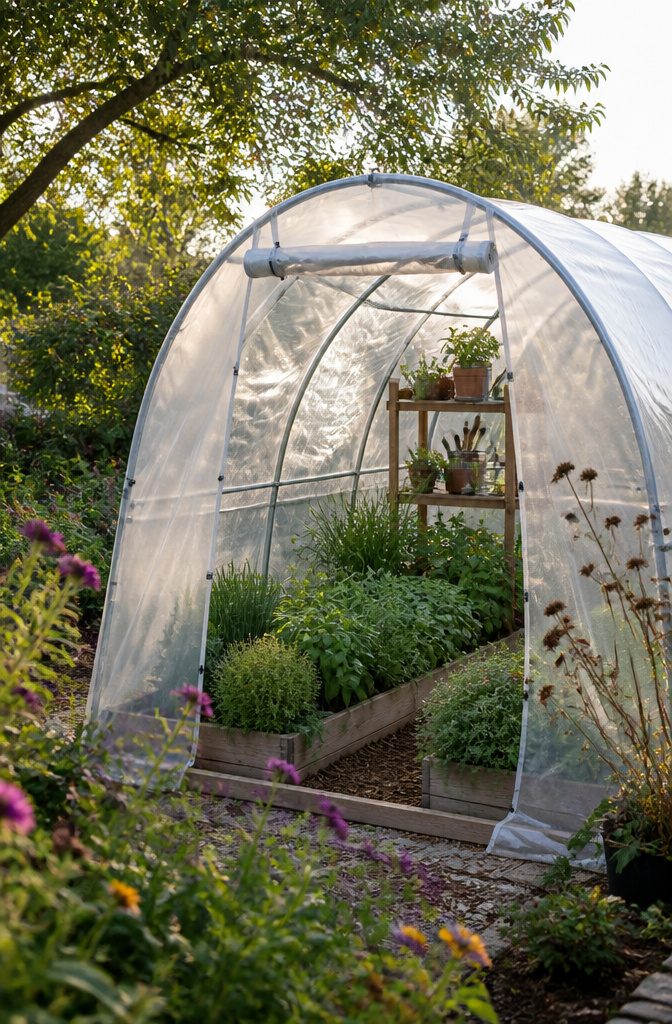
A polytunnel stretches a length of polythene over a half-hoop frame, and for herbs it buys you something no open bed can: months.
The plastic traps heat and holds humidity like a greenhouse, warming soil early enough for planting before your last frost date, yet the whole thing lifts off and stores flat once summer settles in.
I started with one because a full greenhouse cost more than my whole garden budget, and the tunnel did about eighty percent of the work for a fraction of the price.
The catch is that sealed tunnel becomes a steamer. Leave the ends open on warm days, or roll up the sides if yours has that option, or you will cook tender basil and invite rot into thick-leaved sage.
Mice and slugs still find their way in, though the tunnel wall stops rabbits and the worst wind damage.
My first season I sealed everything tight against a cold snap and lost half a tray of thyme to gray mold; ventilation turned out to be the skill, not the structure.
Polytunnels come small enough to sit over a single raised bed, so even a patio gardener running $500 a year can fit one. Move it to follow sun, or to rest the soil underneath.
11. Repurposed Container Garden
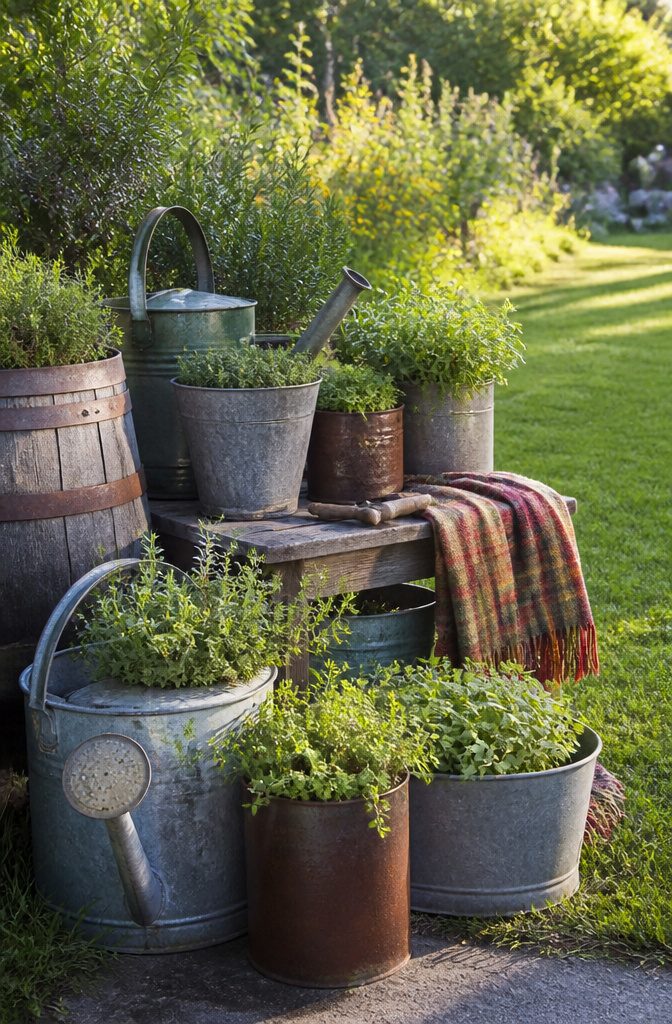
Old barrels, pallets, and the tins your coffee came in can all become herb containers once you drill drainage holes in the bottom.
Without that modification, water pools and rots the roots; with it, a found object functions exactly like a store-bought pot.
Galvanized buckets give an industrial look to a cluster of thyme and oregano. Old watering cans, teapots, or ice cream tubs work the same way, each needing that single hole punched through.
Woven baskets and wooden wine boxes hide a plastic liner for indoor use, though I would keep those near a kitchen window where you will notice if condensation builds.
Paint on old vases or tins lets the container match your decor, but the paint job is optional; the hole is not.
Moving the whole planted unit inside for a cold night, or outside once frost passes, is simpler when everything sits in one portable shell.
The herbs do not care whether the shell cost nothing or thirty dollars. They care whether the water leaves.
12. Kitchen-Adjacent Herb Garden
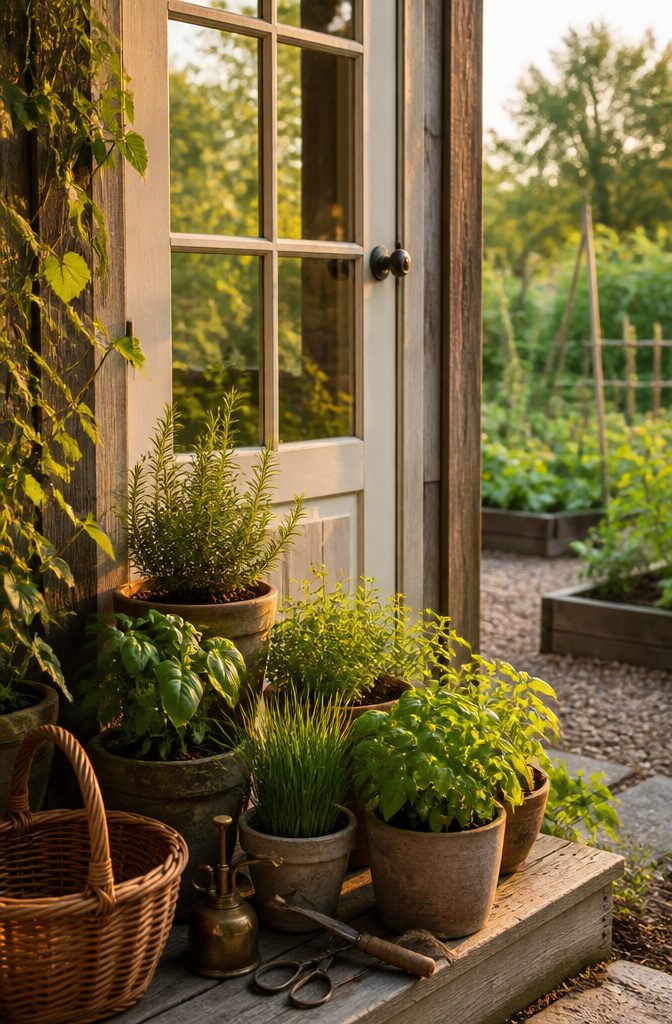
The kitchen door is the obvious place for an herb garden because you actually use what you can grab in thirty seconds.
I learned this after two summers of walking past a perfectly good thyme patch at the far end of my yard to grab dried stuff from the cabinet instead.
Keep the planting within arm’s reach of the door, and you will cook with fresh herbs daily.
Pots work better than open ground here because you can shift them when summer heat radiates off the patio or the house wall.
Move the basil to a cooler morning spot when August arrives, or tuck the mint behind the others so its roots do not escape into your lawn.
A cluster of six-inch terracotta pots fits on most doorsteps and costs less than a single failed raised bed.
"Placing herb pots near outdoor kitchens or grills ensures convenient access to flavorful sprigs for enhancing meat and vegetable dishes"
That same logic applies at the kitchen door: the herbs you see are the herbs you snip.
Choose compact varieties like Greek oregano, chives, and the smaller thymes so the pots do not crowd the threshold. My rosemary started in a twelve-inch pot by the back step and stayed there three years before it outgrew the space.
13. Herb Spiral Garden
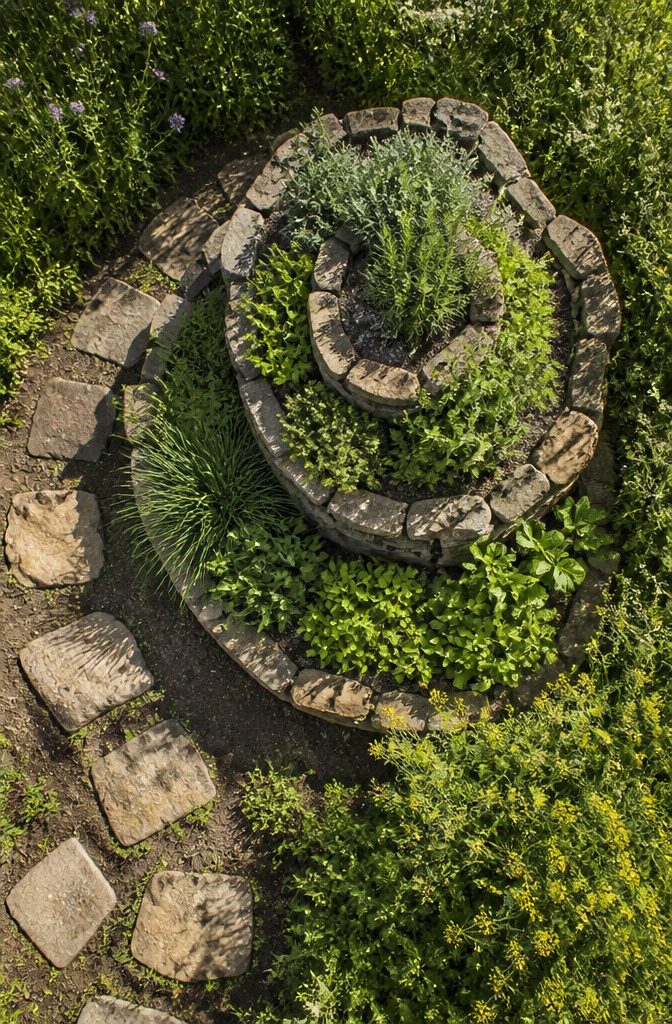
A herb spiral turns a three-foot circle into six or more feet of planting edge by building upward in a curl of stacked stone or brick. The top dries out fastest, which suits thyme, rosemary, and oregano just fine.
Water from the top runnels down to the base, so parsley, mint, and chives sit where the soil stays damp longest. The same structure grows wet-footed herbs and drought-tolerant ones without separate beds.
The curve itself matters. Stones warm on the south face, cool on the north, so a sun-hungry plant gets more heat and a tender one gets shelter from afternoon scorch.
I have seen spirals built from salvaged brick, fieldstone, even broken concrete with the rough edge buried. Stumps or posts work too, though they soften faster.
Start the spiral no wider than you can reach across, or the center becomes a weed trap you cannot touch without stepping on the bed.
Three feet across and rising eighteen inches to two feet at the crown handles most yards. Fill with whatever soil you have improved; the stone does the real work, creating those microclimates from drainage and exposure, not from imported mix.
14. Cottage-Style Herb Garden
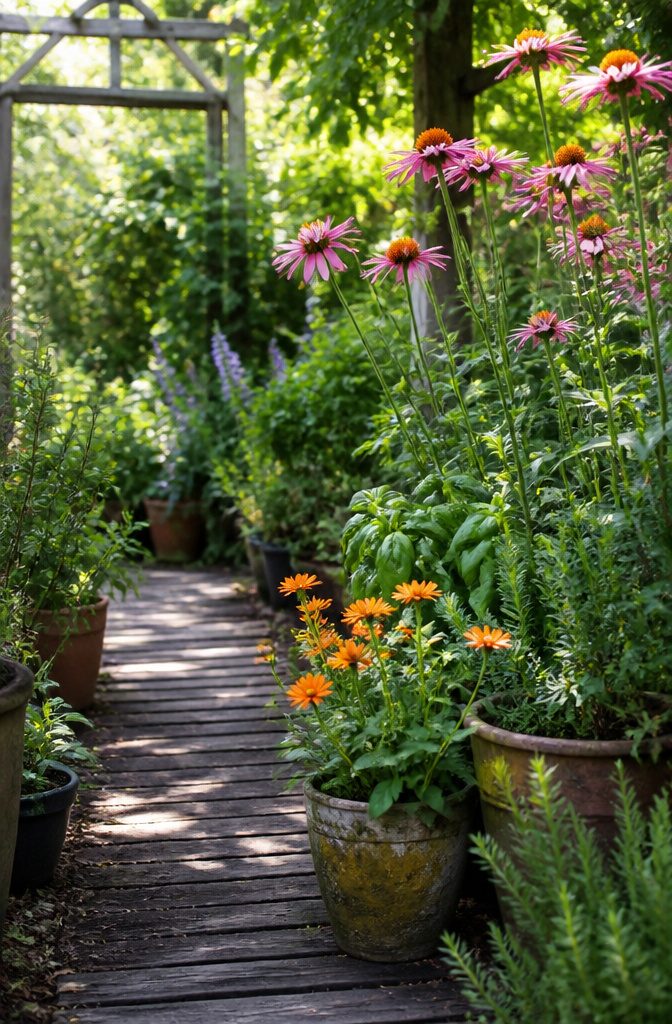
A cottage-style herb garden works best when you stop treating herbs and flowers as separate departments.
I plant echinacea right among the basil and let calendula self-seed between the thyme. The soft, untidy look comes from letting things find their own spacing rather than lining them out in rows.
Echinacea takes two to three years before the root is worth harvesting, but the flowers feed bees and butterflies from the first summer.
Lavender and calendula pull the same duty. Calendula reseeds and comes back like a perennial if you leave a few flowers to set seed in fall, so the patch thickens without replanting.
This is the one style where a little crowding helps. One plant per square foot is the general rule for a full bed, and the overlap hides bare soil and suppresses weeds.
The pollinators do not care whether a bloom is technically an herb or an ornamental, and neither will you once the bed is humming in July.
15. Minimalist Herb Garden
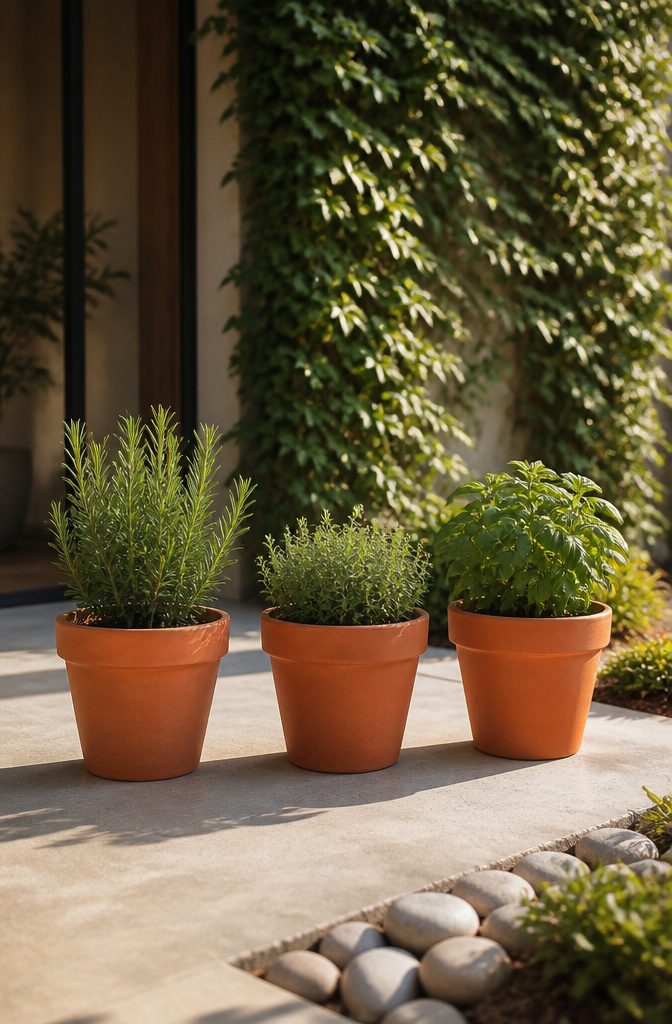
A minimalist herb garden works because restraint gives each plant room to breathe.
Three identical terracotta pots in a row, each holding one rosemary or one thyme, reads calmer than a cluster of mismatched containers fighting for attention. The repetition becomes the design.
I learned this after a season of collecting every interesting pot I found.
The result looked like a yard sale. Switching to one container style, one color, and limiting myself to three herb varieties transformed the same small concrete patio into something that actually felt intentional.
Negative space, the bare surface between and around the pots, did more for the look than any plant I added.
Rosemary makes a good anchor for this setup. Its woody structure and upright habit give the eye something to settle on, especially when the other choices are lower and softer.
Group by use if you want, cooking herbs on the left and fragrance on the right, but keep the containers identical or the grouping stops reading as minimal and starts reading as random.
The cost stays low because you are buying fewer things, and fewer varieties means you learn how those three herbs actually behave in your light and your zone instead of guessing across eight.
16. Indoor-Outdoor Herb Flow
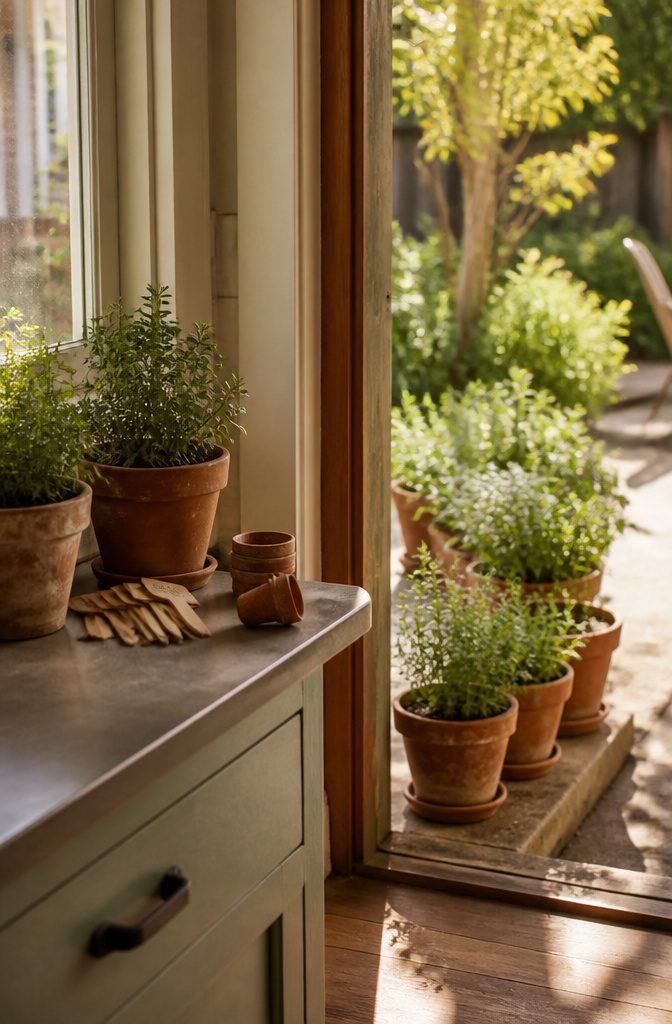
Matching containers let herbs move between indoors and out without the transplant shock that stalls growth for weeks.
I use the same 8-inch terracotta style on my kitchen sill and patio steps, so rosemary and thyme shift with the season. The root ball never gets disturbed.
A transition zone, the space just inside an open door or under a covered porch, is where this back-and-forth works best.
That pocket stays a few degrees warmer than the open yard in late fall and cools slower than the living room in spring, which extends the harvest by a month on either end.
The microclimate buys you about four extra weeks of fresh cuttings.
Continuity matters more than volume. I keep one pot of oregano that never leaves the sill and another that summers outside, then swap their positions.
The outdoor plant hardens off gradually against the house wall, not in one jarring move. The indoor one keeps producing while the transition happens.
The hard limit is light. A container that thrived in June sun will sulk in a north window, no matter how matched the pots are.
I mark the base of each plant with the date it moved, so I know which ones are sulking from low light and which from root trouble.
17. Herb and Vegetable Combo Garden
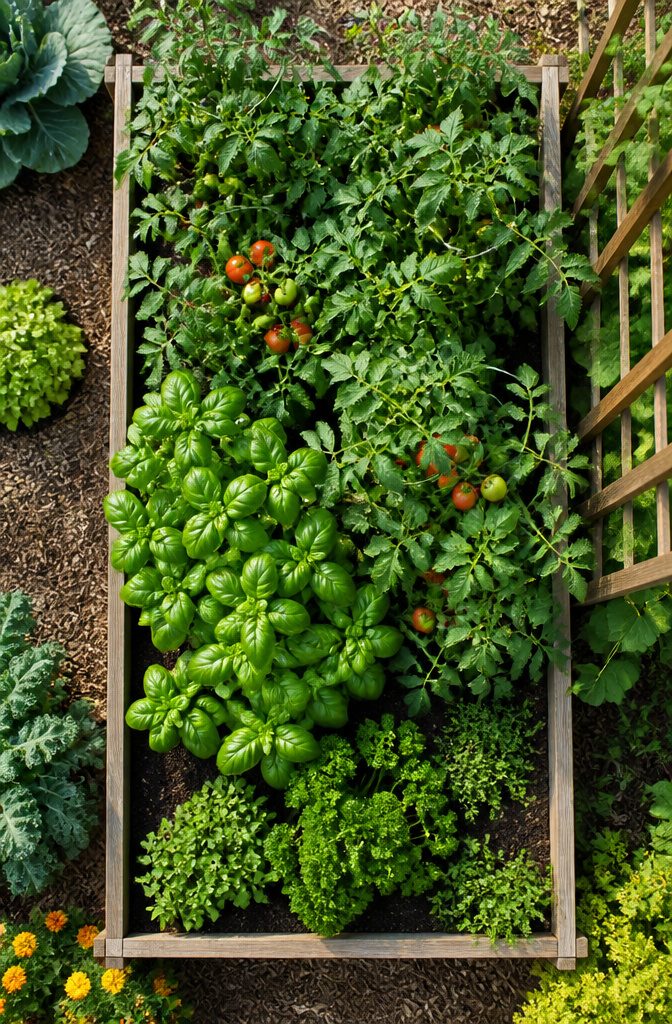
Basil wedged between tomato plants is the pairing most gardeners know, and it works because the basil’s shallow roots don’t compete with the tomato taproot for the same water or nutrients.
I tried this in a 4-by-4 raised bed last season after running out of separate space, and the tomatoes produced normally while the basil stayed bushier from the slight shade on its lower leaves.
Other pairings follow the same logic. Chives planted at the base of carrots can confuse the rust fly with their onion scent, and the carrots return the favor by breaking up soil the chives couldn’t penetrate alone.
Cilantro bolts quickly in summer heat, so tucking it on the east side of taller peppers gives it those few cooler morning hours that stretch the harvest by a week or two.
The real constraint is timing. Fast herbs like dill and cilantro finish before slow crops like Brussels sprouts even form heads, so the bed changes character through the season rather than staying static.
Plan for the herb to be gone by the time the vegetable needs its full spread, or you end up yanking half-mature basil to free a tomato that’s suddenly everywhere.
A 12-inch spacing works for most combinations, but check the mature width on the seed packet of the larger plant and split the difference.
18. DIY Indoor Herb Planter
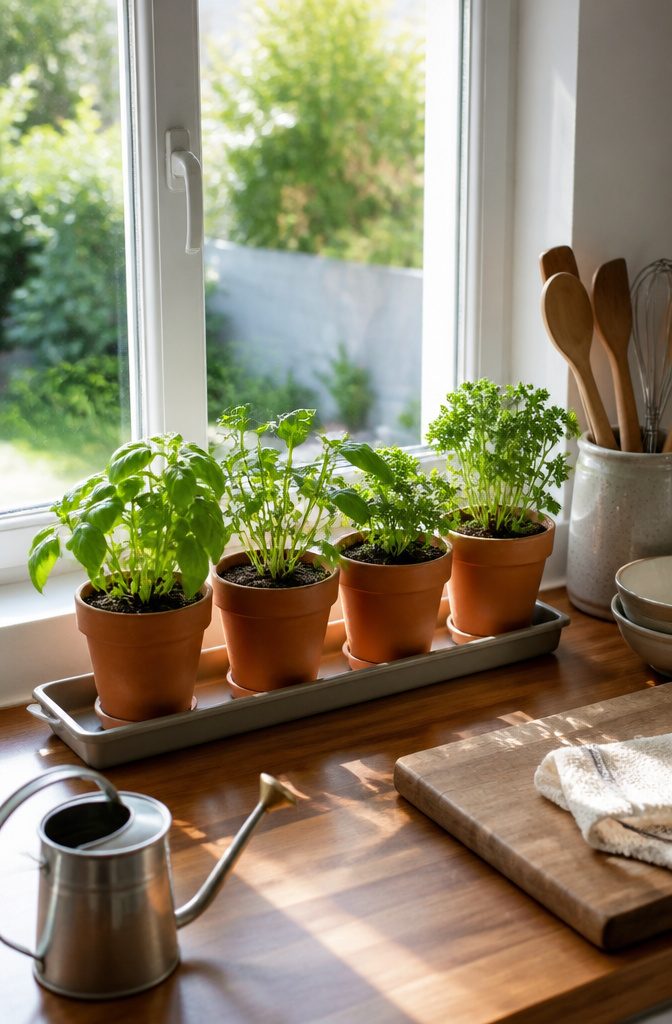
A south-facing windowsill is the easiest place to start an indoor herb garden, but most kitchens need LED or fluorescent grow lights to give herbs enough energy to produce usable leaves.
I learned this the hard way with a basil plant that stretched toward the glass and never filled out; six hours of direct sun is the minimum, and in winter most windows deliver less than half that.
Drainage matters just as much indoors as out. Mediterranean herbs like thyme and oregano evolved in lean, gritty soil that dries fast, and they rot quickly in waterlogged potting mix.
I use containers with holes and a saucer underneath, or nest plastic nursery pots inside cachepots and lift them out to water at the sink.
A handful of coarse sand or perlite mixed into standard potting soil improves drainage enough to keep roots healthy.
For lower-light spots, mint and parsley tolerate shade better than rosemary or basil, though even they grow slowly without adequate light.
Start with one or two plants rather than a full windowsill row; it is easier to adjust light and watering for a single pot than to watch a whole collection fail together.
19. Hanging Gutter Planter
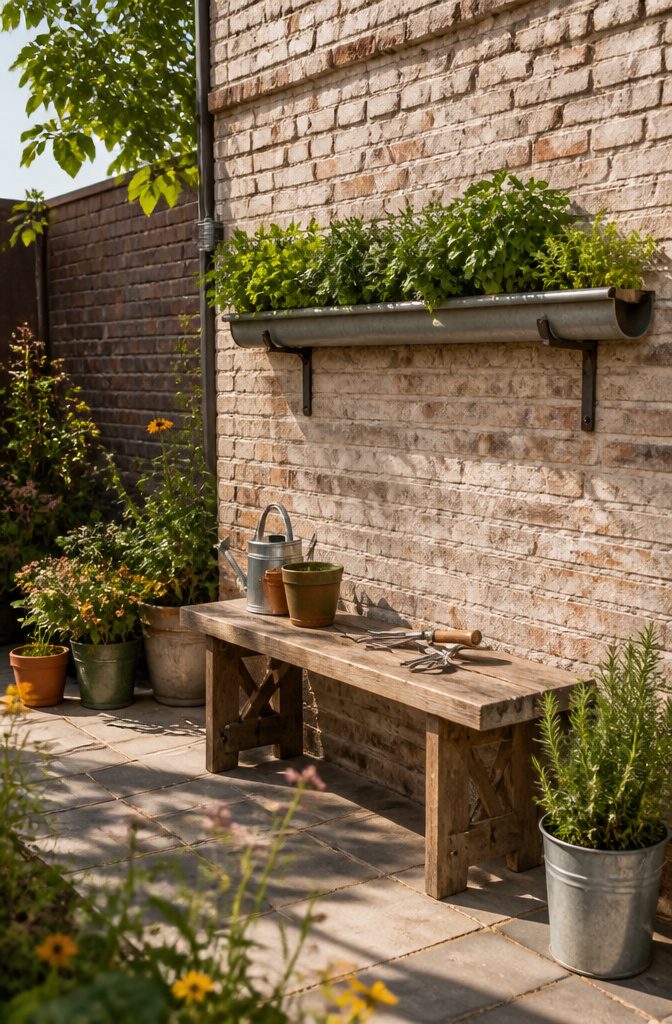
A gutter mounted on a wall or fence rail turns empty vertical space into a row of growing room.
The shallow channel suits shallow-rooted herbs: basil, cilantro, and parsley each spread their roots wide rather than deep, so they settle in without crowding.
Drill drainage holes every six inches or so along the bottom, because trapped water rots the stems faster than drought wilts the leaves.
Brackets need to hold the weight of soil plus a soaking, so skip the light-duty hardware and use something rated for gutters or shelving, not picture frames.
What convinced me, reading through a dozen of these builds, is that the real cost is not the gutter itself but the bracket math.
A ten-foot span might need four solid mounts, and that changes how you price the project against a simple pot on the ground.
The finished look runs modern and clean, which is not every patio’s mood, but for a narrow balcony where floor space is already claimed by a chair and a grill, the wall is the only garden left.
20. Mason Jar Herb Garden
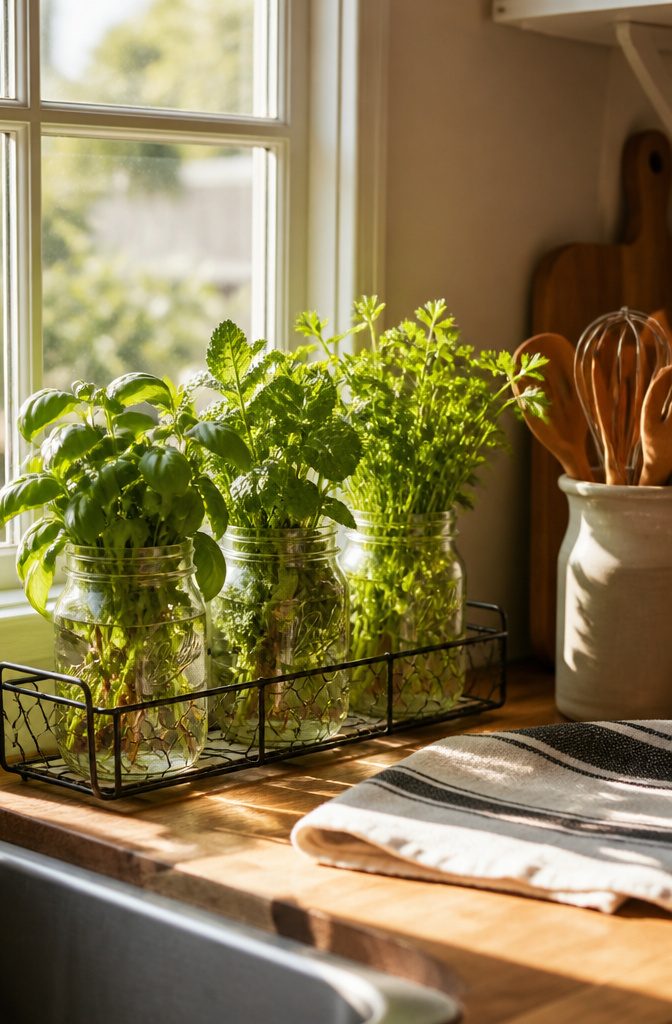
A row of mason jars on a kitchen windowsill is one of the quickest ways to keep basil, mint, and parsley within arm’s reach while you cook.
The look is clean, the footprint is tiny, and the jars cost next to nothing if you already buy preserves or sauces in them.
The catch is drainage. Glass holds moisture against the roots, and without drainage holes or very careful watering, root rot arrives fast.
I have seen the same setup fail twice: once from soggy soil, once from leaving the jar in standing water after a heavy pour. Two ways to play this.
Drill or punch a hole in the bottom of each jar and set it on a saucer, or skip the holes and treat the jar like a terrarium, watering only when the top inch of mix is dry and never letting water pool.
The first route forgives mistakes; the second demands attention every single time.
A simple wire rack or a length of twine hung against the wall turns the jars from countertop clutter into a deliberate display.
Parsley and mint handle the lower light of a north-facing sill better than basil, which wants the brightest spot you have.
21. Herb Garden Labels
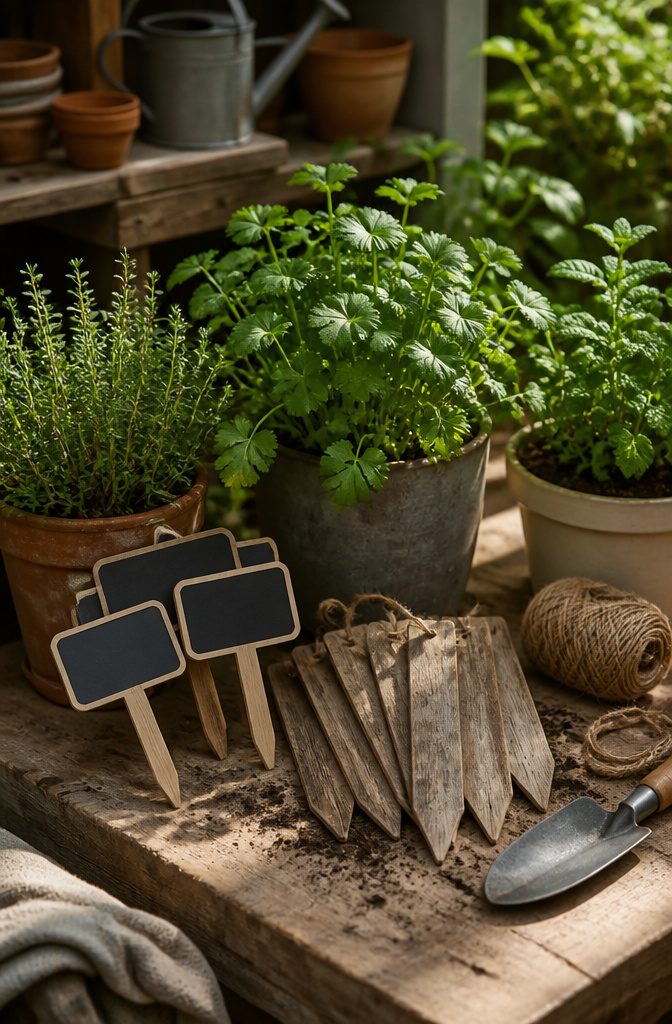
Seedlings and first-year cuttings all look the same, so a labeling system saves you from the classic June mistake of treating cilantro like parsley. I learned this after pulling three "weeds" that turned out to be slow-starting dill.
Temporary chalkboard labels work well for annual beds or container rotations.
A frame coated in chalkboard paint lets you rewrite names as you swap summer basil for fall chervil, and the black surface against green foliage reads clean from across the patio.
For something less involved, plain garden string and handwritten tags tied to mason jars or tin cans do the job without extra cost.
Permanent identification matters more in raised beds or perennial borders where herbs return for years.
Vinyl labels cut on a machine like the Silhouette Cameo give a crisp, script finish that survives rain and sun; the cut file is free, and the project takes under an hour once you have the file ready.
Painted tin cans with chalkboard stickers sit in between: durable enough for a season or two, cheap to replace when the writing fades.
The choice depends on how often your planting changes.
Chalkboard systems win if you rotate crops. Vinyl or stamped metal tags suit the herb bed you plan to keep static for three to five years.
Either way, label before the leaves are fully formed; by midsummer, the stem structure and flower buds make the plant obvious, but the label has already earned its place.
Best Herbs for Beginners
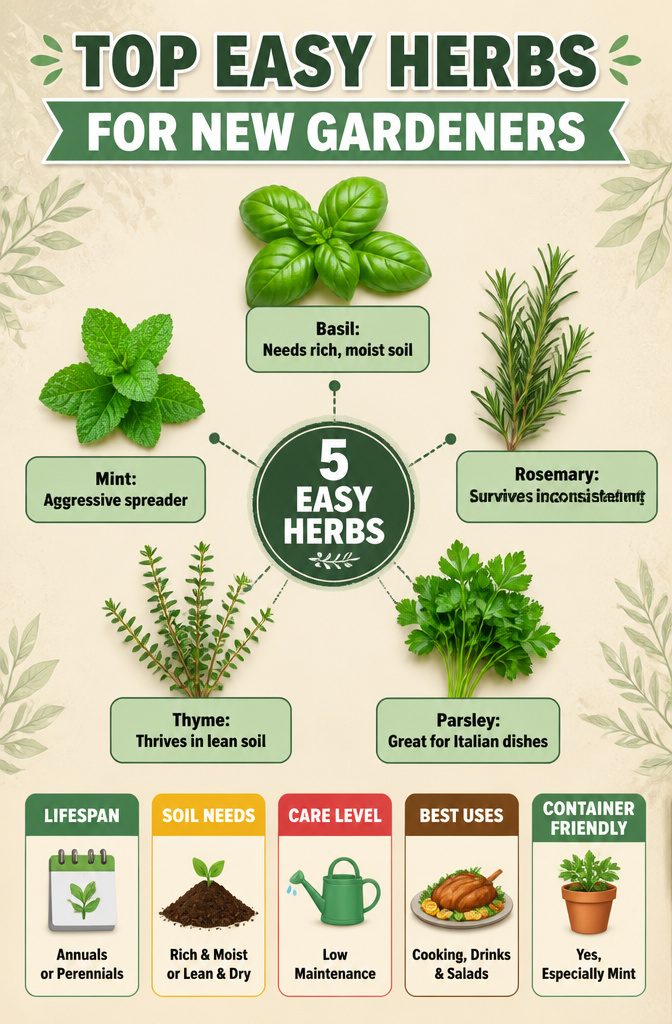
Some herbs practically raise themselves. Basil, mint, rosemary, thyme, and parsley are the ones I point new gardeners toward first, because each forgives the lapses that kill fussier plants.
Basil wants heat and rich, moisture-holding soil, and it dies back with the first frost, so you replant it every spring.
That annual cycle makes it less work than it sounds; you are not managing it through winter, just starting fresh when the weather warms.
Parsley and mint handle the same richer soil, and mint spreads so aggressively that a container saves you from regret later.
Rosemary and thyme are the perennials in this group, and the woody structure helps them survive inconsistent watering and still produce that pine-scented, earthy flavor through multiple seasons.
They prefer leaner, drier soil, so pairing them together in one bed or pot keeps your care simple.
What you cook matters here. Basil and parsley lean toward Italian dishes; rosemary and thyme pair with roasted meats; mint lands in drinks and salads.
If you only grow what you will actually pinch for dinner, the garden stays manageable and you notice when a plant struggles.
Soil and Drainage Needs
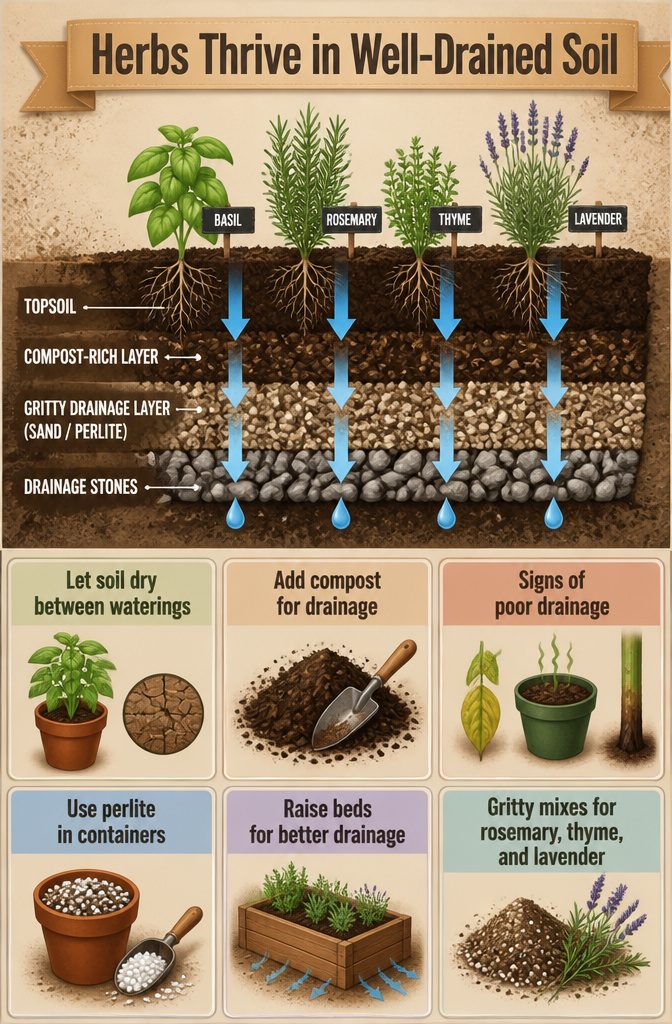
Most herbs come from Mediterranean hillsides where the soil drains fast and dries between rains.
That heritage means their roots suffocate in the soggy ground that tomatoes or lettuce might tolerate. Let the soil dry between waterings; wet feet kill more herbs than drought ever does.
Compost fixes both problems at once.
Worked into the top few inches of a bed or mixed into a container blend, it opens tight clay so water moves through and gives hungry leafy herbs like basil the organic matter they want.
For rosemary, thyme, and lavender, lean toward grittier mixes; these plants prefer leaner soil and will stretch and flop in too-rich mixes.
Poor drainage announces itself. Yellow leaves, a sour smell from the pot or bed, and stems that darken at the base all point to roots sitting in water.
In containers, the fix is usually fresh mix with more perlite or coarse sand. In raised beds, fork in compost and consider whether the bed itself sits high enough; a true raised bed should shed water, not collect it.
If the surrounding yard stays muddy after rain, your bed may need another layer of drainage material or simply more height above the native soil.
Sunlight Requirements
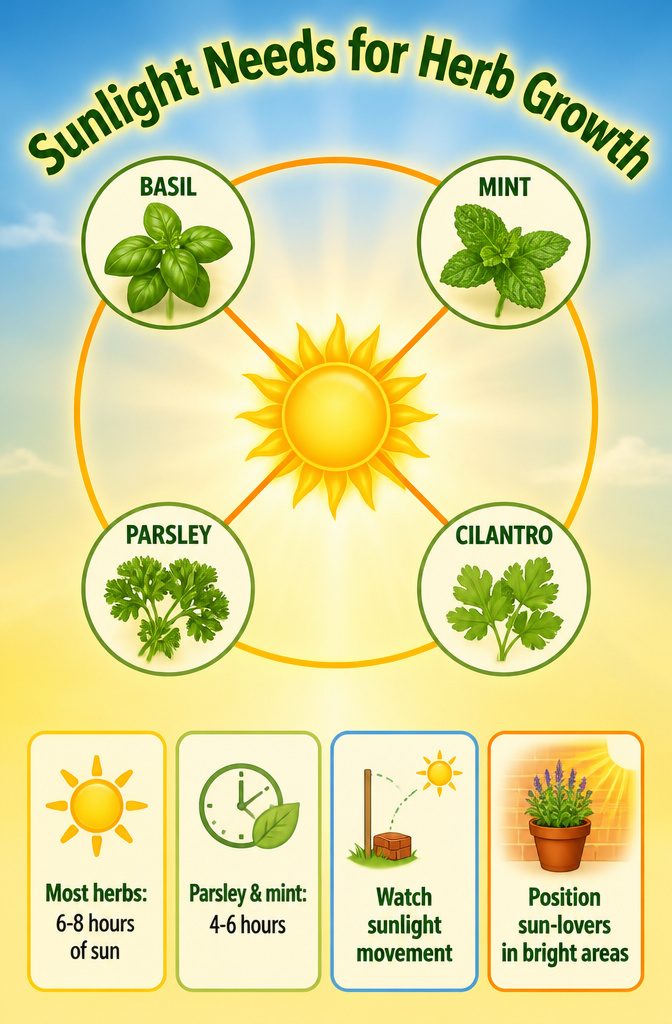
Most herbs want full sun, meaning six to eight hours of direct light each day, and they will let you know when they do not get it by growing leggy and producing thin, pale leaves.
Parsley, chives, mint, and cilantro are the exceptions that still perform well on four to six hours, so partial shade is workable for those four.
Before you commit a bed or container to its spot, watch how sunlight actually moves across your space. A corner that looks bright at 10 a.m. can fall into shadow by early afternoon once the sun shifts.
I spend three or four days marking the line of shade with a spare brick or a stick every couple of hours; the pattern usually surprises me.
A south-facing wall or the open center of a patio typically holds the steadiest light, while east-facing spots work for the shade-tolerant herbs if that is all you have.
Place your sun-lovers like basil and lavender in the brightest real estate you can find, and reserve the dimmer edges for mint and parsley.
Watering and Harvesting Tips
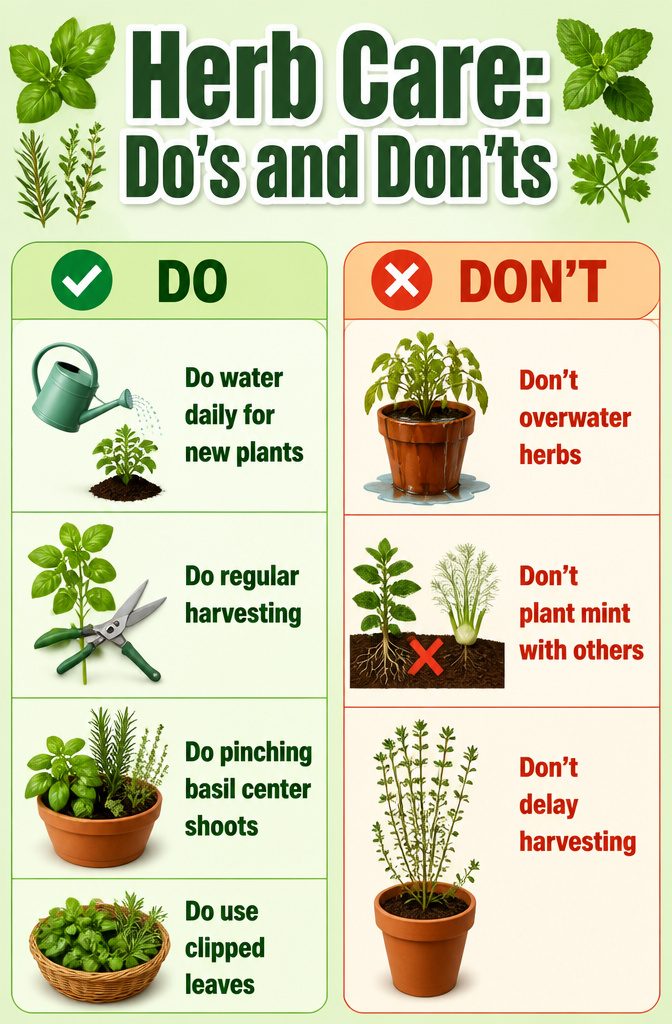
Newly planted herbs need water every day for at least the first month while their roots settle in.
After that, the top inch of soil is your guide; when it feels dry, it is time to water. Basil wants that moisture more often, while rosemary and thyme can handle a little dryness between drinks.
Regular harvesting keeps herbs from turning leggy and sparse.
Pinching off the center shoots on basil forces the plant to branch out instead of flowering into bitterness. The leaves you clip become your dinner, so this is not waste; it is the whole point of growing them.
Three mistakes undo more herb gardens than pests ever will. Overwatering rots the roots faster than underwatering wilts the leaves, especially when drainage is already marginal.
Planting mint, dill, or fennel right next to other herbs courts trouble; mint spreads underground and those others carry their own chemistry that neighboring plants do not appreciate.
The third error is the gentlest: waiting too long to cut, letting the plant grow tall and thin out of politeness. Herbs respond to pruning with more growth, not less.
Container Gardening Basics
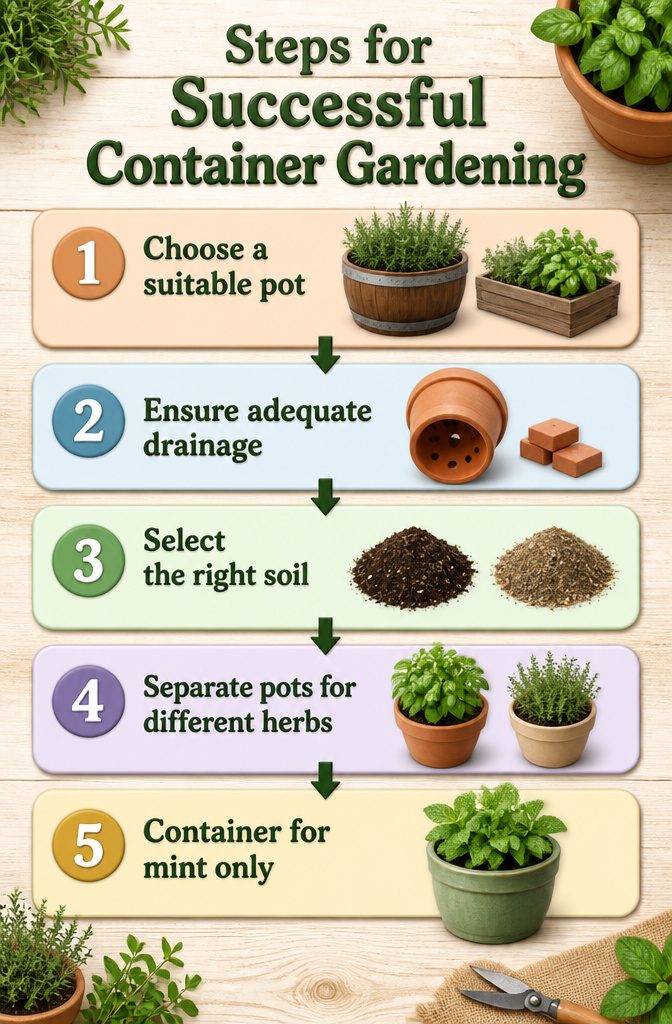
Containers turn almost any sunny spot into herb garden territory, and that portability matters more than I expected starting out. A pot that sits too long in shade one month rolls into afternoon light the next, no digging required.
A half wine barrel or a planter roughly 4 by 4 feet gives woody herbs like rosemary enough room to establish, while smaller pots suit annuals such as basil and cilantro that finish in a single season.
Drainage separates thriving herbs from rotted roots.
Every container needs holes; without them, even careful watering pools at the bottom. I raise pots slightly on feet or bricks so water exits freely rather than sealing against a saucer or patio stone.
Soil control is where containers really earn their keep. Leafy herbs want richer, more moisture-retentive mix, while Mediterranean natives like thyme and oregano prefer leaner, faster-draining conditions.
Growing both in the same box means compromise and usually weaker plants; separate pots let each group get what it actually needs. Mint demands its own container regardless, unless you want it colonizing whatever sits nearby.
Frequently Asked Questions
What herbs should I start with?
Start with basil, rosemary, mint, thyme, and parsley. These five are forgiving enough for beginners and useful enough that you will actually harvest them.
The article groups them by growing habit, basil and parsley want richer soil and more water, while rosemary and thyme prefer leaner, drier conditions, so you learn two different care routines at once.
Do herbs grow better in pots or ground?
Most herbs grow well in either. The article favors pots and raised beds for control over soil and drainage, especially when you need to separate mint from everything else or move tender plants indoors for winter.
Open ground lets plants reach full size, but containers solve more problems for small spaces and beginner mistakes.
How often should I water herbs?
Water when the top inch of soil feels dry.
Basil wants more frequent moisture, while rosemary and thyme prefer to dry out between waterings. The article stresses drainage holes as non-negotiable in any container, soggy soil rots roots faster than underwatering stalls growth.
What is the best way to harvest herbs?
Snip regularly and a little at a time. The article notes that herbs at eye level or within arm’s reach get harvested more often, and frequent cutting keeps plants bushy rather than leggy.
A basket beside the kitchen door or a rail bolted to a balcony puts the scissors where you will actually use them.
Can I grow herbs indoors?
Yes, if they get enough light and drainage. The article recommends south- or west-facing windows for most herbs, with parsley, chives, mint, and cilantro managing on four to six hours.
Ceramic pots lined with small stones keep drainage from damaging drywall, and matching indoor and outdoor containers lets plants move seasonally without transplant shock.