
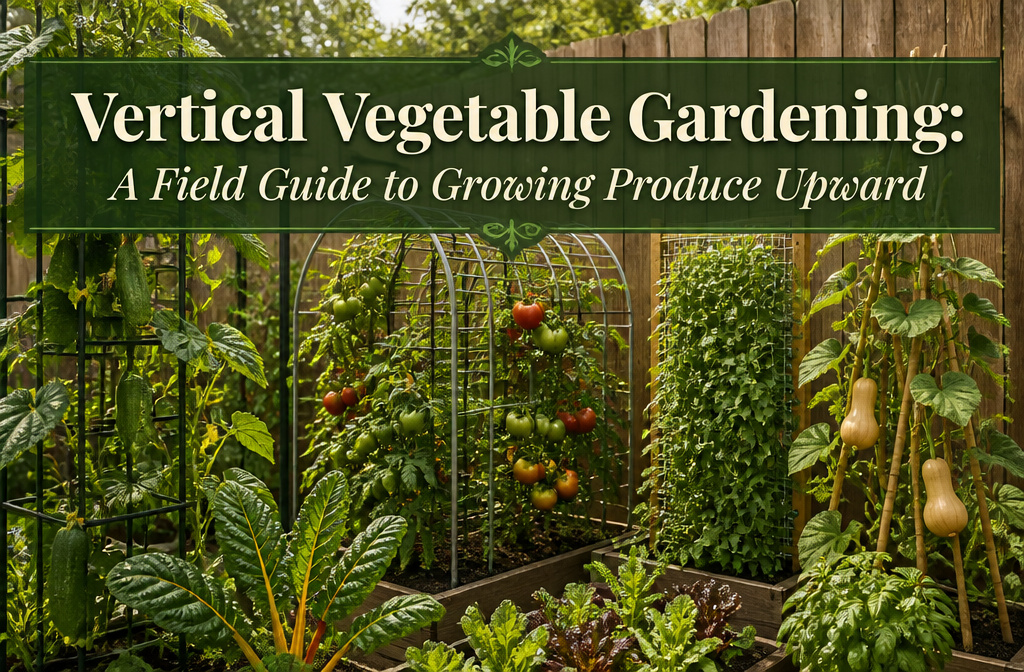
Vertical vegetable gardening is the practice of training crops upward on trellises, panels, and supports rather than letting them spread across the ground.
It only works if you match the plant to the structure; a full-size butternut squash will tear a basic frame right out of the soil, while indeterminate tomatoes on an arched cattle panel can reach eight feet and stay clean all season.
The payoff is measured in square footage recovered from narrow beds and in the blight that never showed up on my trellised plants because the leaves dried faster than the sprawled ones two feet away.
Tomatoes
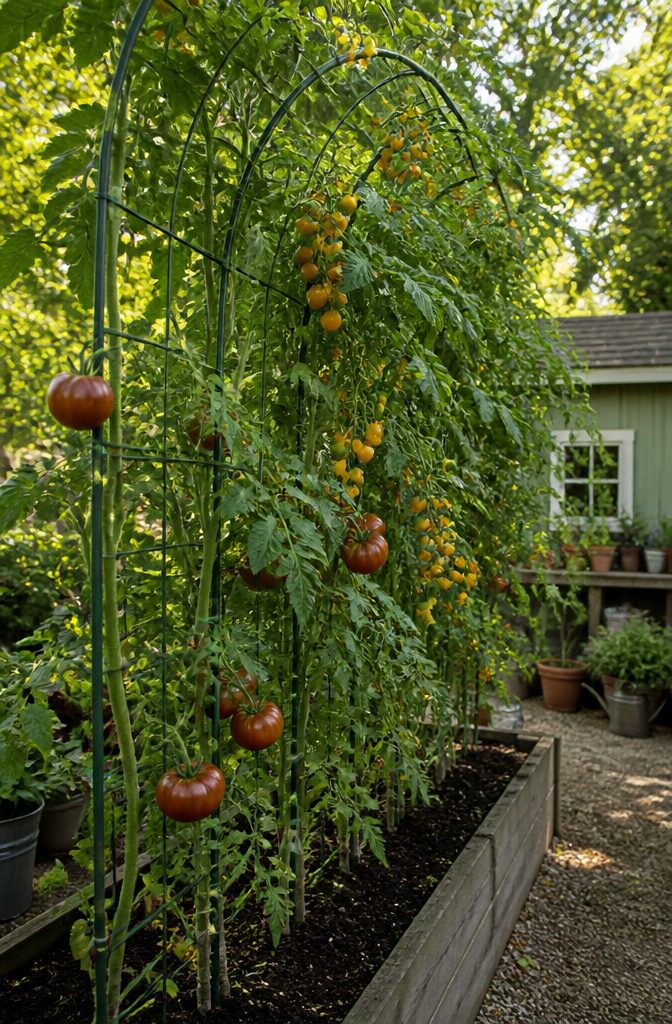
Indeterminate tomatoes are the ones that make vertical vegetable gardening worth the effort.
These vining types keep growing and setting fruit all season, often reaching 8 feet tall on a sturdy trellis, while determinate varieties top out at bush height and stop.
That distinction matters because a determinate plant will never climb; it will only collapse against whatever you prop it on.
My first season, I tried standard tomato cages.
The indeterminate plants outgrew them by July, flopped over, and turned the bed into a humid tangle where blight moved in fast. Staking worked better but meant constant tying as new growth shot past the pole.
A trellis, specifically an arched cattle panel, changed the game: the pliable branches tie easily to the vertical wires, and the height handles the full season’s growth.
On that setup, 2 feet between plants is enough; they get the air movement that keeps disease down, and the fruit stays off the ground.
Cherokee Purple and Sun Gold are two varieties that have done well for me on that kind of support.
Cucumbers
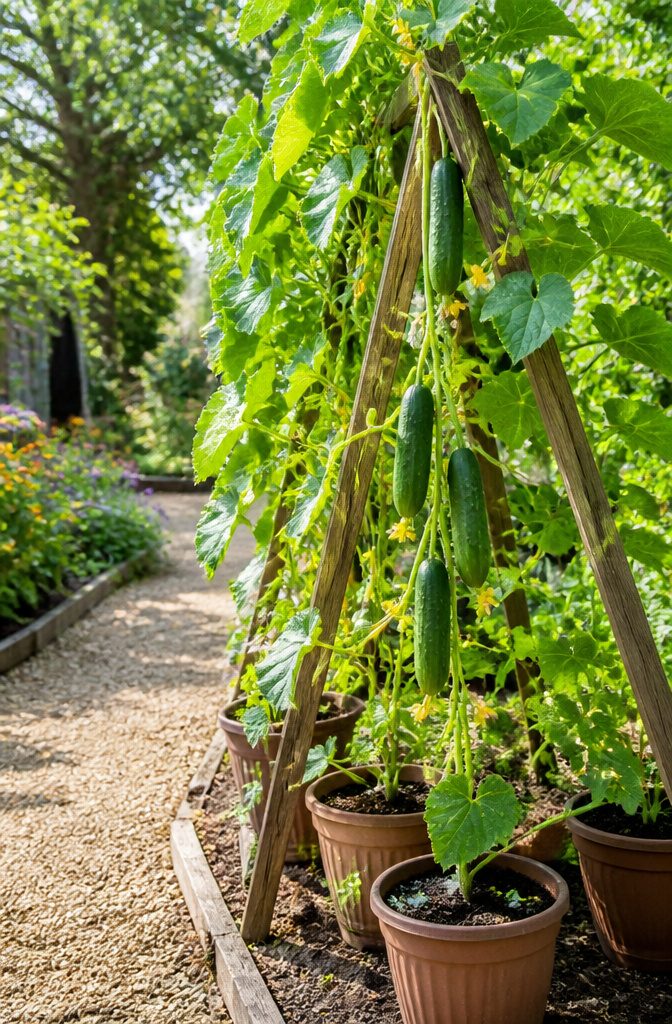
Cucumbers are where I first saw how much vertical growing changes yield.
Vining types grown up a trellis or A-frame outproduce the same plants left to sprawl; the fruit stays cleaner, straighter, and easier to pick, while the leaves dry faster and pick up less mildew.
Bush varieties exist and work in tight spots, but they spread horizontally and tend to shade out whatever sits beside them. For a small patio, the vine is the better use of space.
I space vining plants 6–8 inches apart against the support and check them every few days early on.
The tendrils grip on their own once they find the trellis, though they will happily trail along the ground instead if you let them. A quick tuck of the growing tip upward is usually enough to start the habit.
Bitterness has been my warning sign for stress. In my experience, cucumbers turn bitter fastest when the soil dries unevenly or when afternoon sun beats on exposed fruit without enough leaf cover.
Growing vertically helps with both: the foliage layers over itself for shade, and the improved airflow from pruning lower leaves lets me spot trouble before it spreads.
I still lose a few to heat each July, but far fewer than when I grew them flat.
Peas
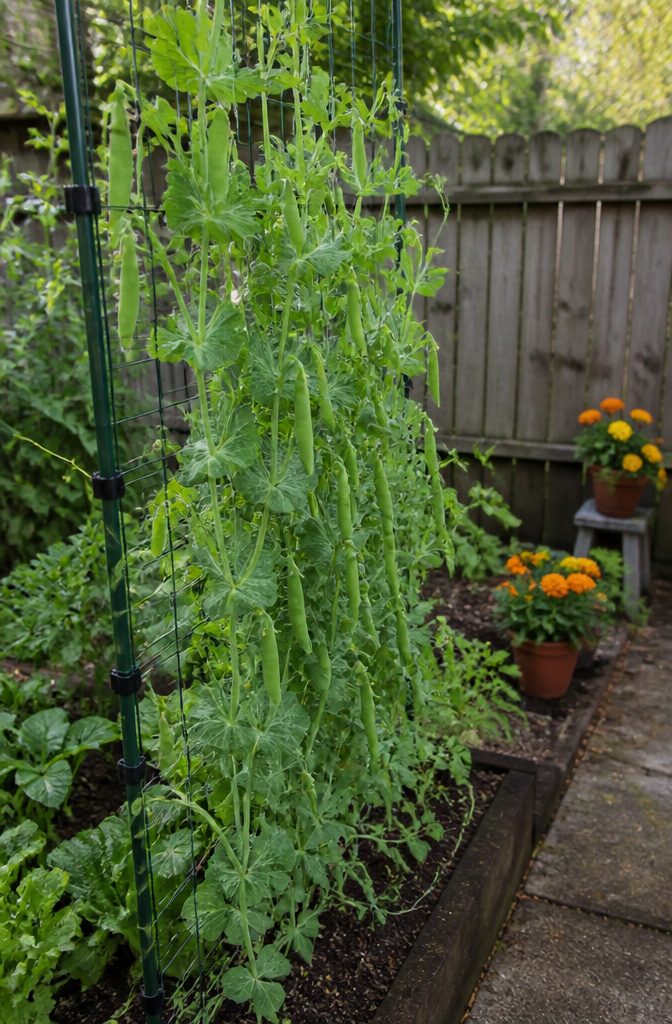
Peas are the crop that taught me vertical vegetable gardening works best when you plant early and trust the plant to do the climbing.
Shelling peas, snap peas, and snow peas all handle cool soil, so I push seeds in as soon as the ground can be worked in March or April.
A fall crop goes in around late July in my zone, though the spring planting always yields heavier for me.
The symbiotic relationship peas form with nitrogen-fixing bacteria means they pull their own fertilizer from the air and leave the soil richer than they found it.
I still amend lightly at planting, but I skip the nitrogen-heavy side-dressing I give hungrier crops.
For trellis height, four to five feet has been enough for every variety I have grown.
Last spring my snap peas topped out at about six inches below the wire and then stopped reaching, which left me with a trellis I could have cut shorter.
The tendrils twine on their own once they find the support; I check weekly in April to nudge stray stems back toward the netting, but the training mostly handles itself.
Pole Beans and Runner Beans
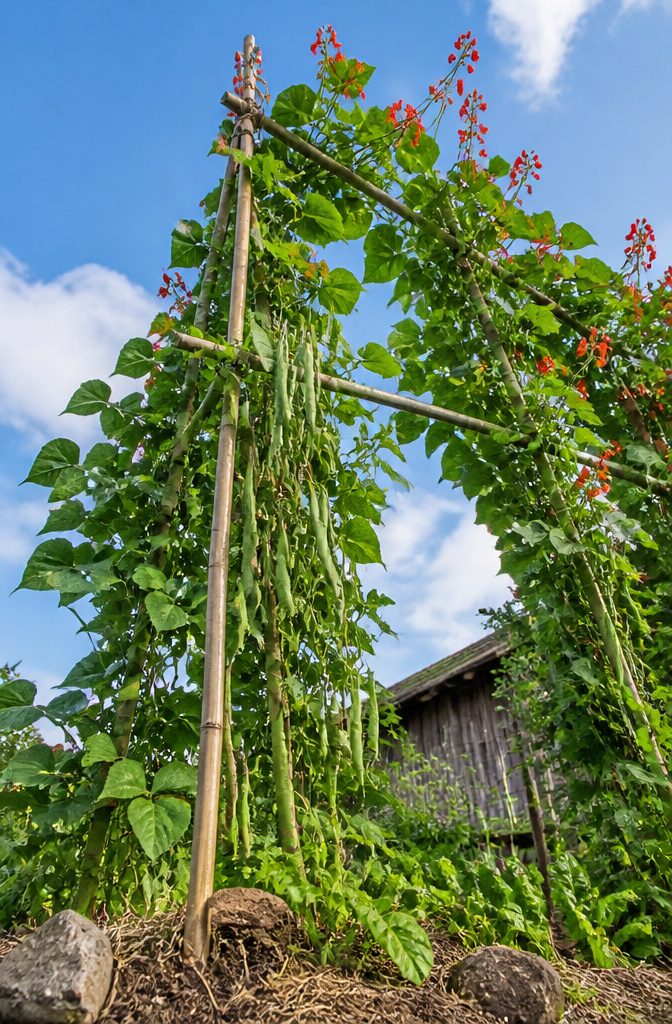
Pole beans are the natural starting point for vertical vegetable gardening, and the distinction between pole and bush habits matters more than most beginners expect.
Bush beans top out around knee height and produce one concentrated flush, while pole beans keep climbing and yielding until frost takes them.
That longer harvest window is why I switched after my first season, when three short weeks of bush beans left me staring at empty green stalks.
Runner beans work the same vertical space but bring a different attitude.
Scarlet runner beans carry brilliant red blossoms that read as ornamentals first and food second; I grow them along the back fence where neighbors comment on the flowers before they notice the pods.
Kentucky Wonder is the workhorse I plant for actual meals, with flat, stringless pods that hold up to repeated picking.
The forgiving part is real. Beans fix their own nitrogen, so mediocre soil still gives you something edible, and the seeds are large enough to handle without tweezers or guesswork.
Plant directly after last frost, usually around April, and water every two to three days once the vines are climbing.
Pole varieties do need guidance at first; I twine the first few shoots clockwise around their support by hand, and the rest follows on its own.
Vining Squash
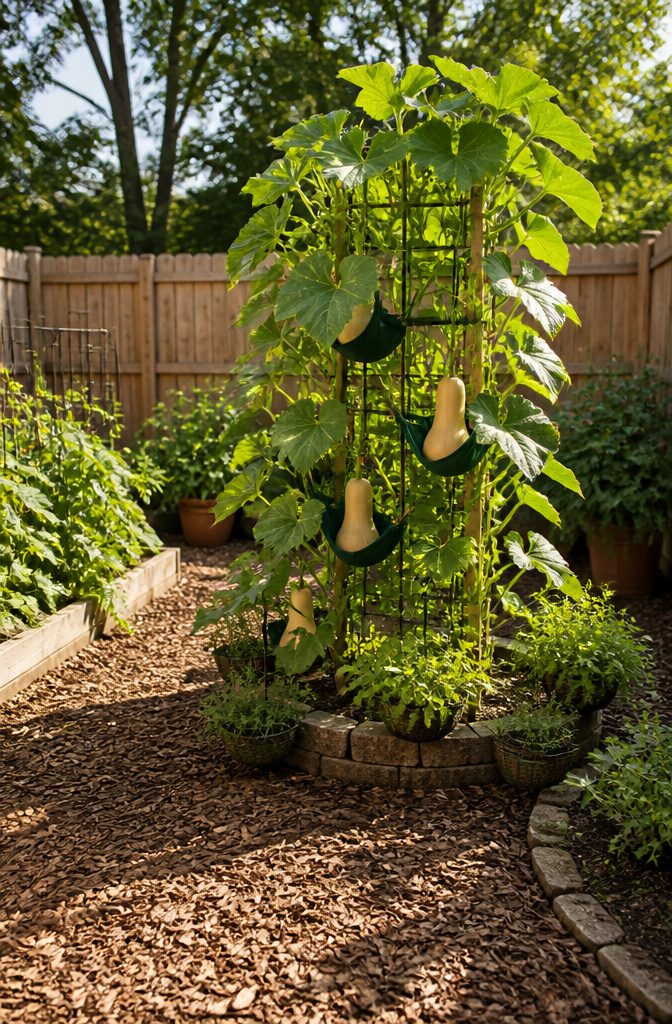
Vining squash can go vertical, but the variety makes or breaks the setup. Acorn squash and summer zucchini stay light enough for most trellises, while a full-size butternut will tear a basic frame right out of the soil.
The fruit itself needs help too: once a squash passes about softball size, its weight starts pulling stems and splitting slings.
I switch to wide fabric strips or melon netting, tied off to the trellis like a hammock under each fruit.
One August I tried a spaghetti squash that outgrew its support by late season; the sling frayed, the squash cracked on the ground, and the whole vine sagged.
Smaller-fruited varieties are the safer bet unless you are building an arbor-grade frame and checking slings twice a week.
Melons
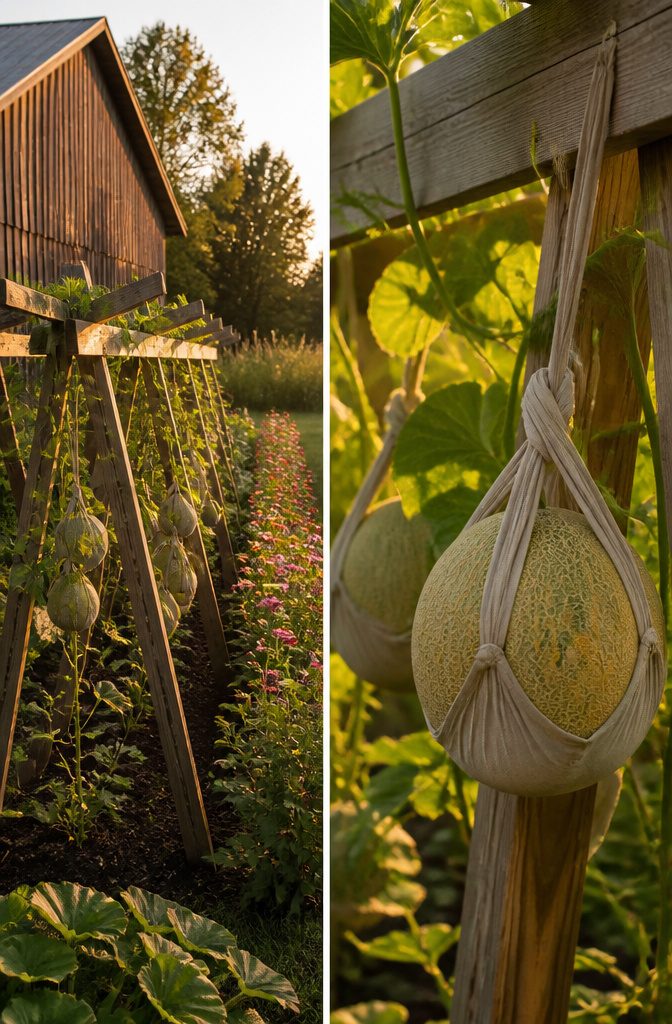
Smaller melons behave better on a trellis than the full-size field types.
Personal-size varieties, the ones sold as serving one or two people, keep their fruit load light enough that a sturdy arbor or cattle-panel arch can hold them without bending.
I train the vines upward by tying them in place; unlike cucumbers, melons do not climb on their own, and their tendrils grip weakly if at all.
The real work starts once the fruit sets. Each melon needs a sling, made from an old T-shirt or scrap of row cover, knotted to the trellis like a hammock.
Without it, the stem tears under the weight or the whole vine snaps. Last season I tried skipping the sling on what looked like a small fruit, and it dropped at golf-ball size.
Hanging fruit ripens with more even sun exposure than ground melons, and the sugar concentrates better where the rind turns fully.
The catch is telling when to cut. Color change on the belly, the spot that faces the soil, is invisible on a vertical melon.
I check the tendril nearest the fruit instead; when it browns and withers, the melon is usually ready. I have also listened for the hollow thump, though that takes practice and I still misjudge one in four.
Varieties worth trying include the compact Asian types and the older Minnesota Midget strain. I lost two plantings to squash vine borers before I got a clean crop, so pest pressure is the honest limiting factor, not the trellis itself.
Eggplants
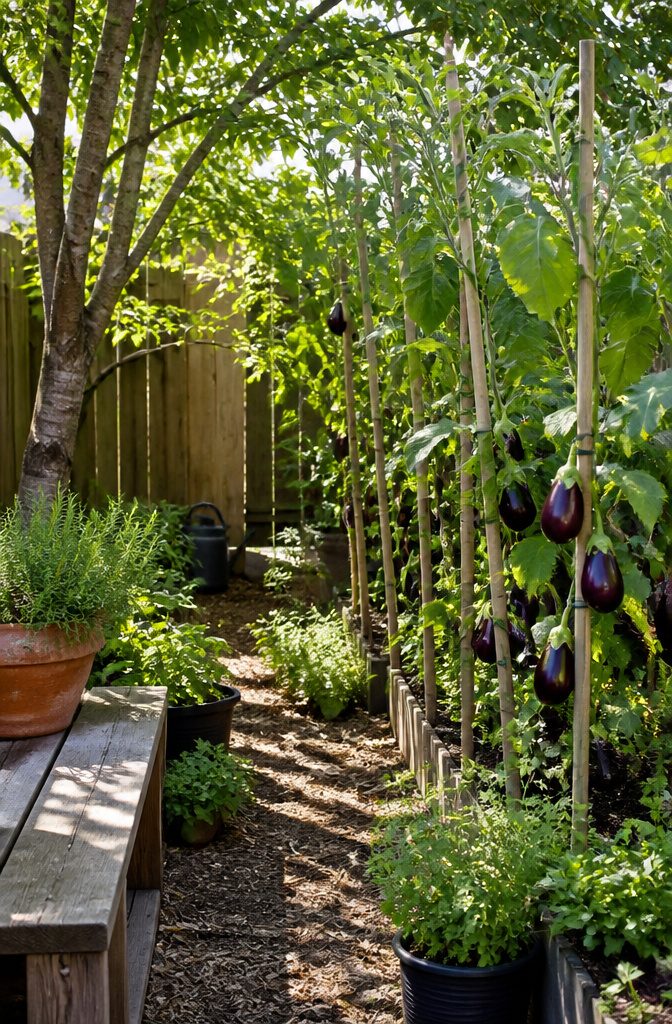
Eggplants are not the first vegetable most people picture when they think of vertical vegetable gardening.
Tomatoes and pole beans climb so naturally that they steal the spotlight, but compact or dwarf eggplant varieties, usually topping out around two feet, adapt well to staking or small tomato cages.
The shorter stature means less weight pulling stems sideways, and a single bamboo stake or a narrow cage gives enough backbone to keep the plant upright through summer.
The real payoff, in my reading, is air circulation.
Eggplant leaves grow broad and overlap fast; left to sprawl, the canopy traps humidity against the soil. Vertical space between leaves and stems dries faster after rain, which cuts down on the moisture-loving fungi that plague nightshades.
I have not grown eggplant myself, but the pattern shows up reliably enough in accounts from gardeners who have: tighter spacing with better airflow beats loose spacing with none.
Flea beetles are the pest that convinced me this matters. They chew tiny shot holes in leaves, and while the damage rarely kills a mature plant, a seedling can stall for weeks.
Beetles overwinter in soil and leaf litter; lifting foliage off the ground removes their easiest highway up from the base.
A staked eggplant also puts the lower leaves at a height where you spot the first pinholes early, before the population explodes.
Small Pumpkins
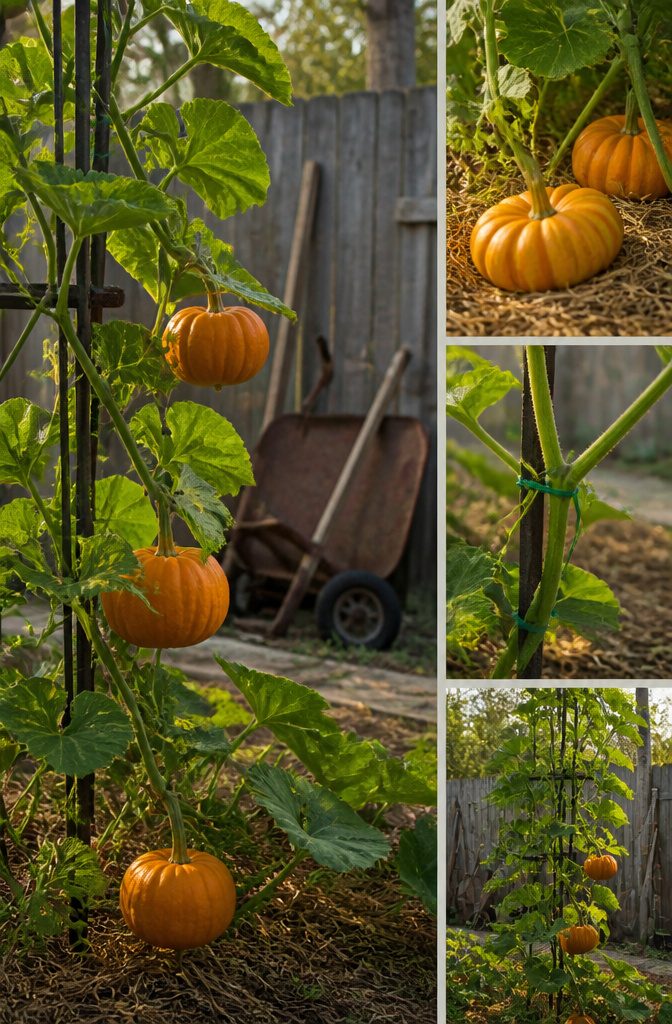
Small pumpkins are where vertical vegetable gardening starts to feel like a magic trick. Jack Be Little, Small Sugar, and the white Casperita all climb willingly enough, though they will not cling the way cucumbers do.
Tendrils appear, but they want guidance: soft ties or clips every foot or so, trained upward through the first few weeks until the vine remembers which way is north.
The stems thicken as the fruit sets, which is the plant doing its own load-bearing calculation. Still, a hammock of stretchy fabric or old pantyhose saves a three-pound pumpkin from snapping off in a wind gust.
I have tried the netting some growers swear by and found it overkill for anything under five pounds, but the sling itself is not negotiable if you want the fruit to ripen fully.
What I did not account for, the year I grew Small Sugar up a cattle-panel arch, was how much a dozen pumpkins would weigh all at once. The panel held, but the wire ties at the base did not.
The whole structure leaned six inches by September, and I spent a morning reinforcing it with stakes I should have installed in June. That arch was meant for decoration, a glowing aisle of orange globes I could photograph.
The pumpkins were edible, technically, but the variety is bred more for pie than show, and the ones that survived the sag were stringy from uneven sun.
Now I grow Jack Be Little on a straight trellis against the garage wall, slung in rows like lanterns, and leave the arch for lighter crops.
Gourds
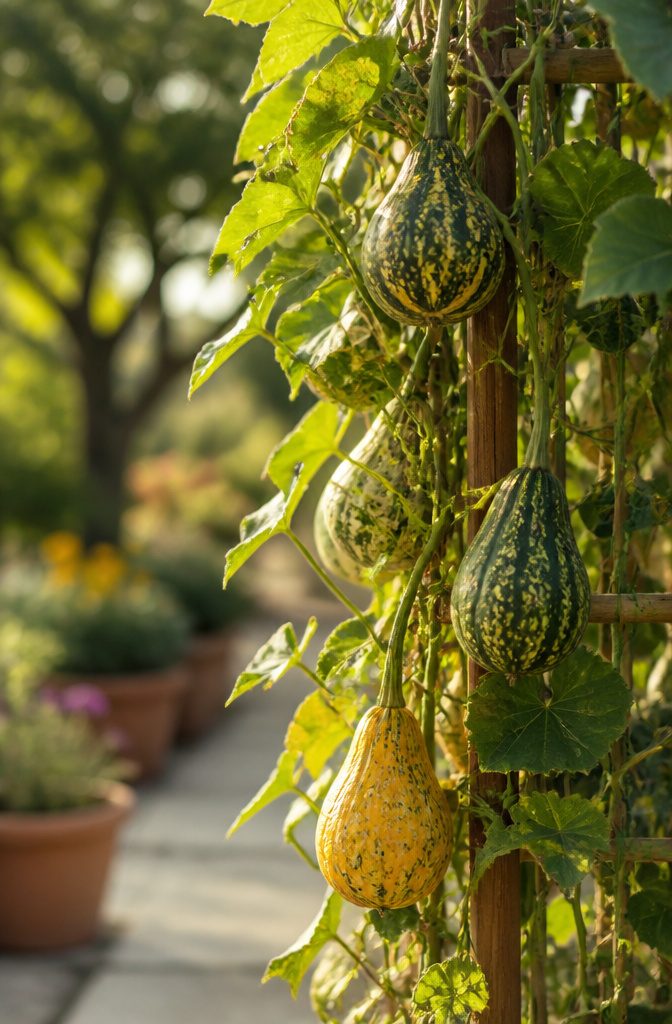
Hard-shelled gourds climb a trellis like they were made for it, their vines reaching six, eight, ten feet while the fruit hangs below, gravity doing the shaping.
Most take 120 to 140 days from seed to maturity, so in shorter zones you start indoors or you wait until next year.
The patience pays off once they dry: leave them on the vine until the stem browns and the skin hardens, a process that stretches well past the first frost.
What you get are the mottled, warty fall decorations that sell for eight dollars at farm stands, or a birdhouse gourd with a clean, pale shell ready for a one-inch entry hole.
I grew luffa once thinking I was clever, forgetting they need even more heat and a full five months of growing season. The vine climbed beautifully, flowered late, and produced exactly two sponges the size of my forearm.
They worked, once the black seeds rattled inside and the skin peeled away like wet paper, but one hundred forty days is the minimum for anything worth harvesting.
Utility or decoration, gourds reward the gardener who has the space to let them dangle and the calendar to ignore them until they rattle.
Basil, Mint, and Thyme
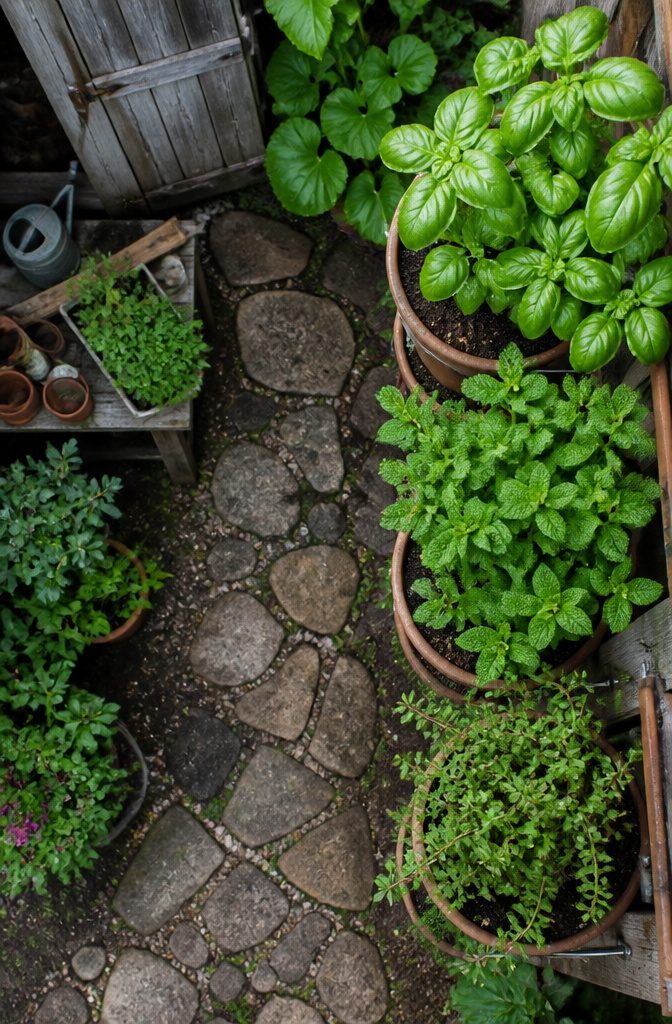
Basil, mint, and thyme are the herbs most often named for vertical setups, and the reasons differ for each.
Basil wants the warmth radiating off a south-facing wall and rewards pocket planters with steady leaf production through summer, though its roots demand drainage holes; water that sits for even a day breeds rot.
Thyme handles drier compost better than most herbs, which makes it forgiving in the shallow soil of stackable systems where moisture evaporates fast from the exposed sides.
Mint is where vertical growing shifts from preference to necessity. Left in ground, it spreads by runners that surface three feet from where you planted it and colonize neighboring beds.
A wall-mounted container or dedicated pocket interrupts that escape route. The containment works, but the same exposed surfaces that limit mint’s invasiveness also wick moisture away faster than an in-ground root zone.
I learned this the hard summer my first herb wall looked lush at 9 a.m. and wilted by 4 p.m.; the pockets dried to dust while the mint in my mother’s border stayed plump on the same day’s rainfall.
"Check which type of green wall is suitable for your garden. Can you connect to mains water? If so, it’s possible to use a drip irrigation system for watering. If not, look for systems where you can use a watering can."
That distinction matters more for herbs than for tomatoes or beans.
A drip line turns a vertical herb wall from a twice-daily hand-watering chore into something you can leave for a weekend, while can-only access means choosing compact, drought-tolerant varieties and accepting some midday stress.
Fence-top planters and plant ladders both work for this scale, but pocket planters with their individual cells keep aggressive spreaders like mint from mingling roots with slower-growing thyme.
What Vertical Growing Changes
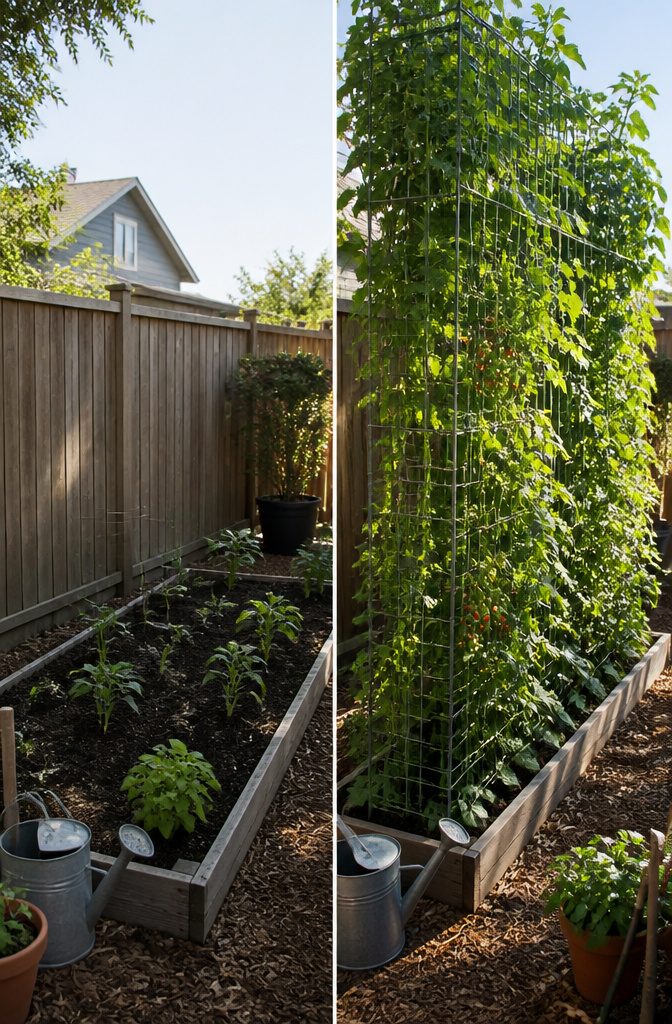
The first thing vertical vegetable gardening did for my patio was buy back square footage I had already written off.
A cattle panel arched over a narrow bed turned about six square feet of soil into enough climbing room for four tomato plants that would have sprawled across twenty if I had let them.
The mechanism is simple: you are farming in three dimensions, not two, so the same footprint holds more plant.
That upward pull changes how the plant lives. Leaves that would have nested against damp soil stay exposed to moving air, and that airflow dries foliage faster after rain or watering.
In my first season growing tomatoes on the ground, powdery mildew showed up by late July; the trellised plants two feet away, same variety, same watering schedule, stayed clean until frost.
The difference was the speed of leaf drying, nothing more exotic than that.
Fruit held off the ground also escapes the soil-borne spores and the slugs that make contact on damp nights.
You spot trouble earlier too: a hornworm on a vertical leaf is at eye level, not hidden under a canopy you have to kneel to inspect.
Harvesting follows the same logic. Pole beans at shoulder height fill a basket in minutes; the same plants on the ground mean bending, parting leaves, and missing the ripe pods that yellowed underneath.
Sun exposure rounds out the advantage. A vertical leaf presents its surface to the light more consistently than one lying horizontal or half-shaded by its neighbor.
More photosynthesis, more sugar, more produce from the same plant. The tradeoff is water: wall-mounted planters especially sit in a rain shadow and dry out faster, so drip line or a timer becomes worth the setup.
Trellis Types
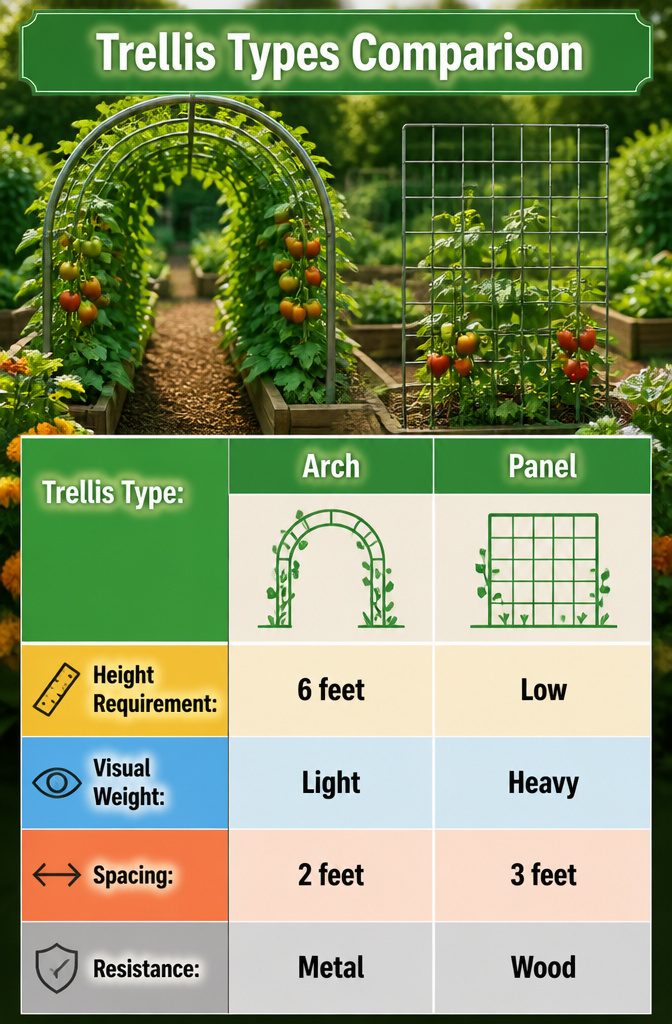
Arch trellises turn the space between two raised beds into a tunnel of hanging produce, with tomatoes or cucumbers ripening at eye level as you walk through.
The curve adds height before anything even climbs, and by August the structure disappears under leaves and fruit.
I learned the hard way that a trellis needs to be at least six feet tall for indeterminate tomatoes and pole beans; anything shorter leaves you with a green tangle at season’s end.
Panel trellises, usually a section of cattle panel or welded wire, work flat against a bed or bent into that same arch shape.
They are cheap, rigid, and let you space vining tomatoes two feet apart instead of three because the air moves through so well. The downside is visual weight; until vines cover it, you are looking at hardware.
Obelisk trellises suit smaller spaces like patio corners or the center of a bed where you want height without length. Peas and shorter beans climb them neatly, but a full cucumber vine will outgrow one by July.
Metal stands up to wind and the weight of wet vines better than wood. If you use timber, push the legs a foot into the soil and check after hard rain.
My wooden obelisk, bought because it looked garden-center sharp, leaned six degrees after one storm and came right out of the ground the next.
Spacing and Training
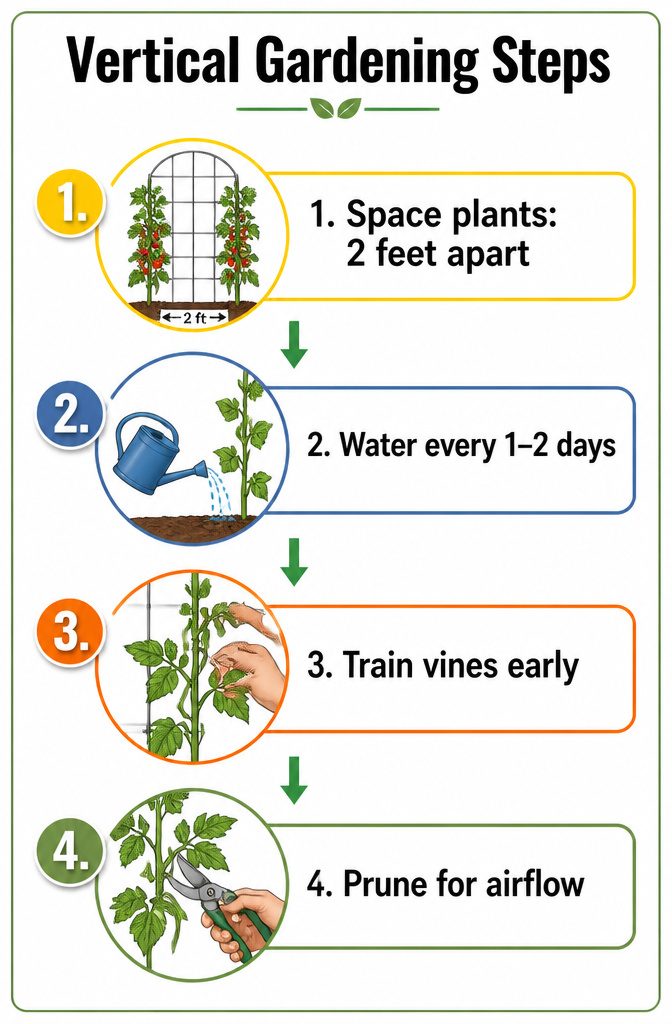
- Space plants closer than you would in a ground bed, but not by much. On my arched cattle panel trellises, tomato plants go 2 feet apart; the vertical growth keeps the vines from crowding each other once they climb.
- Water every 1–2 days during warm months. Air moves freely through a vertical garden, and gravity pulls water downward fast, so the soil dries out quicker than a flat bed. I check the top few inches with my finger each morning before I decide.
- Train vines early and often. I weave new growth through the trellis wires every few days while the stems are still soft; wait too long and you are wrestling woody branches that snap.
- Prune for airflow. My first season, I let tomatoes bush out against the support until the center turned into a humid tangle. Blight followed. Now I pinch off suckers and thin crowded leaves so sun and wind reach every branch. The plants stay drier, and I lose less fruit to rot.
Built-from-Scratch Supports
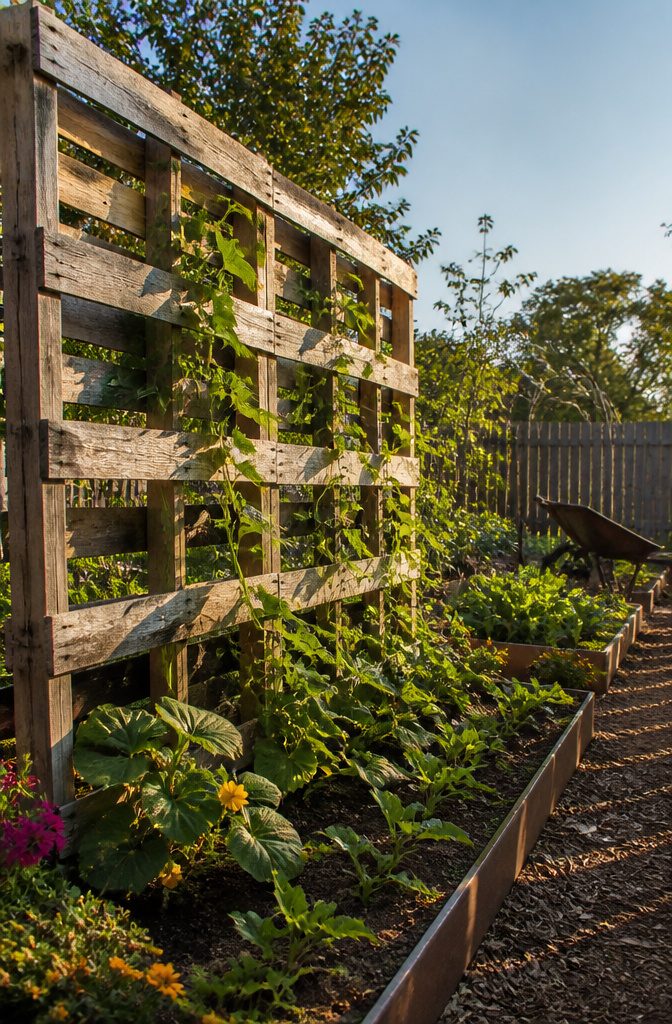
Pallets split into narrow slats and screwed into ladder frames make decent temporary trellises, though the wood rots faster than you expect. Mine lasted two seasons before the bottom rungs turned soft and the whole thing leaned south by August.
Metal tomato cages wrapped with bamboo poles work better for the long haul; the bamboo gives tendriled plants something to grab, and the cage skeleton keeps the shape through heavy wind.
Cattle panel fencing arched between two posts is the structure I keep coming back to.
At 16 ft. by 50 in., a single panel bent into an arch gives you about six feet of walk-through height underneath and rigid support for cucumbers or small melons above.
Anchor the legs at least a foot deep, or the whole arch lifts in a thunderstorm once the vines fill out.
Old ladders and discarded gates need inspection before you lean them into service.
A painted wooden gate looks romantic for about six weeks, then the paint traps moisture and the rails split. Raw cedar or black locust lasts longer untreated than painted pine ever will.
For wall-mounted setups against a fence, skip the pallet with its flush face; you want gaps for air to move, which means less mildew on the undersides of leaves.
What Grows Beside What
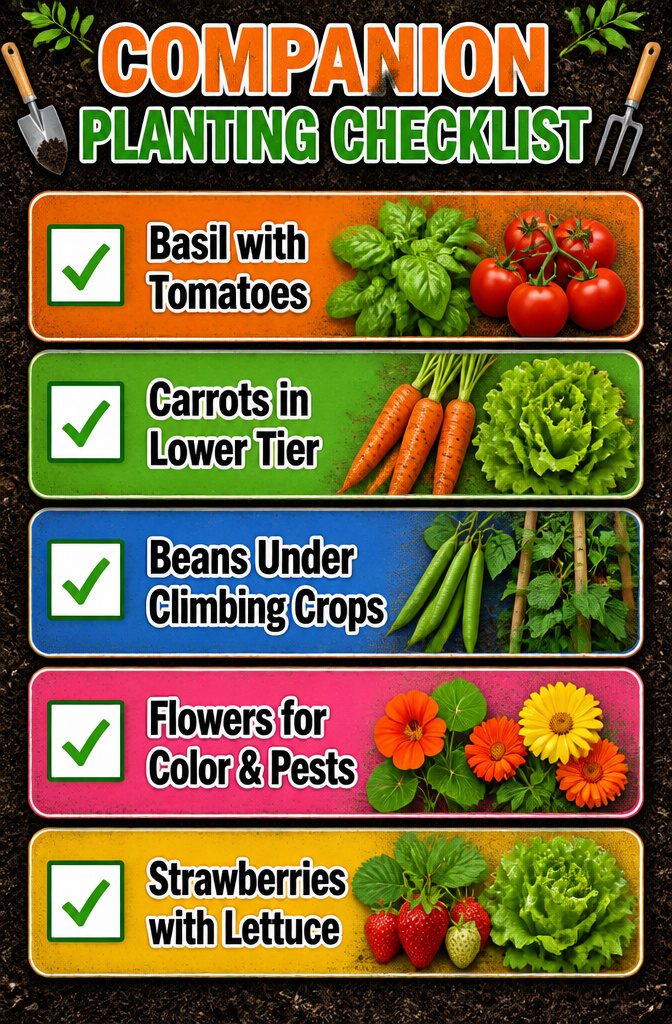
Companion planting in a vertical setup works the same way it does in ground beds, only the stakes are higher because your plants share a trellis as well as soil.
- Basil tucked against tomatoes repels aphids and, in my experience, seems to sharpen the tomato flavor; I plant one basil every two feet along the row and let it bush out between trusses.
- Carrots and lettuce pair well in the lower tier of a tower or the shaded base of a teepee; the carrots break soil while lettuce cools the surface with its leaves.
- Beans climbing a trellis leave nitrogen in the soil for leafy greens planted directly underneath; peas work the same way, and both give you a second crop from the same square foot.
- Flowers planted under climbing crops add color and draw pest predators; nasturtiums and calendula are the ones I see used most often for this.
One thing to watch: strawberries and lettuce can share a hanging planter the first season, but strawberries return and thicken, so after year one you will likely have to choose between them.
Frequently Asked Questions
What vegetables grow well in a vertical garden?
Tomatoes, cucumbers, peas, pole beans, vining squash, melons, eggplants, small pumpkins, and gourds all climb or adapt well to trellises and supports.
Herbs like basil, mint, and thyme also work in wall-mounted pockets or stacked containers. The article covers each crop with specific variety recommendations and spacing guidance.
How do you set up a vertical garden?
Pick a structure suited to your crop: arched cattle panels for tomatoes and cucumbers, obelisks for peas and short beans, or wall-mounted pockets for herbs.
Anchor legs at least a foot deep, especially for metal arches that catch wind once vines fill out. Add drip irrigation if you can; vertical planters dry faster than ground beds and may need watering twice daily by hand otherwise.
What are the benefits of vertical gardening?
Vertical gardening turns a small footprint into three-dimensional growing space, so six square feet of soil can hold what would sprawl across twenty.
Leaves dry faster with better airflow, cutting disease pressure; fruit stays cleaner and off the ground; and harvesting happens at shoulder height instead of kneeling level.
Sun hits vertical leaf surfaces more evenly, which boosts photosynthesis and yield from the same plant.